


As labor dispute cases have surged following the implementation of the Yellow Envelope Law, the Central Labor Relations Commission (CLRC) is considering introducing a 'summary judgment' system. The move aims to simplify case processing procedures to clear backlogs and expedite rights protection for both labor and management parties.
According to government sources on the 17th, the CLRC is internally reviewing the introduction of a system modeled after the Fair Trade Commission's 'summary procedure' to handle adjudication cases more swiftly.
The background for the CLRC's review of expedited processing measures lies in the increasing number of labor dispute cases and the resulting burden on adjudication work. The CLRC judges that as cases handled by labor committees—such as unfair dismissals and unfair labor practices—become more diverse and complex, the burden of hearings and reviews required to process each case is also growing.
The CLRC believes that handling cases suitable for swift judgment through a separate procedure will reduce the overall processing time for adjudication cases and allow the committee to concentrate its adjudication capacity on complex cases with numerous contentious issues.
It is explained that as the waiting period for labor committee rulings lengthens, both workers and employers must remain in a state of dispute for an extended period; thus, shortening case processing times is necessary from the perspective of swift rights protection.
Currently, labor committee adjudications follow a structure where relief applications, such as those for unfair dismissal, are first heard by local labor committees. If parties disagree with the ruling, the case proceeds to a retrial at the CLRC. If parties remain dissatisfied with the CLRC's retrial decision, they may file an administrative lawsuit.
If the CLRC introduces summary judgment, it appears likely to consider selecting cases for expedited processing based on case nature and contentious issues rather than simplifying all cases uniformly. However, detailed institutional design—including specific target cases, hearing methods, and how to guarantee parties' right to present evidence—requires further discussion. Concerns have also been raised that handling cases summarily could make it difficult to conduct sufficient content reviews of the matters at hand.
A government official stated, "We are reviewing institutional improvement measures to enhance the speed of case processing while ensuring that rights protection for parties is thoroughly implemented."
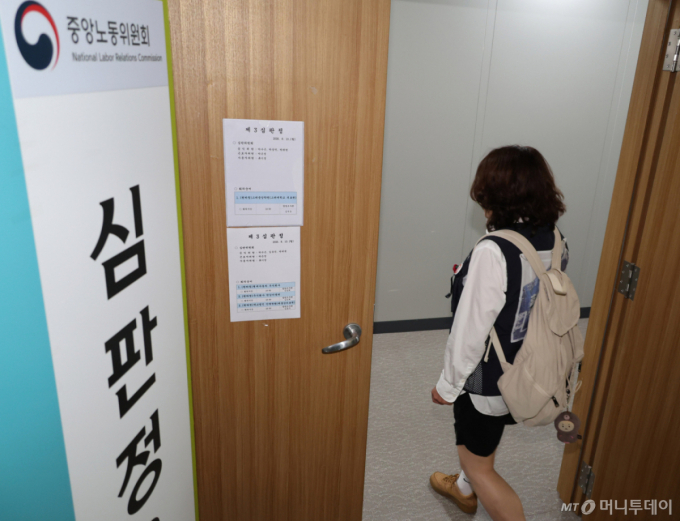
Although the Central Labor Relations Commission is reviewing expedited processing measures such as 'summary judgment' to clear case backlogs, critics argue that enhancing the credibility of rulings must take precedence over speed. In a situation where controversies over fairness continue, such as adjudications concentrating on specific public members, simply simplifying procedures may not be sufficient to resolve disputes.
According to labor and legal circles on the 17th, labor committee adjudications handle disputes that directly affect workers' livelihoods and corporate personnel and labor management practices, including dismissals, disciplinary actions, and unfair labor practices. While swift rights protection is important, there are concerns that simplifying hearing procedures before factual relationships and legal judgments are sufficiently established could undermine the credibility of rulings.
In particular, it has been consistently pointed out that labor committee hearings sometimes proceed with brief interrogations and a focus on written documents, making it difficult for parties to fully explain their arguments. The more complex the labor dispute, the more carefully both sides' claims and evidence must be examined; thus, focusing solely on processing speed could compromise the thoroughness of adjudications.
Fairness in the composition of public members and the assignment of adjudication committee members is also a challenge. In recent CLRC retrial cases related to amendments to the Labor Union Act, it was pointed out at the National Assembly that adjudications were concentrated on specific public members, sparking controversies over fairness.
According to the office of People Power Party (PPP) lawmaker Na Kyung-won, among 39 CLRC retrial cases related to the amended Labor Union Act, only seven of the total 31 public members participated. Chairman Park Soo-geun participated in 36 cases, Standing Committee Member Kim Yu-jin in 35 cases, and Standing Committee Member Kim Eun-cheol in 28 cases.
Na (Rep.) pointed out concerns over fairness due to the concentration of adjudications on specific members and demanded adherence to the principle of random assignment. In response, Park (Chairman) said, "I share some concerns regarding doubts about fairness," and pledged to make efforts for random assignment.
The CLRC explained that in the early stages of implementing the amended Labor Union Act, hearings were conducted primarily by full-time public members to ensure expertise and consistency in judgments on original-subcontractor negotiation cases. It later announced that it had changed its operational method to allow external public members to also serve as presiding judges of adjudication committees.
If processing speed is increased without sufficient trust in rulings, there is a possibility of a 'balloon effect' where disputes do not end at the labor committee but shift to the courts. This is because parties dissatisfied with labor committee rulings can proceed to CLRC retrials and subsequently file administrative lawsuits.
Labor and legal circles point out that before increasing case processing speed, efforts must first be made to enhance the credibility of existing adjudications, including fairness in the composition and assignment of adjudication members, thorough verification of factual relationships, and review of legal principles. They argue that if procedures are simplified while controversies over the quality of adjudications remain unresolved, it is difficult to rule out the possibility of appeals against rulings.
Following the implementation of the Yellow Envelope Law (amended Labor Union Act), companies have repeatedly challenged labor committee rulings concerning issues such as original contractor employer status. Cases where judgments are overturned between first-instance and retrial hearings have emerged, showing that legal disputes unresolved at the CLRC are moving to the courts. Projections suggest that the ambiguous provisions of the Yellow Envelope Law will ultimately lead to more company challenges and court filings.
An analysis by the National Assembly Climate, Energy, Environment, and Labor Committee's office of People Power Party lawmaker Yoon Jae-ok, based on data submitted by the Ministry of Employment and Labor on the 17th, revealed that as of the end of July, 70 cases related to the Yellow Envelope Law had been filed with the CLRC. Excluding 'separation of bargaining units' cases—which can be filed by both sides and involve complex interests between multiple unions, making them difficult to view as simple labor-management wins or losses—24 out of 31 concluded rulings were recognized, resulting in a recognition rate of 77.4%.
The recognition rate is the proportion of applications accepted in cases where the labor committee has completed its ruling, serving as an indicator of the labor committee's judgment trends regarding Yellow Envelope Law disputes. At the first-instance Local Labor Committees (LLCs), the recognition rate for concluded cases using the same standard was 87.4%. While recognized decisions accounted for a significant portion in CLRC retrials, there were only two cases where LLC recognition rulings were overturned and rejected at the CLRC.
Conversely, there were also cases where LLC rejection rulings were overturned and recognized by the CLRC. Jungheung Construction, Jungheung Civil Engineering, Korea Road Traffic Authority, and Korea Industrial Complex Corporation are representative examples. As judgments differ between first-instance and retrial hearings, legal disputes over employer status and other issues do not conclude at the labor committee stage.
Companies continue to challenge CLRC retrial decisions. According to the CLRC, as of August 14, five administrative lawsuits were filed with the Seoul Administrative Court; among these, four cases had companies as plaintiffs. Hanwha Ocean, Jungheung Construction, Jungheung Civil Engineering, and POSCO E&C sought cancellation of the retrial decision, arguing that they are not employers under the Labor Union Act and thus have no obligation to announce the fact of a negotiation demand, yet the CLRC ruled otherwise.
Yoon Jae-ok (Rep.) urged, "Ambiguous Yellow Envelope Law provisions and biased rulings by the labor committee are driving companies into court," calling for "the establishment of legally binding standards to prevent on-site chaos and an immediate overhaul of the labor committee ruling system."
Legal circles believe that since the core issue of the Yellow Envelope Law—the criteria for determining original contractor employer status—has not yet been sufficiently specified, legal disputes surrounding labor committee rulings are highly likely to proceed to the courts. If an original contractor is recognized as an employer, a duty to engage in collective bargaining arises; refusing negotiations without just cause can lead to liability for unfair labor practices, suggesting that courts may eventually provide specific judgment criteria.
There are also limitations in the government's interpretation guidelines. Although the Ministry of Labor's guidelines can offer judgment criteria to reduce on-site confusion, they do not constitute final legal standards binding on the courts.
President Lee Jae-myung recently also pointed out that administrative interpretations alone are insufficient regarding contentious issues under the Yellow Envelope Law, calling for the establishment of specific criteria. In response, the Ministry of Labor is reviewing various institutionalization measures, including subordinate laws such as enforcement decrees and enforcement rules.
Given that this is an early stage of the Yellow Envelope Law's implementation, cases appealing CLRC retrial results to the courts are expected to increase further. Concerns arise that if a gap widens between labor committee judgments and the final establishment of legal principles by the courts, legal uncertainty on the labor-management front could persist for an extended period.

 in ECONOMY

