

The government is moving to establish a new Future Response Fund utilizing excess revenue and other sources. This fund will serve as a separate 'fiscal reservoir' to mitigate tax revenue volatility, while also reforming the Local Education Grant (Education Grant) and Local Allocation Tax (Allocation Tax) in the process.
The Ministry of Planning and Budget held a Fiscal Operation Strategy Council meeting on the 21st and announced the 'Future Response Fund Implementation Plan.' The Future Response Fund is a newly established fund to be used for future-oriented initiatives such as youth, regional development, and education, funded by semiconductor-driven excess revenue and additional revenue. This marks the first time a dedicated fund has been created using increased tax revenues for specific purposes.
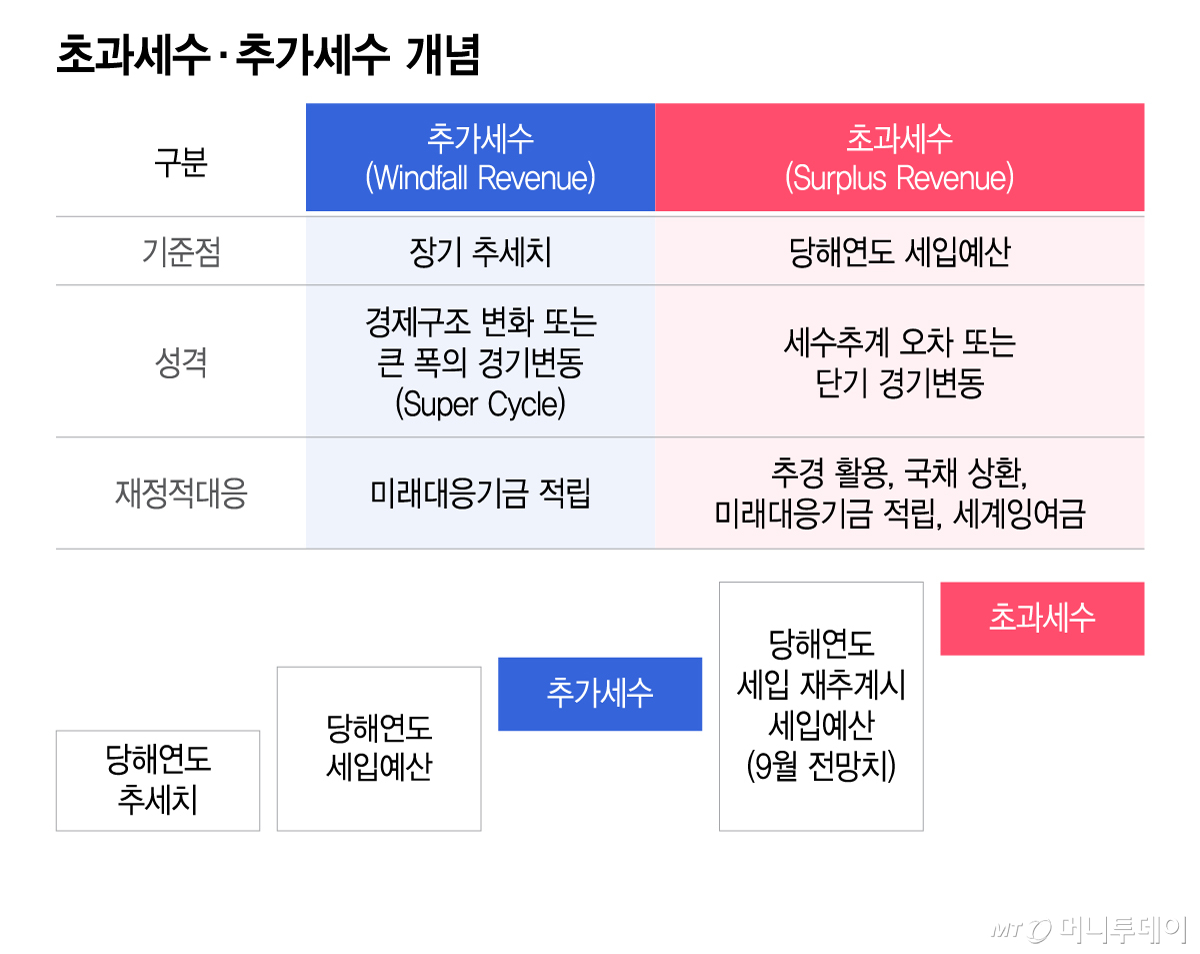
The sources of the Future Response Fund are excess revenue and additional revenue. Excess revenue refers to taxes collected beyond what was projected when the government formulated its budget. At least several tens of trillions of won in excess revenue is expected this year as well. A portion of this excess revenue will be transferred to the Future Response Fund.
Additional revenue is a newly introduced concept. The Ministry of Planning and Budget defines additional revenue as 'the amount by which domestic tax revenue in the next year's budget exceeds the domestic tax trend value.' The benchmark for determining trends is the average annual growth rate of actual domestic tax collections over the past 10 years. In addition to excess revenue and additional revenue, surplus funds from world reserves and returns from flexible fund operations will also be accumulated into the Future Response Fund.
If the government's proposal passes through the National Assembly, the Future Response Fund will be reflected in next year's budget starting next year. The Ministry of Planning and Budget has not disclosed the specific scale of the Future Response Fund. Some forecasts suggest it could exceed 100 trillion won. The exact scale will be included in next year's budget to be submitted to the National Assembly in early September.
The Future Response Fund will be invested in four key areas: youth, growth drivers, regions, and education/talent development. For youth, the fund will support policies related to employment, housing, marriage, and childbirth. Growth drivers include AI (artificial intelligence) and three major mega-projects. Regional initiatives involve expanding basic income in rural and fishing villages and supporting administrative integration. The fund will also be used to invest in education and talent development sectors such as universities.
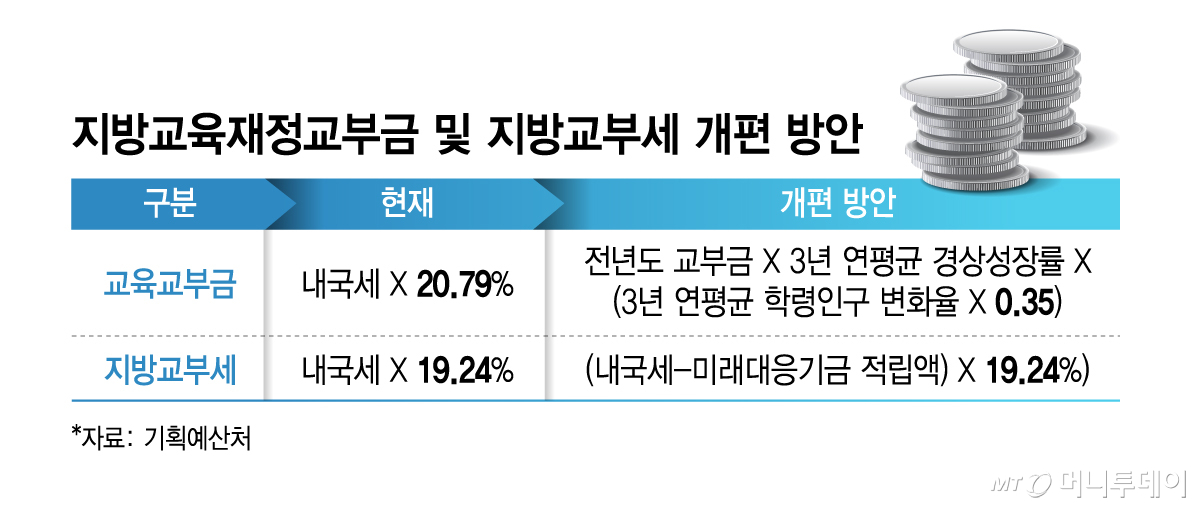
Alongside the establishment of the Future Response Fund, the Ministry of Planning and Budget is reforming two representative components of local finance: the Education Grant and the Allocation Tax. The Education Grant is an education budget utilized by local education offices, funded at 20.79% of domestic taxes. The Allocation Tax, funded at 19.24% of domestic taxes, constitutes the share of local budgets allocated to local governments.
The Education Grant will abolish its long-standing domestic tax-linkage structure maintained since 1972. Instead, it will be calculated by multiplying the previous year's grant amount by the three-year average annual economic growth rate and 35% of the three-year average annual change in school-age population. Only 35% of the school-age population change rate is reflected to mitigate shocks on the ground. The system is designed to ensure that if the total Education Grant amount decreases compared to the previous year, the difference will be compensated so that the total does not decline.
While reforms to the Education Grant have been widely discussed, the reform of the Allocation Tax, which has not been previously mentioned, is also included in the Future Response Fund implementation plan. The Allocation Tax will maintain its 19.24% linkage structure but will revise its base amount. Currently, the base is domestic taxes; moving forward, the base will be domestic taxes minus the amount accumulated in the Future Response Fund. This means excess revenue and additional revenue will be excluded from the base calculation.
Consequently, when excess revenue or additional revenue occurs, the Allocation Tax will decrease compared to current levels. Conversely, if a tax shortfall arises, part of the support can be drawn from the Future Response Fund. To this end, the Allocation Tax Act will be amended to include new provisions allowing for additional support to local governments based on economic conditions and fiscal circumstances.
The Ministry of Planning and Budget plans to submit a package bill including the establishment of the Future Response Fund along with next year's budget proposal to the National Assembly on the 3rd of next month.

 in ECONOMY

