

The Korean economy is drawing a steep upward curve driven by strong export momentum from the semiconductor supercycle (boom period). At the beginning of the year, the economic growth rate forecast was targeted at 2.0%, but it has now surged to the early-to-mid 3% range. However, concerns are also raised that the warmth generated by semiconductors is concentrated in certain areas, leading to industrial and class polarization without improvement in the felt economy.
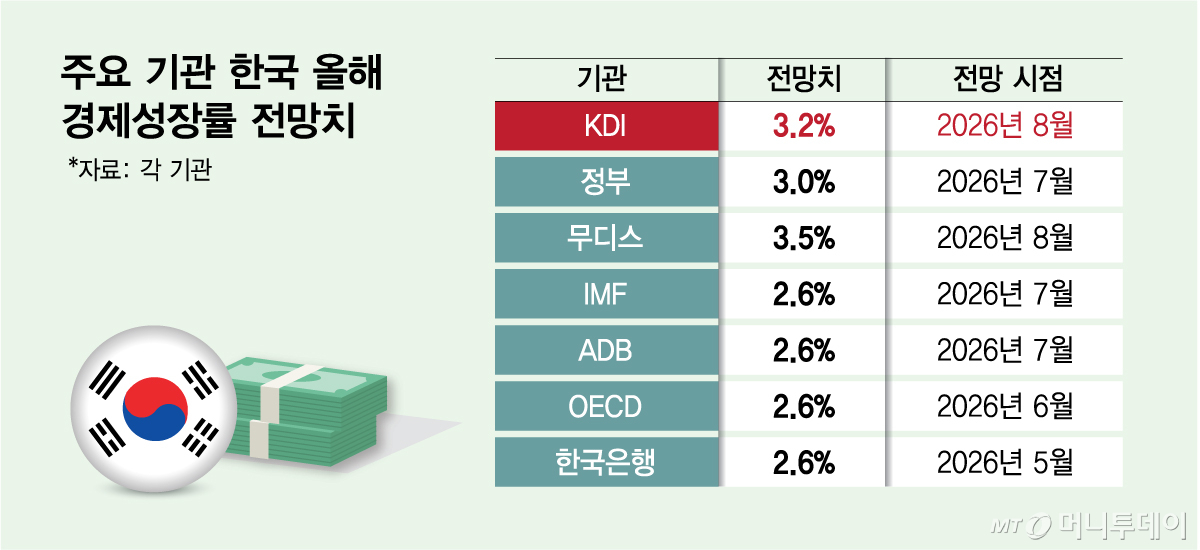
The Korea Development Institute (KDI) presented this year’s GDP (gross domestic product) growth rate forecast at 3.2% in its “August 2026 KDI Economic Outlook Revision” released on the 19th. This is 0.7 percentage points higher than the previous forecast of 2.5% released in May. It is the highest level among major domestic and international institutional investors. Previously, the government had announced a forecast of 3.0%, and the Bank of Korea had announced 2.6%.
Among international organizations, the OECD (OECD), International Monetary Fund (IMF), and Asian Development Bank (ADB) each expected 2.6%. KDI also raised its growth rate forecast for next year from the previous 1.7% to 2.2%, an increase of 0.5 percentage points.
KDI raised its growth expectations by reflecting strong exports and increased equipment investment due to a global semiconductor boom, despite the ongoing Middle East war. Specifically, of the 0.7 percentage point upward adjustment from the previous forecast (2.5%), 0.6 percentage points are attributed to semiconductors. Based on this year’s growth rate forecast of 3.2%, more than half is related to semiconductor-driven growth.
KDI forecast that exports will increase by 8.7% and equipment investment will rise by 7.9% this year due to the semiconductor boom. These figures are 4.1 percentage points and 4.6 percentage points higher, respectively, compared to the previous forecasts. In particular, it is expected that equipment investment will see its largest increase in five years since 2021 (+10.2%).
This trend is not unique to KDI’s observations. Credit rating agency Moody’s also recently raised Korea’s growth rate forecast for this year from the previous 2.8% to 3.5% in a recent report. Moody’s adjusted its growth rate forecast upward, noting that Korea’s merchandise exports from January to July of this year surged by 51% compared to the same period last year.
In particular, it stated, “Semiconductor demand continues, and there are limited companies that can realistically replace Korea’s advanced memory suppliers,” and added, “This semiconductor upcycle is likely to remain strong at least until mid-2027.”
The Bank of Korea also signaled a significant upward adjustment to its growth rate forecast.
Bank of Korea Governor Shin Hyun-song said at a press conference held last month, “This year’s growth rate forecast is expected to significantly exceed the previous May forecast of 2.6%.” The Bank of Korea will release its revised economic outlook at the Monetary Policy Board meeting scheduled for the 27th.
Some express concern about growth being overly concentrated on semiconductors. The warmth of growth is focused on the semiconductor industry, which has a low employment generation effect, and thus fails to spread sufficiently to improve the felt economy. KDI significantly lowered its forecast for this year’s increase in the number of employed persons from the previous 170,000 to 110,000. This is because the semiconductor sector has a low employment generation effect, and companies in other industries are being conservative in hiring new personnel due to uncertainties related to the Middle East war.
Kim Mi-ru, KDI Macro-Finance Jeong Chaek-yeon-gu (Director), stated, “Although our economy is showing high growth driven by the semiconductor superboom fueled by expanding global AI (artificial intelligence) investment, these results are not sufficiently spreading into household incomes such as private consumption or employment.” He further explained, “Despite a significant increase in real GDI (gross domestic income), the real wage growth rate is not high compared to the 10th-year average, and manufacturing conditions excluding semiconductors are not very bright. Therefore, high economic growth rates may differ from the felt economy.”

 in ECONOMY
