

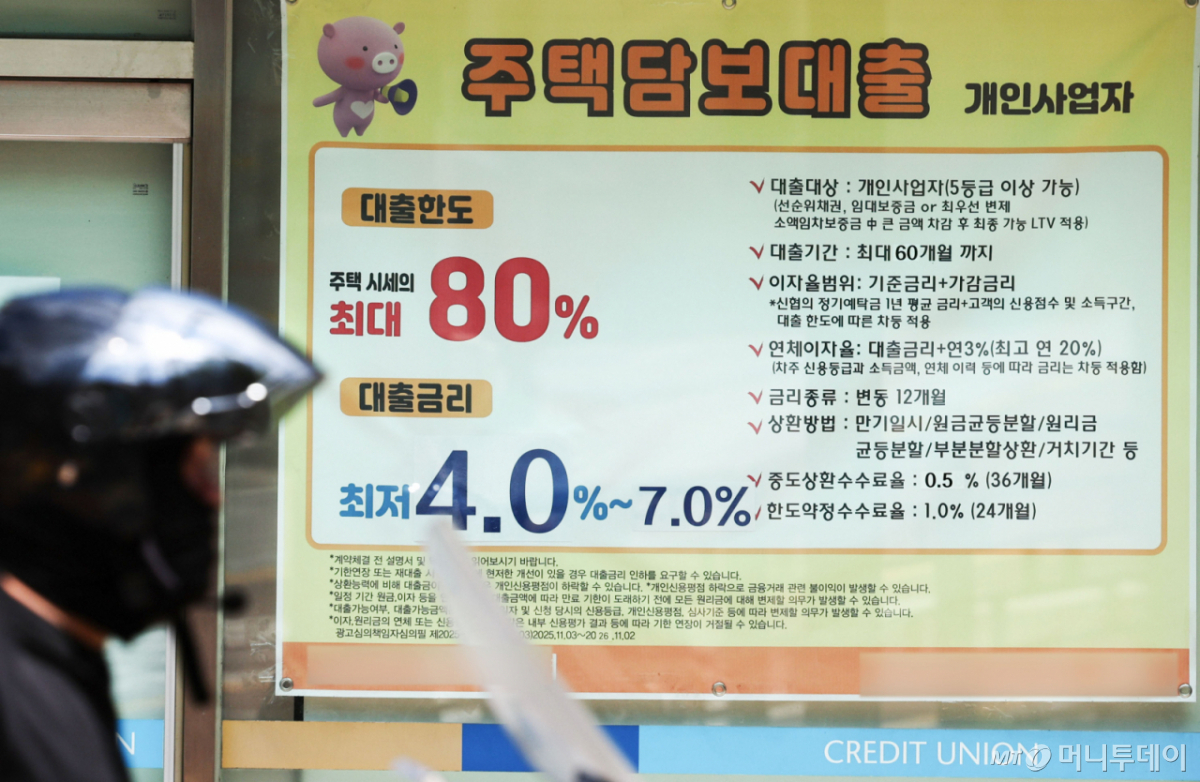
Strengthened household loan management by financial institutions led to the smallest level of new household loans per borrower in the second quarter of this year in over three years. In particular, home mortgage loans decreased significantly among those in their 30s and 40s, who have high demand for purchasing homes, and in the capital region. On the other hand, mortgage loans for borrowers in their 20s, who have a higher proportion of first-time homebuyers and non-homeowner loans with relatively less regulatory restrictions, increased.
According to the Bank of Korea's "Preliminary Household Debt Statistics by Borrower Type for Q2 2026," released on the 25th, the new household loan amount per borrower in Q2 was 34.14 million won, a decrease of 1.28 million won (3.6%) from the previous quarter. This is the lowest level since the first quarter of 2023.
The new loan amount per borrower had fallen to 34.43 million won in the fourth quarter of last year before rebounding to 35.42 million won in the first quarter of this year, but decreased again within just one quarter.
Min Suk-hong, head of the Household Debt Microstatistics Team at the Bank of Korea, explained, "Due to recent loan regulations and other factors, the increase in existing loans by borrowers or the scale of newly processed loans has shrunk, leading to a decrease in the new loan amount per borrower."
By age group, the new loan amount for those in their 40s was 35.88 million won, a decrease of 5.83 million won from the previous quarter—the largest decline. This is the lowest level since the fourth quarter of 2022. Those in their 30s recorded a decrease of 2.74 million won to 49.08 million won.
Those in their 50s and those aged 60 and above saw decreases of 650,000 won and 480,000 won respectively, reaching 30.10 million won and 26.72 million won. In contrast, the new loan amount for those in their 20s increased by 2.60 million won to 20.56 million won—the highest level since the second quarter of last year.
By region, the new loan amount per borrower in the capital region was 37.80 million won, a decrease of 1.93 million won. Seoul dropped from 48.18 million won to 43.47 million won, a decline of 4.71 million won, while Gyeonggi and Incheon also decreased by 530,000 won to 34.91 million won.
By product type, the decline in home mortgage loans was prominent. The new mortgage loan amount per borrower in Q2 was 208.29 million won, a decrease of 21.10 million won (9.2%) from the previous quarter—the lowest level since the fourth quarter of 2024.
The new mortgage loan amount for those in their 40s was 209.77 million won, a decrease of 35.37 million won from the previous quarter. Those in their 30s saw a decrease of 26.32 million won to 206.358 million won. Those in their 50s and those aged 60 and above also decreased by 12.81 million won and 10.69 million won, respectively.
In contrast, the new mortgage loan amount for those in their 20s increased by 3.92 million won to 203.217 million won, surpassing that of those in their 40s. Team Leader Min stated, "Those in their 20s have a relatively higher proportion of non-homeowners and first-time homebuyers compared to other age groups, and these loans face comparatively fewer regulatory constraints."
However, the share of new mortgage loan amounts accounted for by those in their 20s was only 6%. Team Leader Min explained, "Those in their 20s who can receive mortgages are borrowers who meet loan conditions such as income verification. Compared to all individuals in their 20s, the average loan amount may appear relatively large."
The new mortgage loan amount per borrower in the capital region was 203.059 million won, a decrease of 43.97 million won from the previous quarter. Seoul saw a sharp drop of 60.65 million won to 207.140 million won, while Gyeonggi and Incheon decreased by 33.48 million won to 201.349 million won. This is believed to be due to an increase in transactions for mid-to-low-priced homes in the capital region and the impact of loan limit regulations.
On the other hand, in some regions such as Gwangju and Jeonju, loans related to housing developments increased, leading to a 11.13 million won increase in new mortgage loan amounts in the Honam region to 107.315 million won.
By industry sector, non-bank institutions saw a sharp decrease of 61.22 million won in new mortgage loan amounts to 106.82 million won. Banks also recorded a decrease of 12.40 million won to 201.697 million won.
Among all household loans, the new amount for Jeonse (rental deposit) loans was 104.535 million won, a decrease of 5.77 million won. In contrast, credit loans increased by 470,000 won to 19.70 million won, and other loans including card loans, auto installments, leases, and student loans also increased by 730,000 won to 12.80 million won. This is likely due to funds being used for stock market investments.
Although new loans decreased, the outstanding household loan amount per borrower increased. At the end of Q2, the outstanding household loan amount per borrower was 97.90 million won, an increase of 500,000 won from the previous quarter. The outstanding mortgage loan amount increased by 1.87 million won to 106.193 million won, and the outstanding Jeonse loan amount increased by 880,000 won to 102.051 million won.
Team Leader Min explained, "The outstanding balance is largely composed of loans held by existing borrowers. In Q2, the scale of loan repayments decreased compared to the previous quarter, resulting in a smaller amount leaving the outstanding balance, causing new loan amounts and outstanding balances to move in opposite directions."
In the third quarter, there is also a possibility that new loan amounts will increase again, centered on group loans. Team Leader Min stated, "With the expansion of total household loans due to the the 13th measures, it is expected that a significant portion will be executed through group loans, potentially increasing new loan amounts." However, he added, "We need to continue monitoring the trend of strengthened household loan management, the housing market in the capital region, and the movement of funds from financial institutions to the stock market."

 in ECONOMY
