

It was confirmed that Korean residents and domestic corporations reported a total of 111 trillion won in overseas assets this year. Among them, the value of overseas stocks reached 61.3 trillion won, marking the highest amount ever recorded.
The National Tax Service announced on the 2nd that it received a total of 111 trillion won in reports from residents and domestic corporations regarding "Overseas Financial Accounts" and "Overseas Trusts," which were introduced to block offshore tax evasion and legitimize overseas assets as of June this year.
The Overseas Financial Account reporting system requires residents or domestic corporations to report accounts by June 2026 if the combined balance of their overseas financial accounts exceeds 5 billion won on any day during the month-end dates in 2025.
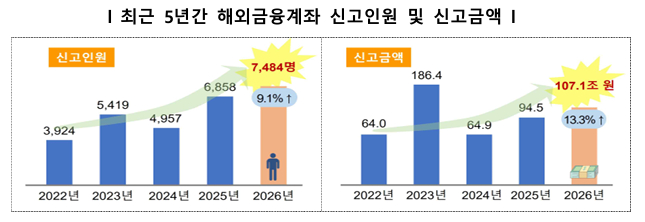
According to the National Tax Service, the number of filers for overseas financial accounts this year increased by 9.1% year-on-year to 7,484, while the reported amount rose by 13.3% year-on-year to 107.1 trillion won.
Overseas financial account reporting amounts over the past three years were recorded as 64.9 trillion won (2024) → 94.5 trillion won (2025, up 45.6%) → 107.1 trillion won (2026, up 13.3%). For two consecutive years since 2024, double-digit growth rates have been maintained.
The number of filers for stock accounts increased by 442 to 2,434 from the previous year's 1,992 (up 22.2%). The reported amount reached 61.3 trillion won, an increase of 13.2 trillion won from the previous year's 48.1 trillion won (up 27.4%), accounting for 57.2% of the total.
This is mainly due to increased stock listings and valuation amounts resulting from Korean companies' expanded overseas expansion.
In the case of corporations, overseas stock values rose significantly due to share listings and rising stock valuations of overseas subsidiaries established in India, the United States, Taiwan, and other countries (from 41.3 trillion won in 2025 to 53.1 trillion won in 2026).
Individual filers numbered 2,356 with a reported amount of 8.2 trillion won, an increase from the previous year's 1,896 filers and 6.9 trillion won. It was found that 7 trillion won, representing 85.3% of the total reported amount, is held through U.S. accounts.
In India, there were 113 account holders (1.5% of the total), but the reported amount increased by 7.2 trillion won year-on-year to 28.9 trillion won (27% of the total), making it the second-largest country in terms of reported amount after the United States, which ranked first with 29.7 trillion won.
Although this was the first year for reporting overseas trusts, thanks to the holding of briefing sessions and prior notification guidance, 1,286 individuals reported a total of 3.8 trillion won across 1,591 cases. This has enabled the formalization of trust assets that were previously undetected by existing tax frameworks.
Going forward, the National Tax Service plans to thoroughly verify suspected underreporting or non-reporting of overseas assets using intergovernmental information exchange data, foreign exchange transaction records, and various other information sources. If violations of reporting obligations are detected, administrative fines of 10% of the underreported (or unreported) amount will be imposed, and related taxes will be recovered in a strict manner.
In particular, it warned that if the amount of non-reporting or underreporting for overseas financial accounts exceeds 50 billion won, criminal penalties and public disclosure of names may apply.
However, taxpayers who diligently file amended reports or late reports even after the statutory deadline will receive reductions in administrative fines. For overseas financial accounts, up to a 90% reduction in administrative fines is possible if amended reports or late reports are filed for non-reporting or underreporting even after the reporting deadline.

 in ECONOMY
