

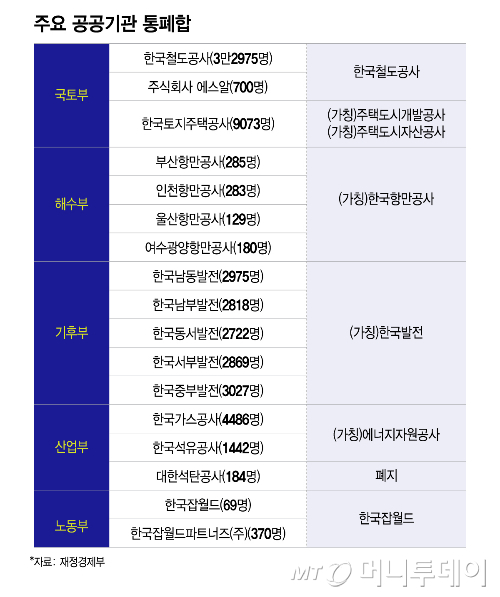
The review of merging public institutional investors began around August last year. President Lee Jae-myung raised the issue of "reform of public institutional investor functions" at a "National Budget Savings Meeting" in August last year, stating, "It seems we need to merge public institutional investors." He also remarked, "There are so many that I can't even count them."
Following this, the government began reviewing the merger of public institutional investors on a cross-governmental level. The Presidential Office took direct charge, and the Ministry of Economy and Finance oversaw the implementation. About a year later, the plan for reforming public institutional investor functions was finalized. It carries the subtitle "Public Institutional Investor Diet 2026." The plan focuses on reduction. This is the first large-scale merger of public institutional investors since the Lee Myung-bak administration.
There are many notable changes. The power generation companies, which were split into five entities—Namdong, Jungbu, Seobu, Nambo, and Dongseo—in 2001, will be merged into "Korea Power Generation." The government plans to achieve policy goals such as renewable energy in Daejeon through the merger of power generation companies. Similarly, Busan, Incheon, Ulsan, and Yeosu port authorities will be consolidated into "Korea Port Authority." This also reflects the intention to prevent excessive competition among port authorities.
Korea National Oil Corporation and Korea Gas Corporation will merge into "Energy Resources Corporation." Functions such as improving distribution structures, including the oil company's fuel-efficient gas stations, will be transferred to the Petroleum Management Office. With the closure of Samcheok Dogye Mine—the last mining office—in June last year, the functions of Korea Coal Corporation have disappeared, and it is now undergoing liquidation procedures.
No conclusion has been reached regarding the merger of Incheon International Airport Corporation and Korea Airports Corporation. The Ministry of Economy and Finance stated, "While the national strategy to make Incheon Airport a hub is clear, there are underlying issues such as deficits in regional airports and accelerating imbalances," adding that "a dual growth strategy between hub airports and regional airports is needed."
Korea Land and Housing Corporation (KLH) will separate its land development and housing construction functions from its residential welfare and asset reserve functions. Accordingly, Korea Land Development Corporation and Korea Land Asset Corporation will be established to dualize KLH. This decision was made because performing both development and residential welfare tasks within a single institutional investor has led to a slowdown in housing supply speed and increased burdens on rental housing operations.
The government is also promoting the integration of similar or overlapping public institutional investors with 100 or more employees. For example, Korea Broadcasting Advertising Promotion Corporation and Viewer Media Foundation will merge into "Korea Broadcasting Media and Telecommunications Promotion Institute," while the Labor-Management Development Foundation and Korea Employment and Labor Education Institute will merge into "Labor-Management Development Education Foundation."
Plans have also been made to vertically integrate parent company Korea Job World and its subsidiary Korea Job World Partners, and to horizontally integrate seven financial public institutional investor subsidiaries. Five subsidiaries of port authorities will also be integrated horizontally. Small-scale institutional investors with fewer than 100 employees, such as the Food Safety Management Institute and the Food Safety Information Institute, will be reorganized by merging them into the "Food Safety Policy Development Institute."
Through this merger and consolidation, the number of public institutional investors, including those designated as "reserved for designation," will decrease by 109. This represents 20% of all institutional investors. Public institutional investors are designated each year at the beginning of the year by the Public Institutional Investor Operation Committee under the Ministry of Economy and Finance; small-scale institutional investors, among others, are classified as "reserved for designation."
As of this year, the number of public institutional investors designated by the Operation Committee is 342. When the current public institutional investor system was established in 2007, there were 298 public institutional investors. This merger and consolidation is the largest in history, surpassing the "Advanced Public Institutional Investor Plan" during the Lee Myung-bak administration, which merged 36 public institutional investors into 16.
Vice Minister Heo Jang of the Ministry of Economy and Finance said, "We will actively work to ensure that the plan for reforming public institutional investor functions is implemented promptly by encouraging ministries to establish and implement roadmaps for functional reform and by immediately merging institutional investors that do not require legal amendments or other procedures." He added, "We will also explore support measures such as ensuring that compensation and treatment are not reduced and strengthening welfare benefits."

 in ECONOMY
