

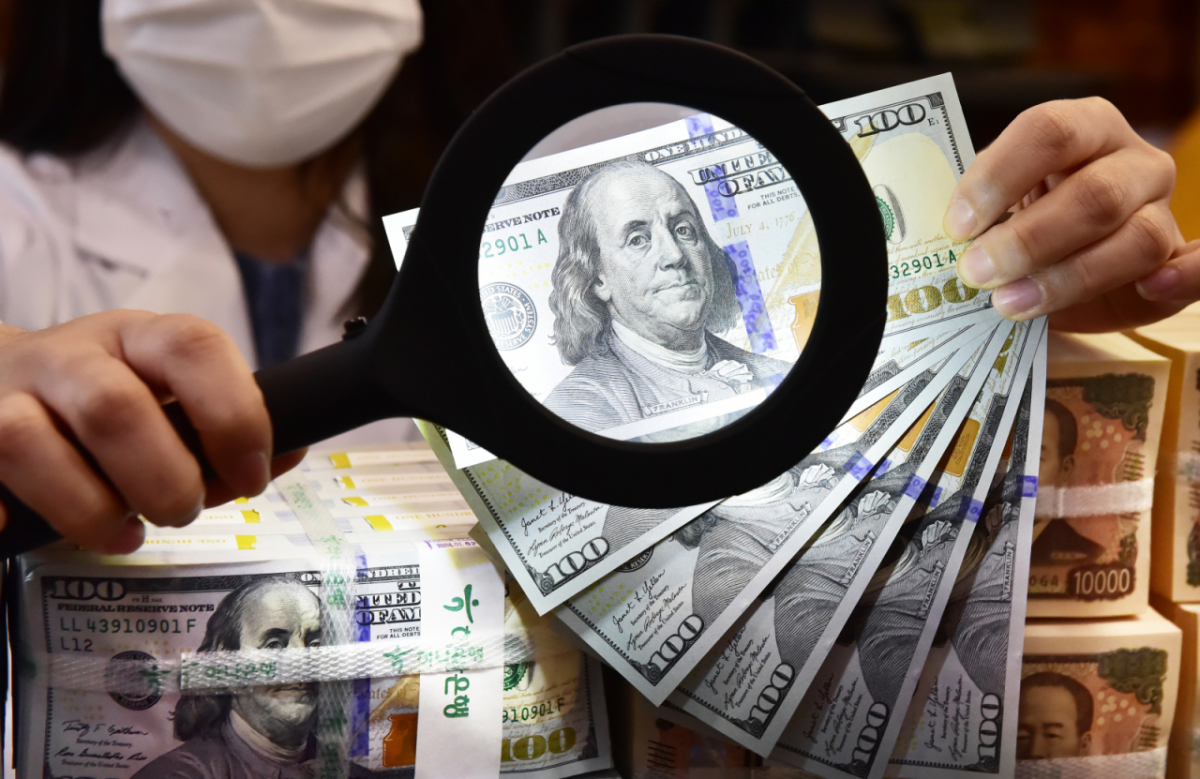
South Korea's foreign exchange reserves increased by more than $14.3 billion in just one month, marking the largest monthly rise ever recorded. The total foreign exchange reserves also surpassed $440 billion, reaching their highest level in four years and three months.
According to the Bank of Korea's "Foreign Exchange Reserves as of End-August 2026," released on the 3rd, foreign exchange reserves stood at $442.28 billion at the end of last month, an increase of $14.33 billion from the previous month-end figure of $427.95 billion.
This is the largest monthly increase since monthly statistics began in 1971, surpassing the previous record of $14.29 billion set in May 2009 by $40 million. Foreign exchange reserves have increased for three consecutive months starting from June, and the current level is the highest since May 2022 ($447.71 billion). Compared to the all-time high of $469.21 billion reached in October 2021, the current figure is approximately $26.9 billion lower.
The surge was largely driven by a significant increase in foreign currency deposits held by financial institutional investors. Amid abundant liquidity in Korea's foreign exchange fund market due to inflows of trade payments from export companies benefiting from the semiconductor boom, it is believed that financial institutional investors deposited large amounts of surplus foreign currency with the Bank of Korea after the central bank began paying interest on excess foreign exchange reserve requirements at the start of this year.
A Bank of Korea official explained, "The sharp rise in foreign exchange reserves was due to a significant increase in foreign currency deposits by financial institutional investors, combined with higher investment returns and an increase in the U.S. dollar value of other monetary foreign assets."
During August, major currencies generally showed strength against the U.S. dollar. The Dollar Index (DXY), which reflects the value of the dollar against six major currencies, fell 0.2% from 99.86 at the end of July to 99.70 at the end of August. The Australian dollar appreciated by 1.9% against the U.S. dollar, while the euro and British pound each rose by 0.5%. The Japanese yen depreciated by 0.3%.
By asset type, marketable securities including government and corporate bonds increased by $7.07 billion to $387.07 billion from the previous month. Deposits rose by $717 million to $30.3 billion. The increases in these two assets accounted for the majority of the total foreign exchange reserve growth.
Special Drawing Rights (SDRs) increased by $60 million to $15.77 billion, and International Monetary Fund (IMF) positions rose by $30 million to $4.34 billion. Gold holdings remained unchanged at $4.79 billion. Gold is valued at its purchase price rather than market value, and no additional gold was purchased during August.
Meanwhile, the Bank of Korea removed the country-by-country foreign exchange reserve rankings from its press releases for the first time in over 25 years without providing any explanation. This marks the first time since the end of February 2001 that the Bank of Korea has omitted global foreign exchange reserve rankings from its monthly data.
The Bank of Korea determined that publishing the rankings offers little practical benefit, as they fluctuate significantly due to factors such as exchange rates and gold prices, and the rankings themselves can be misinterpreted as indicators of external financial health. South Korea's ranking fell from 9th at the end of last year to 13th in May this year before rising again to 10th in June.

 in ECONOMY
