

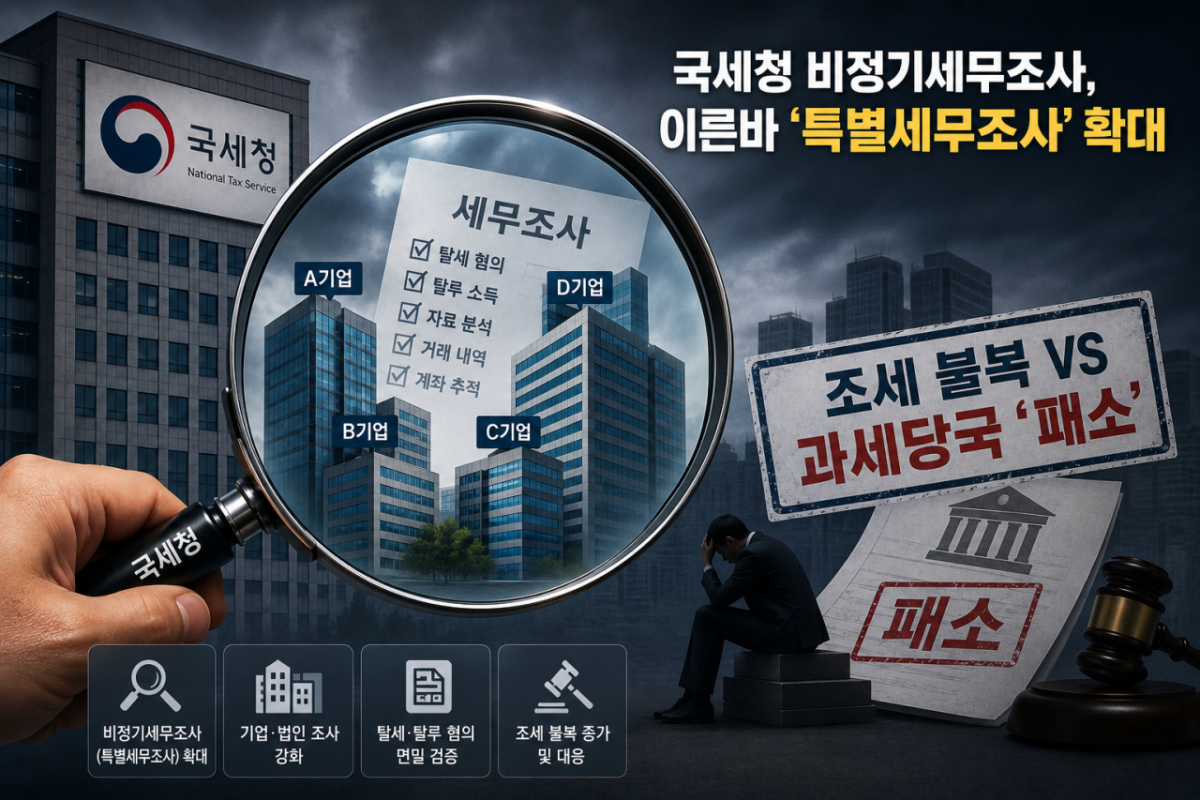
It has been confirmed that the number of irregular tax audits (special investigations) conducted by the National Tax Service from 2023 to 2025, covering the most recent three years, has increased. Press releases related to tax audits also rose nearly fourfold year-on-year in the first half of this year alone.
While there are positive perspectives that these audits meticulously investigate suspicions of corporate illegal tax evasion, there is significant backlash against the mass "strike first" tax audits. This explains why tax dispute lawsuits continue to follow. Furthermore, as the government has repeatedly lost court rulings in these disputes, the reputation of the tax authorities has also been tarnished.
According to the National Tax Service, irregular tax audits increased from 2,928 cases in 2023 to 3,095 in 2024 and 3,323 in 2025.
Notably, public announcements (press releases) related to tax audits by the National Tax Service in the first half of this year surged nearly fourfold compared to the same period last year. This change occurred after Lee Jae-myung's administration took office and the leadership of National Tax Service Commissioner Lim Kwang-hyun began. Data on regular and irregular tax audit cases conducted by the National Tax Service in the first half of this year have not yet been released.
However, even looking solely at the number of press releases related to tax audits posted on the National Tax Service website reveals a clear difference from the same period last year.
Under the previous administration led by former National Tax Service Commissioner Kang Min-soo, which emphasized "conduct proper investigations" and focused on rigorous tax audits, there were only three announcements regarding tax audits and press releases in the first half of 2025. Typically, briefing sessions held by investigation bureaus after thorough reviews were conducted once per quarter for each issue.
Afterwards, it was already anticipated that strong expansion of tax audits would occur when Lim Kwang-hyun Hyeon (Commissioner), known as a "tax audit veteran" who served six times as the head of Investigation Bureau 4—dubbed the "grim reaper of business circles"—took office in July last year.
Demonstrating this, tax audit briefings and press releases from July to the end of last year totaled six cases, doubling compared to the first half of the previous year. Immediately upon appointment, efforts to expand tax audits were launched. This year alone, 12 announcements related to tax audits were made by early September.
The National Tax Service has continued issuing warning pressures regarding suspicions of tax evasion through messages about disclosing audit contents. In this context, the increase in public "warnings" (announcements) related to tax audits indicates a heightened level of cracking down on illegal enterprises. Rigorous investigations into illegal acts are indeed welcome.
The problem lies in the rushed nature of tax audit announcements. When Cheong Wa Dae issues messages regarding specific issues, the National Tax Service immediately follows up with the commencement and announcement of results for tax audits. While one might initially agree that this aligns policy execution with government direction, criticism arises that such frequent immediate responses focus too heavily on the government's stance rather than independent judgment.
The same applies to the public bid corruption briefing released by the National Tax Service on the 3rd. Ten days after President Lee Jae-myung held his first Anti-Corruption Policy Council (on the 21st of last month) and directed comprehensive responses to various forms of corruption, including public contract fraud and improper subsidy receipt, the National Tax Service hastily inserted a briefing on public bid corruption into its weekly plan, which had not been scheduled. It appears that once again, upon receiving a message from Cheong Wa Dae, the National Tax Service responded promptly.
A National Tax Service official explained, "The investigation has been continuously ongoing just like previous cases," and "It was simply omitted from the weekly plan due to an administrative error; we did not hastily include it in the briefing."
Since Lee Jae-myung's administration took office, the National Tax Service has consistently responded immediately after Cheong Wa Dae messages.
Starting from the second half of last year, whenever Cheong Wa Dae issued a message, the National Tax Service promptly announced investigations: unfair tax evasion in the stock market (July), foreign tax evaders acquiring high-priced apartments in Gangnam's three districts (August), tax evasion in industries closely linked to daily living prices under the pretext of rising raw material costs (September), ultra-high-end housing audits along the Han River Belt (October), ticket scalpers (November), and price-fixing market disruption activities (December).
This year, from January's investigation into inheritance practices at large bakeries (confirmed) through August's announcement of the "Emperor's Mansion" audit, all announcements were made immediately following Cheong Wa Dae messages throughout the first half.
This is a stark contrast to the National Tax Service's past behavior, which quietly operated within a one-year plan. This explains why criticisms arise that aligning too closely with the government may be excessive, rather than viewing strict tax audits as purely positive.
In this context, lawsuits challenging assessments and losses by tax authorities have also continued to occur.
For example, in a court ruling this year, approximately 12.9 billion won of taxes imposed on SM Entertainment by tax authorities were ordered to be cancelled. The National Tax Service lost the corporate tax lawsuit based on its argument that the amount paid to former chief producer Lee Soo-man was excessively large.
In the case of Netflix Korea, although not a final judgment due to a first-instance loss, a court ruled to cancel 68.7 billion won out of the 76.2 billion won in taxes imposed. Google Korea also won a second-instance administrative lawsuit filed this year on the 15th against corporate taxes exceeding 150 billion won. Additionally, the National Tax Service lost a corporate tax lawsuit exceeding 310 billion won filed by Oracle Korea, further damaging its image.
An industry official pointed out, "While we support the National Tax Service's strict tax audits on various issues concerning companies and individuals, rushed investigations and announcements can become a burden for the agency itself. If conducted excessively, loopholes may be discovered, ultimately returning as a painful boomerang in the form of disputes followed by court losses."
Meanwhile, another National Tax Service official explained, "As an institutional investor responsible for enforcing tax laws, we conduct tax audits consistently and uniformly according to law and principles at all times. However, to deter tax evasion psychology, we are periodically informing the public about tax audit-related matters to clearly convey our strong response to loopholes and tax evasion."

 in ECONOMY
