

Critics point out that companies' management burdens are increasing due to the Korea Fair Trade Commission's "hit first, think later" approach to imposing fines. As more companies challenge the Korea Fair Trade Commission's decisions as excessive, courts are repeatedly overturning imposed fines.
According to data received by Song Eun-seok of the People Power Party from the Korea Fair Trade Commission on the 6th during a National Assembly Political Affairs Committee session, fines imposed by the Korea Fair Trade Commission through July this year totaled approximately 1.35 trillion won, four times the annual amount of 340 billion won levied last year. Fines exceeding 1 trillion won were imposed in just two cases: sugar collusion (408.3 billion won) and flour collusion (671 billion won).
Notably, a starch and starch syrup collusion case, which has not yet been included in this tally as the decision document remains unpublished, resulted in a record-high fine of 747.6 billion won for a collusion incident.
The expansion of fines by the Korea Fair Trade Commission is interpreted as being closely linked to the Lee Jae-myung administration's comprehensive investigations into food items like sugar and flour, as well as school uniforms and oil, aimed at stabilizing prices. Critics argue that the Korea Fair Trade Commission has effectively become a price regulatory body, with its oversight targets included in special management items selected by the government to stabilize living costs.
Under this policy direction, the level of fines imposed by the Korea Fair Trade Commission is gradually rising. High-value fines, previously ranging from 100 billion to 200 billion won per single case, are now reaching the scale of several hundred billion won. This year alone, multi-billion-won fines were imposed in collusion cases involving bank loan-to-value (LTV) ratios, sugar, flour, printing paper, and starch/starch syrup. Industry observers widely predict that the record for the highest fine ever imposed by the Korea Fair Trade Commission (1.301 trillion won in the 2016 Qualcomm case) will soon be broken.
In fact, the Korea Fair Trade Commission has introduced a new fine system that raised the minimum penalty rate for collusion cases from 0.5% to 10%, a 20-fold increase, and set the minimum penalty rate for cases involving private benefit acquisition (unfair subsidies and improper benefits provided to special related parties) at over 100%. Standards for fines in areas such as subcontracting, franchising, and agency distribution have also been strengthened.
The issue lies in the appropriateness of the fines. As more companies file administrative lawsuits claiming the Korea Fair Trade Commission's decisions are excessive, courts are frequently overturning these penalties.
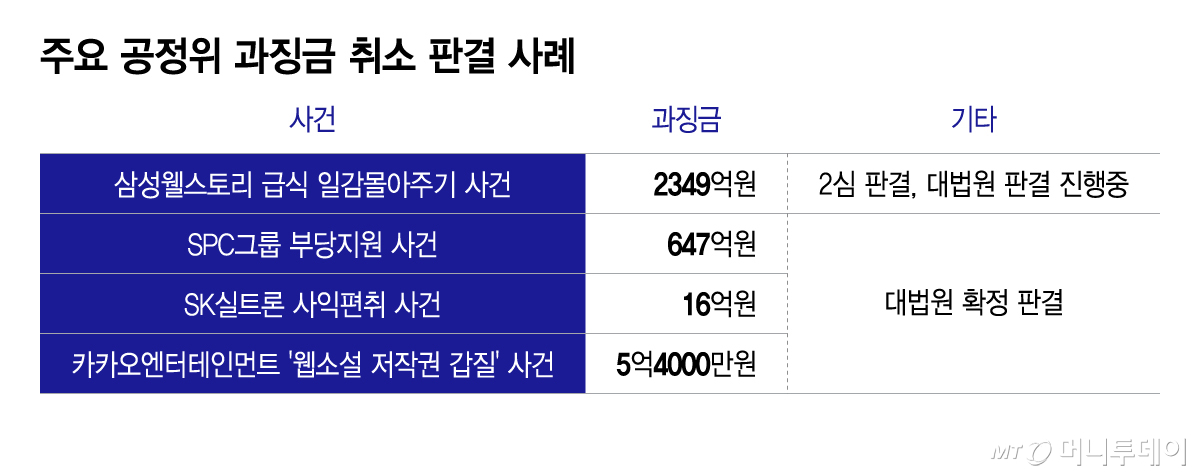
In fact, the Supreme Court recently ruled to cancel a 540 million won fine imposed by the Korea Fair Trade Commission on Kakao Entertainment for "abuse of power over web novel copyrights."
Additionally, in April, the Seoul High Court ordered the complete cancellation of a 234.9 billion won fine imposed by the Korea Fair Trade Commission on Samsung Electronics and other Samsung Group affiliates for allegedly funneling all cafeteria food supply to Samsung Wellstore. The Korea Fair Trade Commission has appealed this ruling, and the case is now before the Supreme Court.
Last year, a final Supreme Court ruling canceled a total of 1.6 billion won in fines imposed on SK Siltron and Choi Tae-won (Chairman) related to a private benefit acquisition case. Prior to that, the Supreme Court also fully canceled a 64.7 billion won fine imposed by the Korea Fair Trade Commission on SPC Group for an unfair subsidy case.
Such flawed decisions by the Korea Fair Trade Commission are frequently cited during National Assembly national audits. According to Democratic Party of Korea lawmaker Heo Young, from 2017 through August last year, the cumulative amount of fines returned to companies by the Korea Fair Trade Commission due to administrative lawsuit losses or ex officio cancellations (recycled funds) reached 624.7 billion won. Refund interest payments, which carry an interest-like nature, amounted to 47.4 billion won.
Industry and legal circles criticize the Korea Fair Trade Commission for imposing excessive fines under a "hit first, leave it to the courts later" approach.
A former official of the Korea Fair Trade Commission stated, "Since the Korea Fair Trade Commission effectively performs the role of a first-instance court, it must issue responsible decisions by carefully reviewing legal principles and considering past precedents."

 in ECONOMY
