

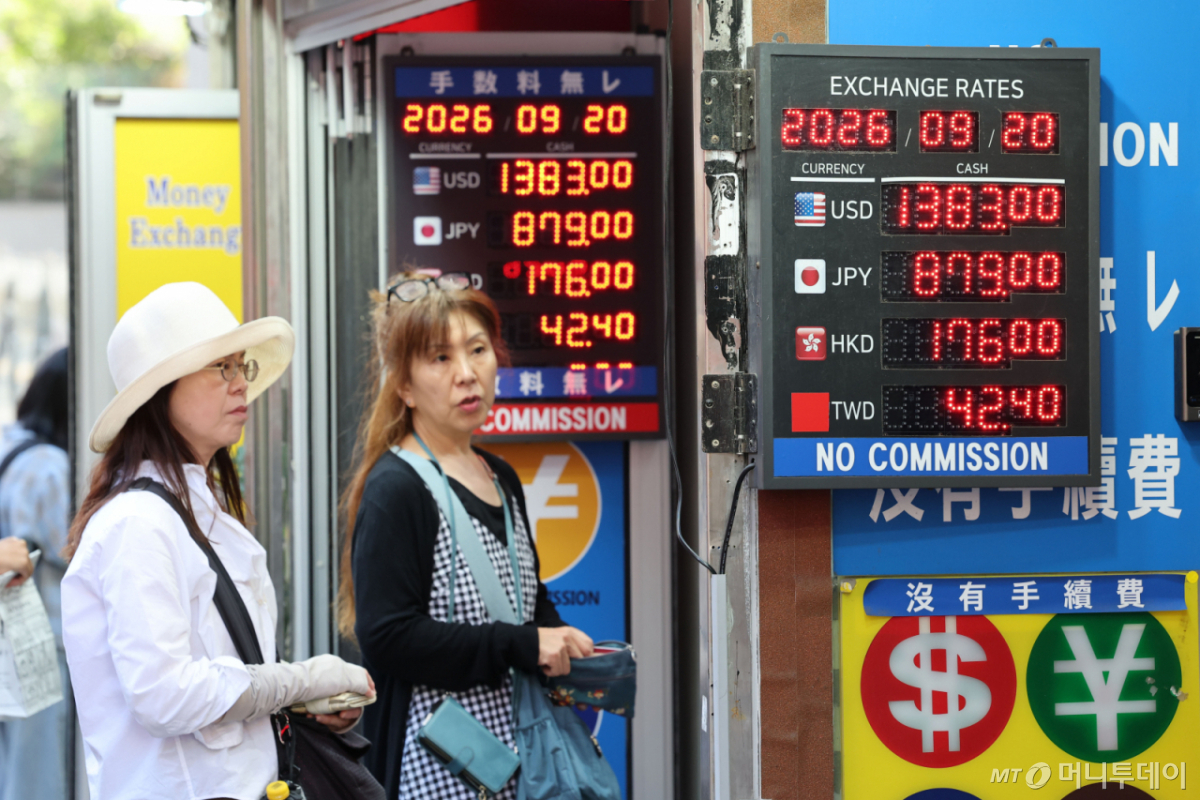
The won-dollar exchange rate, which had surged by nearly 50 won amid expectations of a base rate hike and further tightening by the Federal Reserve System (Fed), has reversed course. After reaching an intraday high of 1,387.9 won on the 21st, the exchange rate fell back into the 1,350 won range within a single day, pressured by corporate hedging activity (dollar sales) from exporters, net foreign purchases of domestic stocks, and a decline in international oil prices.
With the sharp rise followed immediately by a steep drop, market attention is now focused on the direction of the exchange rate after the Chuseok holiday. Key variables expected to determine the won-dollar exchange rate include dollar flows driven by the possibility of further U.S. tightening, the trajectory of the Japanese yen, and hedging volumes from exporters before and after the holiday.
After the holiday, the market is closely watching the dollar. The Federal Reserve raised its base rate by 0.25 percentage points on the 16th, moving from an annualized range of 3.50–3.75% to 3.75–4.00%. This marks the first interest rate hike since July 2023. The dot plot also shows that 16 of the 18th FOMC members have left open the possibility of additional rate hikes within the year.
Driven by better-than-expected U.S. economic growth and inflation, along with expectations for further tightening by the Federal Reserve, the dollar has recently shown strength. Markets are now monitoring the possibility of another rate hike in October.
However, whether this recent dollar strength will persist remains uncertain. Some market analysts suggest that recent U.S. employment and consumption data may have appeared stronger than the actual economic situation. If signs of a U.S. economic slowdown become clear, expectations for additional rate hikes could fade, potentially easing the dollar's strength.
Some analyses also indicate that if the phenomenon of rising international oil prices pushing up prices for other goods and services is not significant, the Federal Reserve may be unlikely to raise interest rates again in October. Instead, it might pause after observing the impact of the September rate hike.
The yen cannot be ignored either. The Bank of Japan (BOJ) raised its policy rate by 0.25 percentage points on the 18th, from 1.00% to 1.25%, reaching its highest level in 31 years. However, despite the rate hike, the yen has shown weakness.
This is partly because Ban (CEO) emerged during the rate decision process, and there is a growing perception that the pace of future tightening will not be as fast as market expectations. Given that the interest rate differential between the U.S. and Japan remains large, expectations for continued yen carry trades are acting as a factor behind the yen's weakness.
However, if the yen weakens further, the likelihood of intervention by Japanese foreign exchange authorities increases. Reports indicate that Japanese authorities have recently conducted "rate checks," asking market participants about their views on exchange rate levels. Concerns over potential actual intervention continue to persist.
Movements in the yen also affect the won. Market analysts note that early this month, when the won-dollar exchange rate fell to the 1,330 won range, it was influenced by a strengthening yen driven by expectations of a BOJ rate hike. Later, as the yen weakened following a less hawkish-than-expected BOJ decision, the won-dollar exchange rate rebounded.
Domestic dollar supply and demand is the most direct variable moving the exchange rate. The recent pullback in the exchange rate was driven by corporate hedging volumes from exporters. As the exchange rate climbed to the 1,380 won range, exporters increased their volume of converting held dollars into won. This coincided with net foreign purchases of domestic stocks, a recovery in risk appetite due to strong U.S. tech stocks, and a decline in international oil prices, all of which bolstered the won's strength.
A large trade surplus also contributes to increased dollar supply. The August trade balance recorded a surplus of $34.75 billion, exceeding $30 billion for three consecutive months. In September, as of the 20th, a surplus of $22.966 billion was recorded. The most recently reported July current account balance also maintained a high level with a surplus of $42.08 billion.
Shinhan Investment Corp. analyzed that since trade surpluses in September are expected to exceed $30 billion, there is ample hedging volume waiting from exporters. If pressure from the strong dollar eases, the downward trend in the won-dollar exchange rate could resume. However, it noted that reduced currency hedging by the National Pension Service and high oil prices are factors limiting the extent of any exchange rate decline.

 in ECONOMY
