

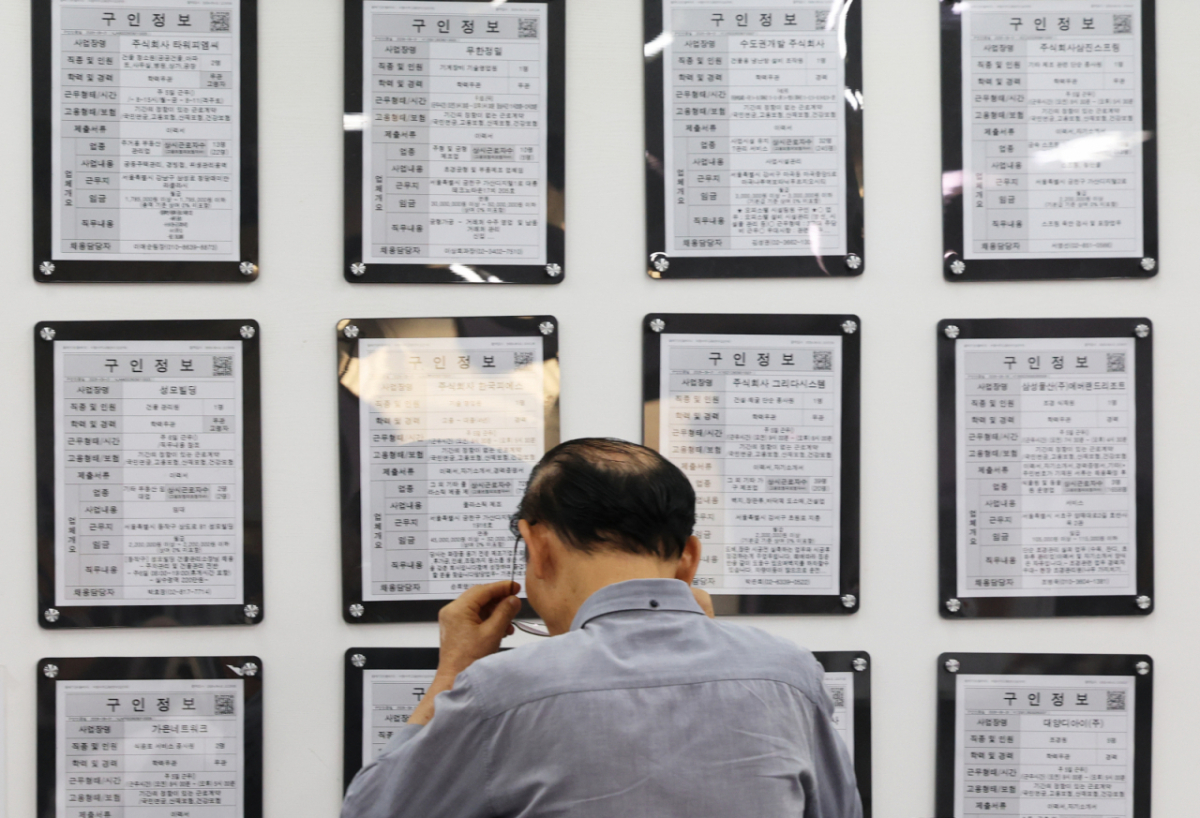
'Economic growth = Job creation' is no longer a formula. While export surges driven by the semiconductor supercycle have improved growth indicators and expanded the national economic pie, the job market temperature felt by citizens continues to cool. In particular, 'growth without jobs' is a factor intensifying polarization among generations, regions, and social classes. Although the government has proposed various measures to overcome employment market difficulties that do not appear in statistics, critics point out limitations in addressing the immediate employment cliff due to mismatches with on-the-ground demand.
According to the Bank of Korea on the 27th, as of 2024, the employment multiplier for computers, electronics, and optical instruments including semiconductors was 2.87 people, down 0.75 from a year earlier. The employment multiplier refers to the number of employed persons directly and indirectly induced across all industries when final demand in a specific sector generates 10 thousand won. It shows how much industry growth translates into job creation.
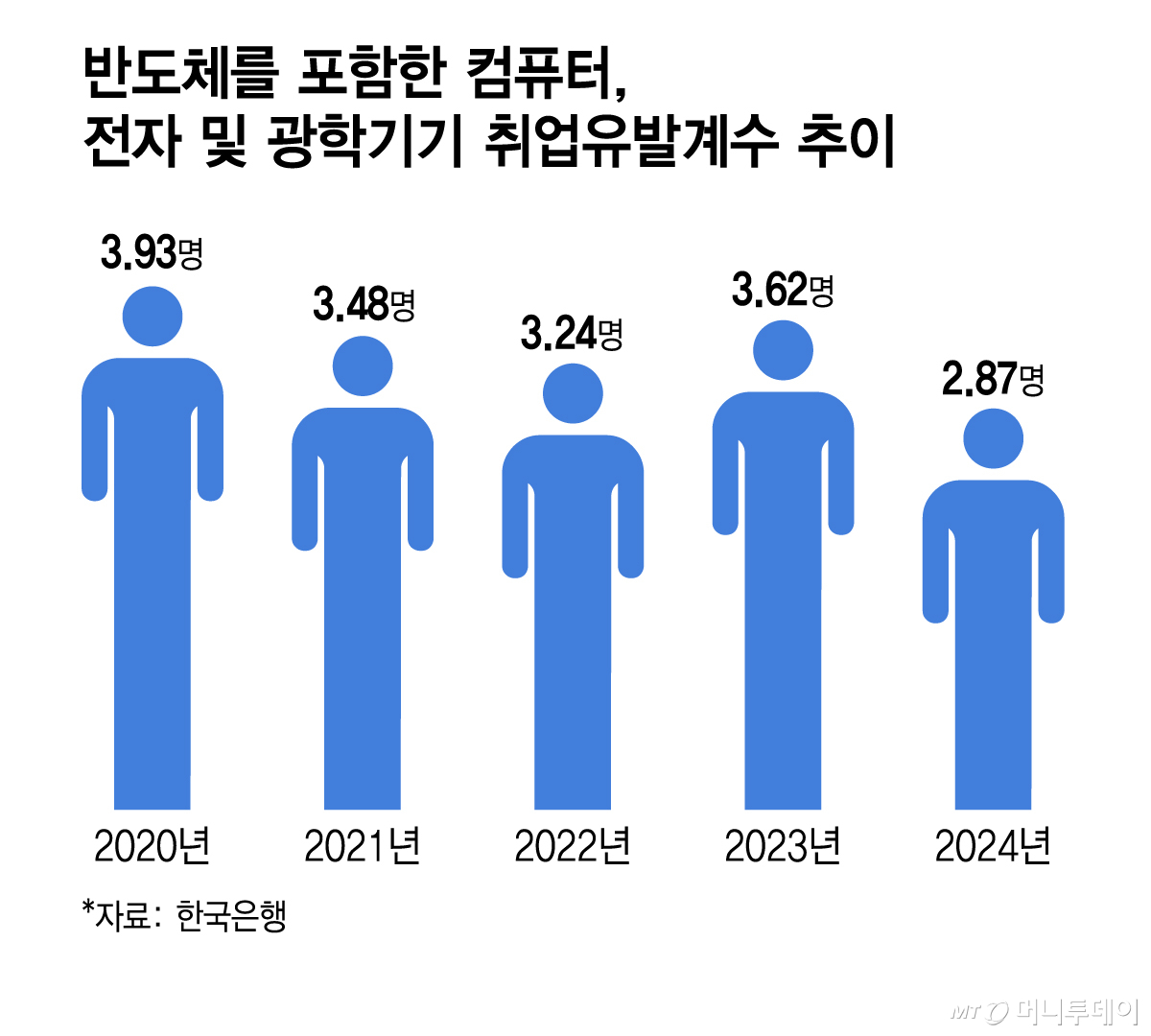
Semiconductors utilize advanced equipment more than manpower in the production process, resulting in lower job creation effects from growth compared to other industrial sectors. This means that Korea's high economic growth centered on the semiconductor supercycle does not necessarily translate into a boom in the employment market.
According to the Ministry of Economy and Finance's "Employment Type and Industry Wage Worker Statistics," wage jobs in the semiconductor manufacturing industry increased by 14.5% compared to eight years ago during the first quarter. However, new hiring jobs decreased by 21.6% over the same period.
Consequently, the gap between growth indicators and the employment market is widening. The Ministry of Economy and Finance revised its real economic growth forecast for this year upward to 3.0% in its second-half economic growth strategy released last July. This was a 1 percentage point (p) increase from the January forecast (2.0%). In contrast, employment forecasts have retreated. The ministry expects the number of employed persons this year to increase by only 150,000, which is 10,000 fewer than the January forecast (160,000).
The Bank of Korea's forecast is no different. In its revised economic outlook last month, the Bank of Korea raised this year's growth rate forecast from the previous 2.6% to 3.3%, but projected that the number of employed persons would increase by only 140,000, which is 40,000 fewer than the initial forecast.
The government is also recently focusing on 'growth without jobs.' Considering that the impact of the employment winter is hitting young people harder, it announced measures to recover youth employment. The plan involves training 300,000 specialized professionals by 2030 and supplying 300,000 private and public jobs and startup opportunities linked to the three mega-projects being promoted by the government (semiconductors, physical AI, and data centers).
The core is cultivating 'new graduates with equivalent experience.' Based on the diagnosis that young people are being pushed out of the job market due to companies' recent preference for experienced hires, the plan involves injecting public funds to create work experience for young people.
However, doubts remain about its effectiveness. It is uncertain whether companies will recognize government-created experience as actual work experience. Furthermore, training measures for advanced fields are merely a long-term blueprint and lack practicality in solving the job search difficulties of young people who are currently facing an employment cliff due to the reduction in new graduate hiring.
A bigger problem is that government policies are moving in the opposite direction of on-the-ground demand. This is because large corporations, which young people prefer most, are being excluded from policy support. Previously, the Ministry of Economy and Finance decided to exclude large corporations from the scope of the integrated employment tax credit. This policy provides tax credits to companies that increase their number of regular workers to encourage job expansion.
The Korea Economic Daily Association submitted an opinion to the National Assembly arguing that large corporations should remain in the scope of the integrated employment tax credit. The explanation was that eliminating employment incentives for large corporations could have a negative impact on expanding quality jobs.
A Korea Economic Daily (Hankyung) association official stated, "Under the current system, large corporations can only receive support when they hire additional young people, persons with disabilities, or workers aged 60 and over, and the level of support is lower than for small and mid-sized companies. Since the scope and requirements for support are already limited, we have recommended maintaining the application of the system to large corporations."
Some voices also warn against the 'employment indicator illusion' caused by government-funded senior jobs created with public funds. The government plans to supply approximately 1.15 million senior jobs this year, the highest in history. It has also compiled a 2027 budget bill to supply about 1.18 million senior jobs next year, which is roughly 30,000 more than this year.
Consequently, the statistical illusion of rising overall employment rates continues as the proportion of people aged 65 and over who are working increases. This is the background for claims that while the positive effects of senior job programs in improving poverty among the elderly should be preserved, institutional measures are needed to prevent distortion in economic judgment.
Lee Hyung-il, Deputy Prime Minister and Minister of Economy and Finance, said at his first executive meeting after taking office, "Do not rest on immediate indicators; please enhance your macroeconomic analysis and forecasting capabilities." He also requested, "Using policy leeway secured through economic recovery, develop effective policies so that the warmth of growth spreads across regions, social classes, and industries, leading to concrete results that citizens can feel."

 in ECONOMY

