

The Democratic Party of Korea and the government are seeking to introduce a market exit measure for businesses engaged in repeat cartels, judging that current sanctions have limits in fundamentally resolving cartels that harm people’s livelihoods. The aim is to reduce incentives for habitual cartel behavior by adding measures that restrict business operations themselves to the existing fine-centric sanctions.
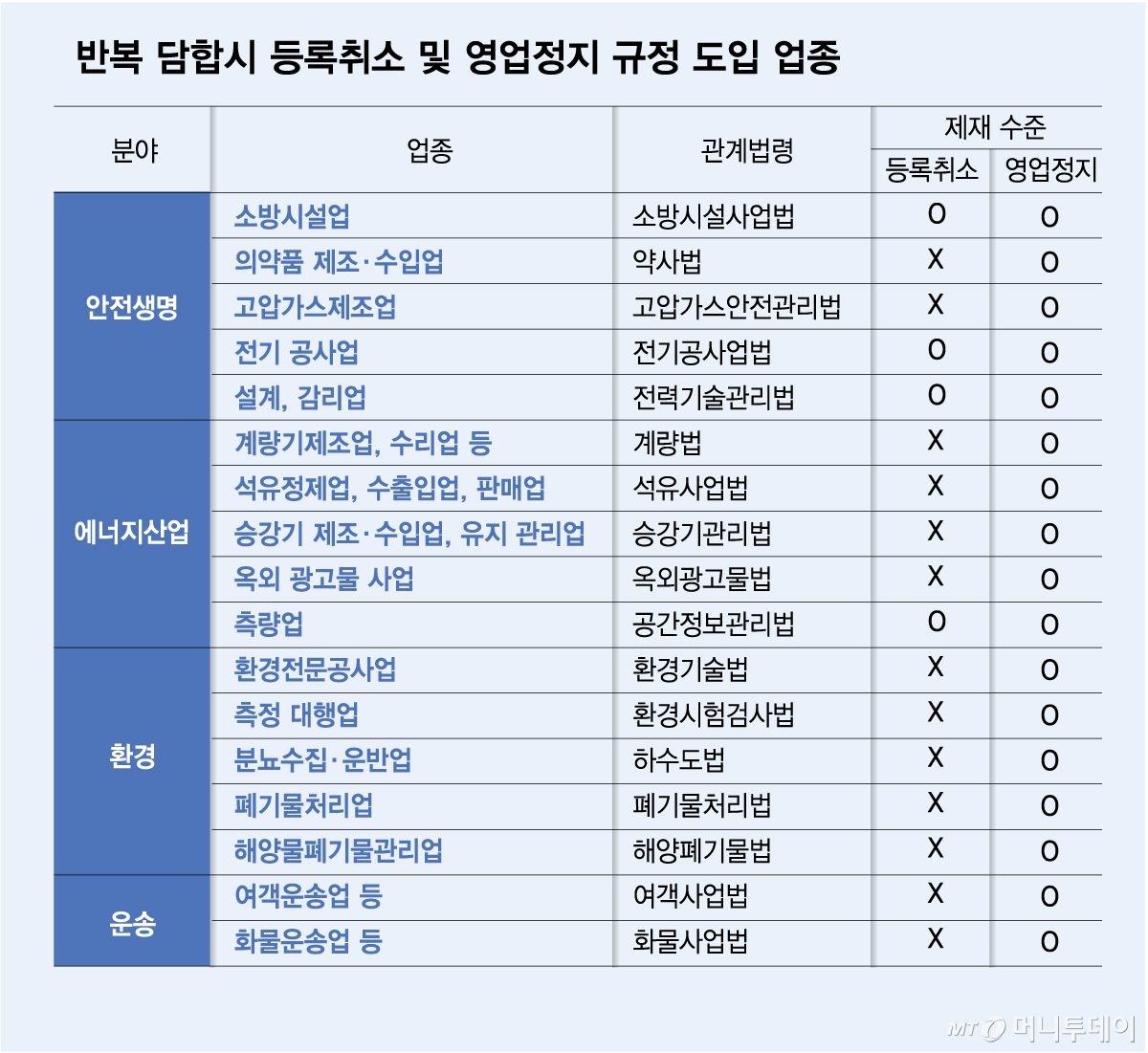
According to the National Assembly and relevant government ministries on the 28th, the party and government are pushing to introduce a system for cancelling registrations and suspending business operations for businesses that have engaged in cartels two or more times within five years, targeting sectors in livelihood-critical fields where cartels frequently occur. The targets are four areas directly tied to public life—safety and life, energy and industry, environment, and transportation—and 17 specific sectors.
Currently, if a construction contractor receives fine penalties for cartels two or more times within nine years, its construction business registration can be erased. Similarly, if a real estate brokerage association or licensed real estate broker repeatedly engages in prohibited acts by business associations two or more times within two years and receives corrective measures or fine penalties, the opening registration of their brokerage office can be cancelled. The party and government plan to expand these provisions to other sectors.
The Fair Trade Commission will identify businesses engaged in repeat cartels based on the Fair Trade Act and request relevant ministries to cancel registrations or suspend business operations, with those ministries then issuing penalties under individual laws. To this end, the party and government plan to amend the Fair Trade Act and 17 individual laws.
Specifically, for four sectors—firefighting facility business, electrical construction business, and design and supervision business in the safety and life field, and surveying business in the energy and industry field—the policy is to allow both registration cancellation and business suspension penalties in cases of repeat cartels. For the remaining 13 sectors, only business suspension can be imposed.
Institutional improvements are also being pushed to increase the detection rate of increasingly sophisticated cartel activities. The statute of limitations for penalties, currently up to 12 years from the start of an investigation, will be extended to a maximum of 15 years. Additionally, to proactively detect public bidding cartels in the education sector, amendments to the Fair Trade Act are being pushed to explicitly designate education offices as one of the mandatory cooperating institutional investors in the Bidding Cartel Indication Analysis System (BRIAS).
A legal basis will also be established for the “price re-determination order,” which the Korea Fair Trade Commission has deployed for the first time in 20 years following the detection of cartels involving flour, printing paper, and starch sugar. Currently, the Korea Fair Trade Commission imposes price re-determination orders based on “other necessary corrective measures” under the Fair Trade Act and “independent price re-determination orders” in review guidelines. However, it is ambiguous whether a failure by businesses to re-determine prices to a level that restores pre-cartel competition can be considered non-compliance with corrective measures. The party and government plan to explicitly state in the Fair Trade Act that prices must be re-determined to “a level that restores pre-cartel competition” to ensure effective price re-determination.
Meanwhile, the food sector was excluded from the targets for registration cancellation and business suspension of businesses engaged in repeat cartels. This is because there is no basis in individual laws to impose registration cancellation or business suspension on food businesses for repeat cartels. In response, the Korea Fair Trade Commission is considering introducing structural measures into the Fair Trade Act. The plan includes providing a basis to impose structural measures, such as corporate division or share sales, when it is judged that existing behavioral corrective measures and fine sanctions alone are insufficient to improve the harms of monopoly.
There are also voices expressing concern about side effects from introducing structural measures. This is because forcibly selling business divisions that companies have carefully cultivated could lead not only to a decline in corporate valuation but also to the loss of future growth drivers. The Korea Fair Trade Commission emphasized that even if structural measures are introduced considering side effects, they will serve as a “last resort.” It explained that structural measures can be considered when cartels, self-dealing, or unfair support acts are repeated.

 in ECONOMY
