

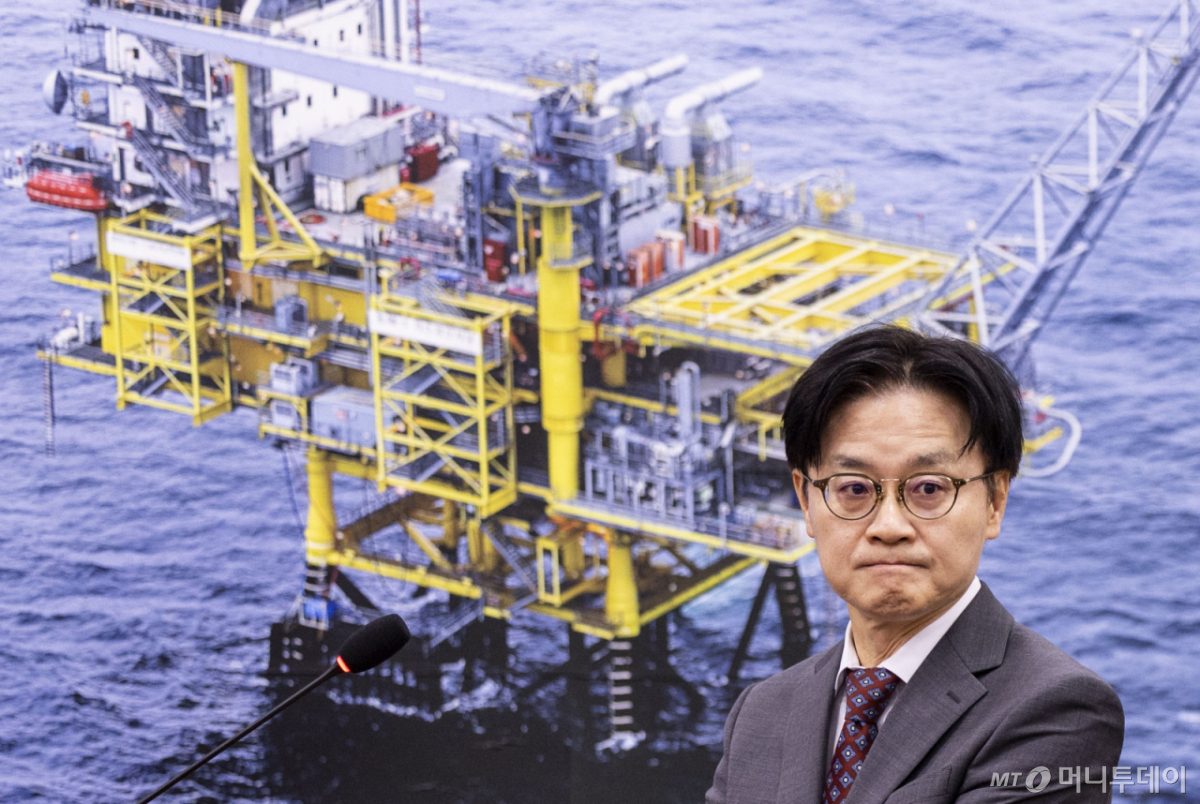
The specific outlines of a $350 billion investment project in the United States have been revealed. Starting with the construction of a gas combined-cycle power plant in Texas, the U.S., the official promotion of three massive projects has begun: the construction of eight large-scale nuclear reactors and the development of liquefied natural gas (LNG) in northern Alaska.
The Ministry of Trade, Industry and Energy officially announced on the 1st its plan to promote three Korea-U.S. strategic investment projects under the Korea-U.S. Strategic Investment Memorandum of Understanding (MOU): the Texas Gas Combined-Cycle Power Plant (Project Star), the Korea-U.S. Nuclear Framework (Project Power), and Alaska LNG (Project North).
◇ First project, 'Project Star'… $22.3 billion Texas gas power plant
The first joint project is 'Project Star,' with a total investment of $22.3 billion. The project involves the construction and operation of a gas combined-cycle power plant with a capacity of 6,472 megawatts (MW) in the Encinal area of Texas, U.S., to supply electricity to artificial intelligence (AI) data centers.
The power plant will operate by directly supplying electricity to nearby data centers, aiming for full operation of all facilities by 2032, starting with commercial operations in Phase 1 in 2029.
The government determined that the project meets 'commercial rationality' after comprehensively considering the market situation where power demand is surging due to expanded AI data center investments in Texas, proven business partners, and appropriate electricity prices. Significant participation from domestic companies is expected across the entire spectrum, from equipment design and construction (EPC) to the supply of major equipment such as turbines and long-term operation and maintenance (O&M). The U.S. side also promised future opportunities for Korean-made equipment to be supplied to other projects within the United States.
◇ 'Project Power'… First entry of Korean nuclear power into the U.S., pursuit of WEC equity acquisition
A historic turning point has been established with the first construction of a nuclear reactor of an independently developed Korean design on U.S. soil. The two countries agreed to the 'Korea-U.S. Nuclear Framework (Project Power),' which involves constructing eight large-scale nuclear reactors in the United States (two APR1400s and six AP1000s) using $120 billion from the Korea-U.S. Strategic Investment Fund. This agreement will be jointly signed by the governments of both countries, Westinghouse (WEC), KEPCO, and Korea Hydro & Nuclear Power.
Nuclear reactor construction will proceed in stages: starting with two AP1000s, a Westinghouse design, in Phase 1; followed by two APR1400s, a Korean design, and two AP1000s in Phase 2; and concluding with two AP1000s in the final Phase 3. The two countries agreed to reduce the time gap between EPC contracts for Phases 1 and 2 to within six months.
Initially, entry into the U.S. market was impossible for the APR1400 due to the impact of a settlement agreement (SA) between companies in both countries. However, through the government's multi-faceted outreach and intense negotiations, entry rights were secured. To proactively secure long-cycle manufacturing items, the government plans to prioritize the execution of up to $10 billion by year-end after reviewing commercial rationality and reporting to the National Assembly. Additionally, to share commercial profits, the acquisition of equity in Westinghouse by Korean companies is being pursued.
◇ 'Project North'… Alaska LNG development and securing tariff benefits
The 'Alaska LNG Project (Project North)' has also been launched to strengthen resource security. The project involves constructing a large-scale pipeline to transport natural gas from northern Alaska to the south, as well as an LNG terminal for overseas export.
The final decision on whether to proceed with the project will be made once commercial rationality and domestic legal requirements are met. If the project proceeds, the U.S. side has agreed to provide tariff reduction benefits for Korean-made equipment such as steel, guarantee long-term LNG purchase contracts (Offtake Agreements) under economically viable terms, and grant Korea priority access rights to Alaska LNG.
◇ Principal and interest guaranteed, annual limit of $20 billion… "Building a solid safety net for taxpayers' money"
Given the injection of massive public funds, the government specified meticulous financial safeguards. The profit-sharing ratio between Korea and the U.S. for individual projects will remain at 5 to 5 until the total principal and interest invested by Korea is fully recovered. A shift to a 1-to-9 ratio before the recovery of principal and interest is strictly suspended. Even if some project revenues are low, the 5th-to-5 sharing period for other projects will be extended to maximize the stability of principal and interest recovery.
The deemed interest rate, which serves as the basis for calculating principal and interest, has been set at 'U.S. Treasury 20-year yield + spread.' Additionally, Korea's annual investment amount is capped at $20 billion, and the total investment scale is limited to $200 billion. The government secured the right to modify plans through intergovernmental consultations if project viability is compromised. Furthermore, income-related taxes paid to the United States will be grossed up to Korea's allocated share, clearly guaranteeing a 5-to-5 after-tax distribution ratio.
Minister of Trade, Industry and Energy Kim Jung-kwan emphasized, "This announcement goes beyond simply fulfilling the Korea-U.S. tariff agreement; it is an opportunity to combine the strengths of both countries in future strategic fields such as AI, nuclear power, and LNG." He added, "Since taxpayers' money is being invested, we will prioritize national interests and invest only in projects that possess commercial rationality."

 in ECONOMY
