

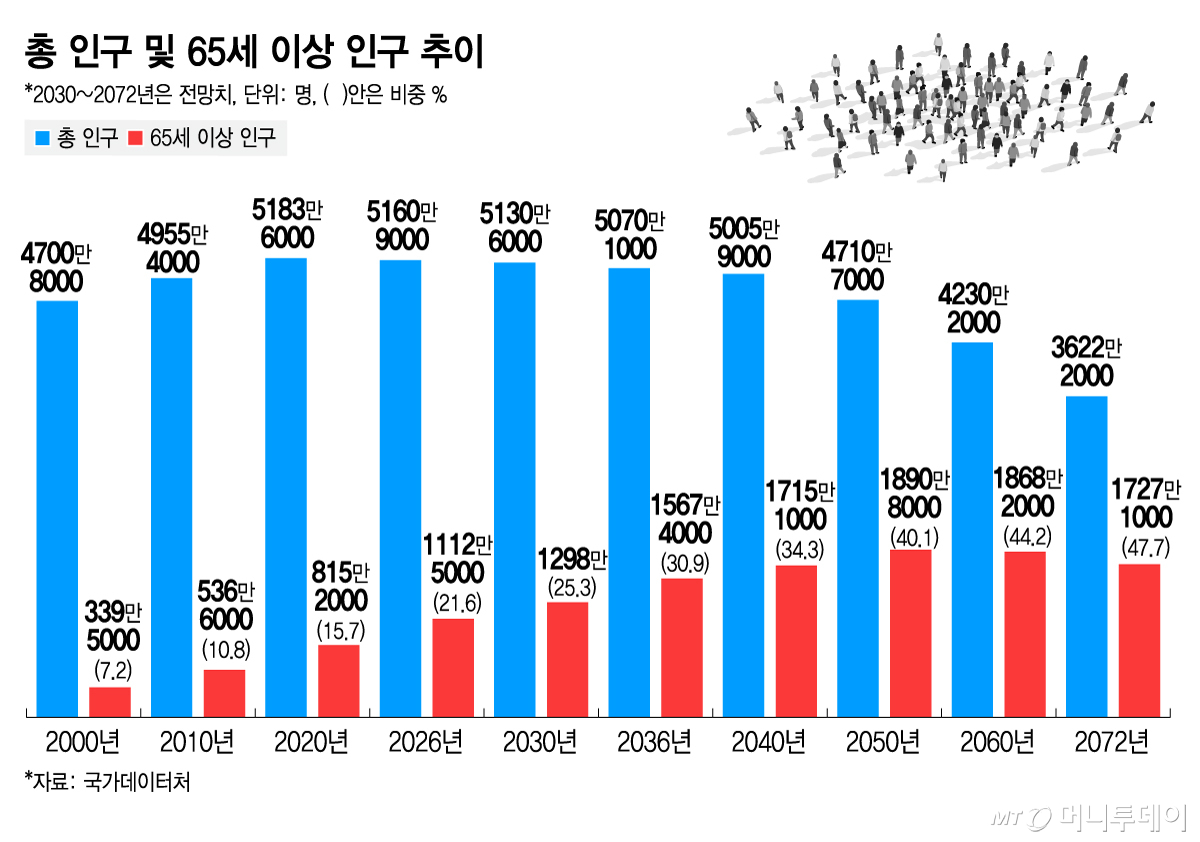
The elderly population aged 65 and over, which has surpassed 20% of the total population, is projected to exceed 40% by 2050. However, the relative poverty rate among the retirement-age demographic was recorded at 37.7%, making it the highest among OECD member countries. In particular, three out of four elderly individuals directly secure their living expenses, deepening their economic isolation.
According to the "2026 Statistics on the Elderly" released by the National Data Office on the 1st, the population aged 65 and over this year stands at 11,125,000, accounting for 21.6% of the total population.
After entering a super-aged society last year when the proportion of the elderly surpassed 20%, South Korea is estimated to see a continued increase in the share of the elderly population. The Data Office forecasted that the proportion of the elderly will reach 30% in 2036 and exceed 40% by 2050.
Examining the age distribution of the elderly population this year, it is as follows: △7.6% (3,937,000) for those aged 65 to 69, △5.3% (2,753,000) for those aged 70 to 74, and △8.6% (4,435,000) for those aged 75 and over. However, the population aged 75 and over is projected to outnumber other age groups starting in 2038.
The issue is that the burden of dependency ratios is also surging. The old-age dependency ratio, which measures the number of elderly people per 100 working-age individuals (aged 15 to 64), stands at 31.3 this year. It is expected to rise significantly to 50.1 in 2036 and 100.8 by 2066. As of 2025, the most common method for elderly individuals to secure living expenses was "burdened by self and spouse," accounting for 74.7%. This represents an increase of 16.2 percentage points compared to 10 years ago (58.5%). This means that seven out of ten people earn their own living expenses, indicating deepening economic isolation.
Consequently, the proportion of elderly individuals preparing for old age has also increased. In 2025, 64.4% of the elderly were preparing for old age, a 17.5 percentage point increase from 10 years ago. Conversely, the proportion of elderly not preparing for old age decreased by 17.5 percentage points, from 53.1% to 35.6%.
The willingness to work among the elderly is also high. This year, 58.7% of those aged 65 to 79 expressed a desire to work in the future, a 1.1 percentage point increase from the previous year. The most cited reason for wanting to work was "supplementing living expenses" at 50.4%, followed by "the joy of working" at 38.7%.
The relative poverty rate among the retirement-age demographic (aged 66 and over) was also recorded at 37.7% as of 2024, a decrease of 2.1 percentage points from the previous year. The relative poverty rate refers to the proportion of the population with income at or below 50% of the median income.
The Gini coefficient (0.377) and the income quintile ratio (6.9 times) also both declined. A Gini coefficient closer to 0 signifies complete equality, while a lower income quintile ratio indicates relatively more equitable income distribution.
However, according to the latest figures compared with major OECD countries (as of 2023), South Korea's relative poverty rate among the retirement-age demographic (39.8%) was the highest. Other countries included △Canada at 10.1%, △France at 6.2%, △Germany at 14.5%, △the UK at 15.0%, and △Spain at 13.1%. Excluding South Korea, only Latvia (34.3%) had a poverty rate exceeding 30%.
An official from the Data Office stated, "There is potential for the relative poverty rate of the elderly to decrease under the assumption that government policies on jobs for the elderly continue," adding, "Perceptions regarding preparation for old age among the elderly are also changing."

 in ECONOMY
