

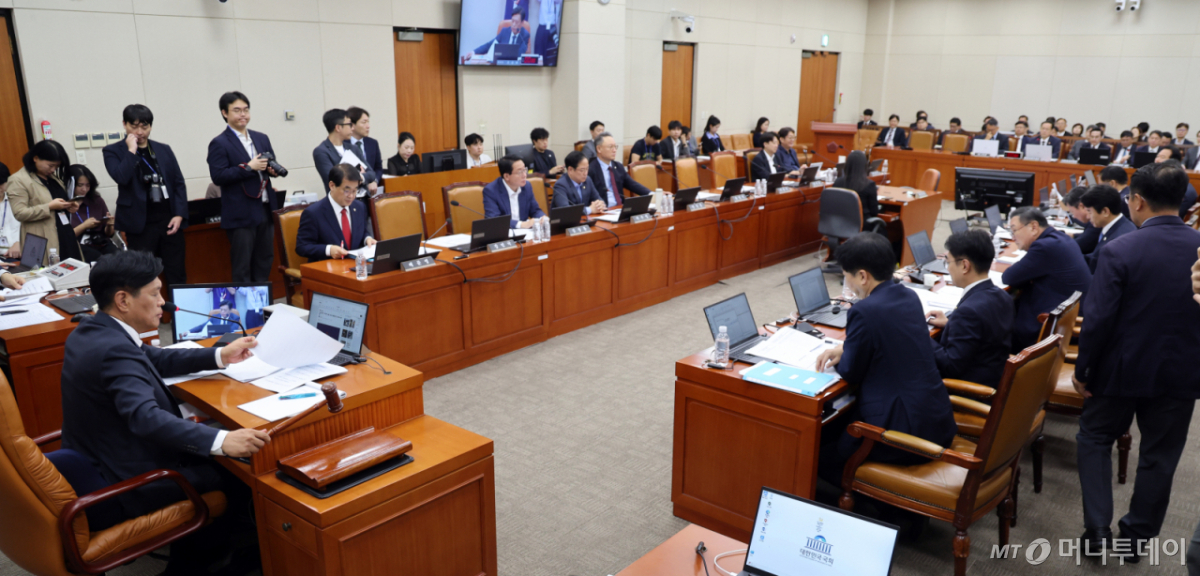
The first national audit following the split of the Ministry of Economy and Finance into the Ministry of Economy and Finance and the Ministry of Planning and Budget is set to begin on the 6th. Key issues expected to be addressed in the Ministry of Economy and Finance audit include a $350 billion investment in the U.S., comprehensive real estate tax reform, and a 63 trillion won error in tax revenue projections. The policy decision-making and coordination capabilities of the Ministry of Economy and Finance, which will now oversee economic policy and taxation following the organizational restructuring, will also face their first test.
According to the National Assembly and government sources on the 5th, the National Assembly's Committee on Economy and Finance will conduct a national audit of the Ministry of Economy and Finance on the 6th. Audits of the Ministry of Planning and Budget on the 8th, the Bank of Korea on the 12th, the National Tax Service on the 13th, and the Korea Customs Service on the 15th will follow.
One of the most pressing issues is a $350 billion investment in the U.S. The government is advancing the EnCinal gas combined-cycle power plant project in Texas, with a total project cost of $22.3 billion, as the first strategic investment project between Korea and the U.S. So-called EnCinal project involves directly supplying electricity generated to artificial intelligence (AI) data centers. The rapid expansion of the AI industry, which has increased new electricity demand, influenced the assessment of the project's viability.
Based on electricity demand from such AI data centers, the government expects to recover between $43.29 billion and $45.403 billion over the next 20 years. However, long-term fixed-price power purchase agreements (PPAs), a core premise of profitability, have not yet been signed. The audit is expected to focus on the basis for the government's projected returns and the risks Korea would bear in the event of project failure.
Securing foreign currency for large-scale investments is also an issue. The government has expanded the issuance limit for foreign-currency-denominated Foreign Exchange Stabilization Fund bonds next year from the existing $5 billion to a record high of $8 billion. It is also pushing a plan in which the Korea-U.S. Strategic Investment Corporation issues 20-year maturity bonds worth $7 billion, with the government guaranteeing principal and interest repayment. Given that up to $20 billion in investments will be executed annually, inquiries are expected regarding the impact on the foreign exchange market and the risks borne by the government.
The tax reform plan is also under scrutiny. The government is pushing a plan to raise the basic deduction for comprehensive real estate tax for owners of one home who actually reside in it from 1.2 billion won to 1.4 billion won based on the announced price, while maintaining the deduction at 1.2 billion won for non-resident single-home owners.
Initially, the government announced that it would lower the basic deduction for non-resident single-home owners to 900 million won and raise the tax burden cap from 150% to 200%. However, within 29 days, the government revised its proposal and withdrew both measures. The audit is expected to focus on the background behind the government changing its policy direction in less than a month and the fairness of a taxation system centered on actual residence.
The accuracy of tax revenue projections will also be tested again. This year's national tax revenue, recently re-estimated by the Ministry of Economy and Finance, is 478.6 trillion won, which is 63.2 trillion won (15.2%) higher than the supplementary budget of 415.4 trillion won. It is also a record high, up 104.7 trillion won from last year.
In particular, corporate tax revenue is expected to reach 136.4 trillion won, an increase of 35 trillion won over the supplementary budget forecast. The government explained that improved performance of semiconductor companies, special dividends, and stock market revitalization had an impact.
The issue is that after large-scale tax revenue shortfalls in 2023-2024, additional tax revenue exceeding 60 trillion won has occurred this year, indicating repeated errors in tax revenue projections. As the government decides to restructure the Tax Revenue Projection Committee and introduce an AI prediction model for corporate tax projections, inquiries are expected at the audit regarding the reasons why previous projections were significantly off and the effectiveness of improvement measures.
Taxation of virtual assets, set to take effect in January next year, is also an issue. Under current law, virtual asset capital gains and lending income arising from 2027 will be separately taxed as miscellaneous income. However, with three months remaining until implementation, the government has not been able to specifically estimate tax revenue effects and collection costs, leading to expected inquiries regarding the status of taxation preparations.

 in ECONOMY
