

Virtual asset taxation, set to take effect next year, has once again reached a crossroads. This is due to prominent variables such as concerns over the tax system and backlash from investors. The government, which had previously shown its will to push through with the policy, appears to have taken a step back by emphasizing the collection of opinions.
According to relevant ministries on the 11th, the Ministry of Economy and Finance is reviewing the entire virtual asset taxation framework. While there has been no change in its position that taxation will proceed as scheduled starting next year, it is understood that the possibility of supplementing the system is not being ruled out.
Vice Prime Minister and Minister of the Ministry of Economy and Finance Lee Hyeong-il stated at the National Assembly's Budget and Economic Planning Committee's national audit of the Ministry of Economy and Finance on the 6th, "We will broadly gather opinions raised by the National Assembly, as well as diverse interests from experts and the industry."
Some interpret this as a departure from the previous stance of adhering strictly to taxation principles, placing emphasis on gathering opinions and leaving open the possibility of postponing taxation. A Ministry of Economy and Finance official said, "It was not an expression premised on postponing taxation, but rather a statement intended to convey that we must broadly gather opinions."
Virtual asset taxation is a system that treats income from the transfer and lending of virtual assets as miscellaneous income, applying a tax rate of 20% (22% including local taxes) after a basic deduction of up to 2.5 million won per year. It was originally scheduled to be implemented starting in 2022, but has undergone three postponements due to issues such as the lack of taxation infrastructure.
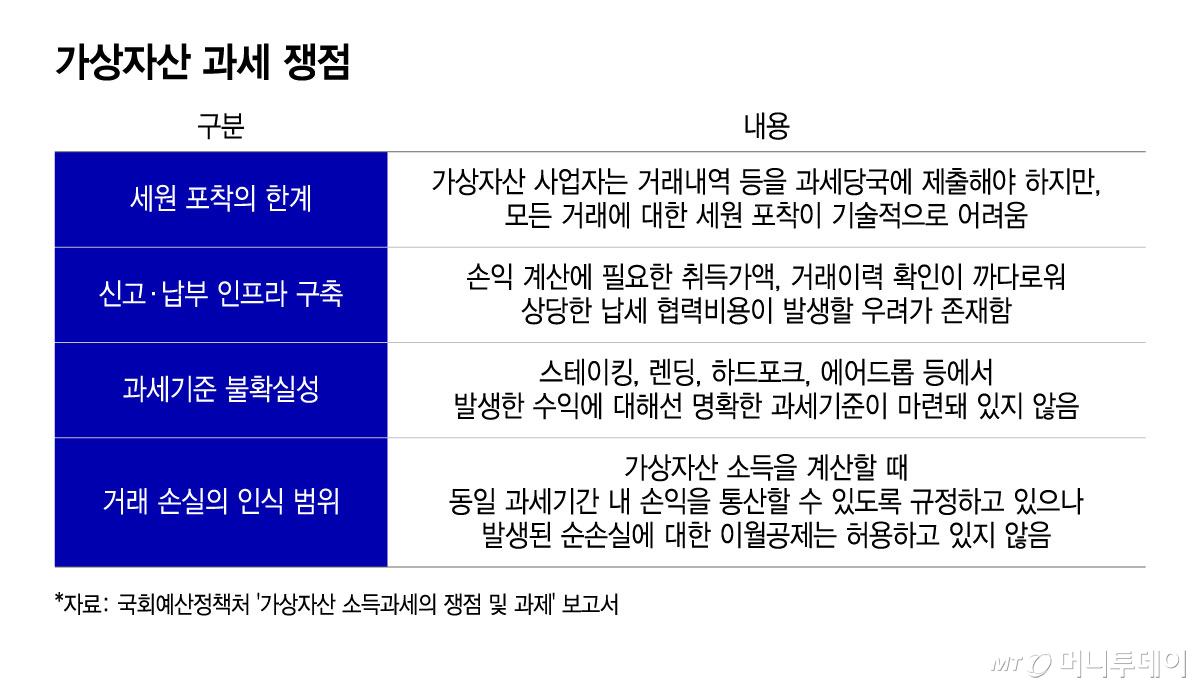
If no additional legislative procedures are undertaken, taxation on virtual asset income will take place starting next year. However, voices expressing concern over problems and side effects of the tax system are not insignificant.
Issues raised include fairness concerns that may arise given the abolition of the financial investment income tax on profits from financial investments, tax avoidance issues that could occur when utilizing decentralized exchanges, and synchronization problems due to differing implementation timelines for the Crypto-Asset Reporting Framework (CARF) across countries.
Above all, there is a view questioning whether it is necessary to rush virtual asset taxation, which is controversial, in a situation where tax revenue has recently been increasing.
The Blue House is also known to be comprehensively reviewing the entire system by examining related discussions underway in the National Assembly and the Ministry of Economy and Finance's own opinion-gathering process. While it has not withdrawn its policy of implementing taxation as scheduled, it has left open the possibility of supplementing the system if problems are identified.
President Lee Jae-myung is particularly emphasizing to each ministry that they should review and gather public opinion and communicate closely before the implementation of major policies, while clearly informing the public about the purpose of the systems.
A source from the ruling party said, "Before implementing a system, we should carefully examine its impact, and if problems are found, shouldn't we naturally supplement it, including through legislative amendments, rather than forcing it through?"

 in ECONOMY
