

Virtual asset taxation three months away… Government's stance shifts from 'forcing through' to 'caution'
The implementation of virtual asset taxation next year has once again reached a crossroads. This is due to prominent variables such as concerns over the taxation system and backlash from investors. The government, which had previously shown its will to force through the policy, appears to have taken a step back by emphasizing the collection of opinions.
According to relevant ministries on the 11th, the Ministry of Economy and Finance is reviewing the entire virtual asset taxation system. While there has been no change in its position that taxation will proceed as scheduled starting next year, it is known that the possibility of supplementing the system is not being ruled out.
Vice Prime Minister and Minister of the Ministry of Economy and Finance Lee Hyeong-il said at the National Assembly's Budget and Economic Planning Committee's national audit of the Ministry of Economy and Finance on the 6th, "We will broadly collect opinions raised by the National Assembly, as well as diverse interests from experts and the industry."
Some interpret this as a departure from the previous stance of adhering to taxation principles, placing emphasis on opinion collection and leaving open the possibility of a tax deferral. A Ministry of Economy and Finance official said, "It is not an expression premised on tax deferral, but rather a statement to the effect that we must broadly collect opinions."
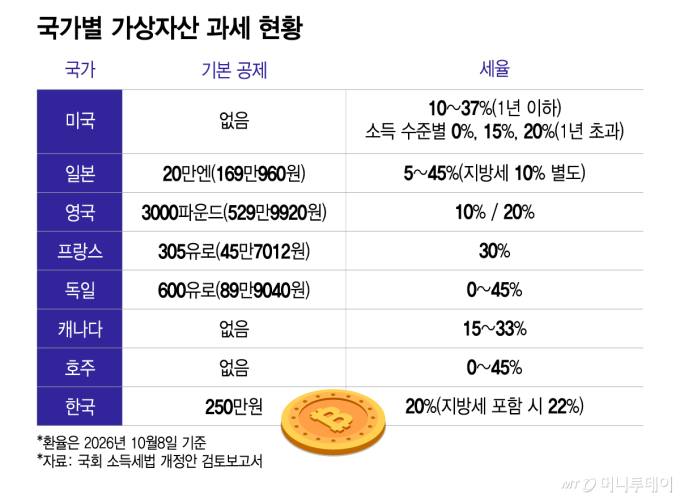
Virtual asset taxation is a system that treats income from the transfer and lending of virtual assets as miscellaneous income, applying a basic deduction up to 2.5 million won annually, followed by a tax rate of 20% (22% including local taxes). It was originally scheduled to be implemented starting in 2022, but has undergone three deferral processes due to issues such as taxation infrastructure.
If no additional legislative procedures are undertaken, taxation on virtual asset income will take place starting next year. However, voices expressing concern over problems and side effects of the taxation system are not insignificant.
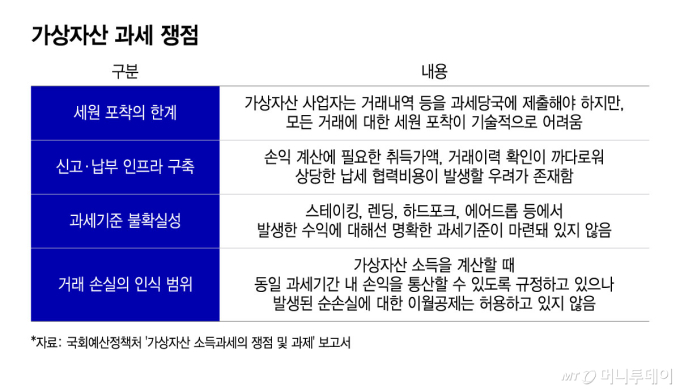
Issues raised include fairness problems that may arise in a situation where the financial investment income tax, which taxes profits from financial investments, has been abolished; tax avoidance issues that can occur when utilizing decentralized exchanges; and synchronization problems due to the Crypto-Asset Reporting Framework (CARF), an automatic information exchange system for virtual assets with different implementation timings by country.
Above all, there are views questioning whether it is necessary to rush the controversial virtual asset taxation in a situation where tax revenue has recently increased.
The Blue House is also known to be comprehensively reviewing the entire system while observing related discussions underway at the National Assembly and the Ministry of Economy and Finance's own opinion collection process. While it has not withdrawn its policy of implementing taxation as scheduled, it has left open the possibility of supplementing the system if problems are identified.
President Lee Jae-myung is particularly emphasizing to each ministry that they should review and collect public opinion before implementing major policies, communicate closely, and clearly inform the public of the purpose of the systems.
A ruling party official said, "As we approach the implementation of the system, if we carefully review its impact and find problems, shouldn't we naturally supplement it, including through legislative amendments, rather than forcing it through?"
"Lost 5 million won," yet taxes are being taken?… Why voices for delaying the 'crypto tax' are growing
Issues regarding loss carryforward deductions… Concerns over taxation blind spots also exist
Virtual asset taxation, referred to as the 'crypto tax,' is scheduled to begin in January next year. However, that 'schedule' has already been changed several times.
The decision on virtual asset taxation was made in 2020. At the time, the Ministry of Economy and Finance expressed the opinion that it was necessary to implement taxation at an early stage to minimize the taxation gap. On the other hand, there were also opinions that more time was needed to build the taxation infrastructure.
Accordingly, virtual asset taxation was decided to be implemented starting in January 2022. However, even in 2021, ahead of the implementation, the taxation infrastructure was not properly established, and the timing was postponed once to January 2023. From then on, virtual asset taxation repeatedly underwent postponement decisions.
In 2022, the taxation timing was postponed again to January 2025. This was a period when uncertainty in the virtual asset market increased due to incidents such as the Luna and Terra crashes, and the need for investor protection was emphasized.
There were also discussions about postponement in 2024. This coincided with discussions on abolishing the Financial Investment Income Tax (hereinafter FIIT). Ultimately, the timing of virtual asset taxation was postponed to January 2027. There have been a total of three deferral or postponement decisions so far. However, there is no concrete movement for deferral at this time.
The Ministry of Economy and Finance, which handles tax policy, maintains its position that it will proceed with virtual asset taxation as scheduled starting next year. Former Vice Prime Minister and Minister of the Ministry of Economy and Finance Koo Yun-cheol said at the National Assembly in July, "We will first implement it next year and push forward in a direction of supplementing necessary parts if any are found."
Vice Prime Minister and Minister of the Ministry of Economy and Finance Lee Hyeong-il also stated in his written response to the personnel hearing submitted during his candidacy period, "In accordance with the basic tax principle that 'where there is income, there is taxation,' it is desirable to implement taxation as scheduled starting in 2027."
Contrary to the government's position, concerns about virtual asset taxation remain. Issues such as loopholes in the system and limitations of the taxation infrastructure are being highlighted.
According to the Income Tax Act, the taxable objects for virtual assets are income arising from transfer and lending. If virtual asset income is 2.5 million won or less annually, it is not taxed. For income exceeding that amount, a deduction of 2.5 million won is applied, and taxation is imposed at a rate of 20% (22% including local taxes).
In particular, virtual asset income is classified as miscellaneous income, which means loss carryforward deductions are not allowed. This means past losses are not deducted from the following year's profits.
For example, if one incurs a loss of 10 million won this year and earns a profit of 5 million won next year, although the total loss is 5 million won, taxation will be applied to the 5th million won profit next year.
The relationship with the FIIT is also cited as an issue. The FIIT is a tax levied on investors at a rate of 20% (25% for amounts exceeding 300 million won) on the excess portion when profits from financial investments such as stocks, bonds, and funds exceed 50 million won annually. The FIIT, which was scheduled to be introduced in 2023, was ultimately decided not to be implemented.
Kim Woo-cheol, President of the Korean Society for Public Finance (Professor at University of Seoul), said, "The FIIT has been abolished, yet only virtual assets are being taxed, creating a situation where fairness in policy is compromised," adding, "I expect the government will have no choice but to postpone [the taxation timing] due to backlash from young people who invest in virtual assets."
Concerns regarding taxation infrastructure also exist. The National Assembly Budget Office stated in a report released last month, "For transactions conducted through decentralized trading and over-the-counter markets, the reporting entity is not clear, so there may be limitations for tax authorities to grasp all transactions and impose taxes."
The blind spot issue regarding overseas transactions is expected to be resolved to some extent by the 'Crypto-Asset Reporting Framework' (CARF), which will be implemented starting next year. However, concerns over synchronization remain, as 29 countries including Canada, Switzerland, Singapore, and Hong Kong will begin their first information exchange in 2028, while the United States will start in 2029.
Oh Moon-sung of Han Yang-yeo-dae (Prof.) said, "There are many loopholes to escape due to the situation where each country participates in different years," adding, "Many investors have moved to Binance, an overseas exchange located in the UAE, and investors are preparing for tax avoidance."
Seemingly mindful of this situation, Vice Prime Minister Lee also stated at the national audit on the 6th, "I think we will broadly collect opinions regarding diverse interests," revealing a stance different from the past.
[MT Report] The tangled mess of the crypto tax (Part 2) Angry 'retail' coin investors… Ruling party also urges caution with "Let's collect it properly"

 in ECONOMY

