

Insurance companies’ first-half results this year are diverging due to the financial authorities’ implementation of more realistic actuarial assumptions. In particular, insurers that expanded their new coverage portfolios saw profitability deteriorate despite strong sales, driven by higher loss ratios.
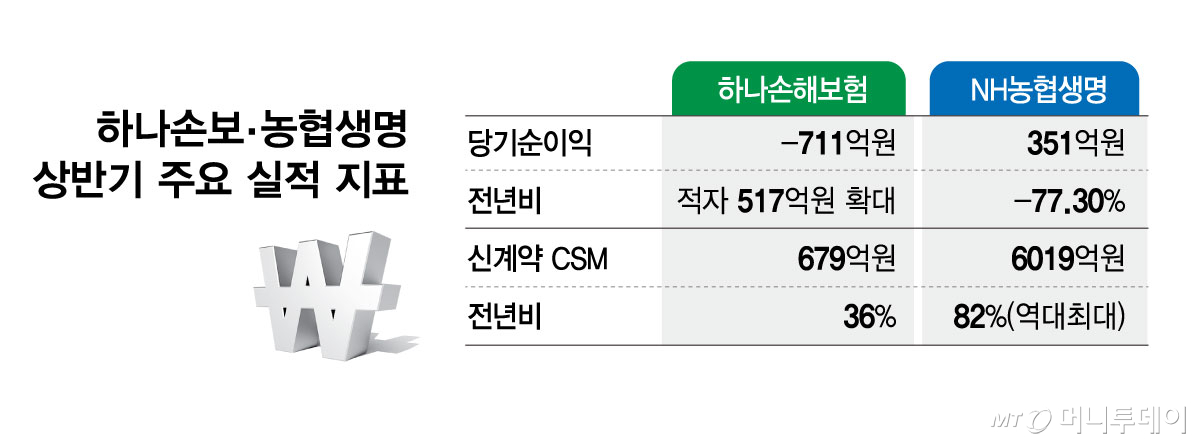
According to the insurance industry on the 30th, Hana Insurance recorded a net loss of 71.1 billion won for the first half of this year, an increase in the deficit of 51.7 billion won compared to last year. Notably, the impact of regulatory changes accounted for approximately 50.5 billion won of Hana Insurance’s first-half results. NH Nonghyup Life also saw its net profit for the first half fall to 35.1 billion won, a 77.3% decline year-on-year.
Notably, both companies experienced declining profits despite significant growth in new contract customer service margins (CSM). Hana Insurance’s new contract CSM rose by 36% year-on-year to 67.9 billion won in the first half, while NH Nonghyup Life achieved its highest-ever performance with a new contract CSM of 601.9 billion won, up 82.2% from the same period last year. This indicates that although their products sold well, they failed to generate corresponding profits.
Hana Insurance and NH Nonghyup Life are understood to have been most affected by strengthened actuarial assumptions starting this year as they expanded their product portfolios. The financial authorities have further reinforced realistic actuarial assumptions and the calculation standards for long-term insurance loss ratios since the first half of this year. In particular, for new coverage accumulated within five years, a conservative loss ratio (90%) or the actual loss ratio—whichever is higher—is applied.
Consequently, analyses suggest that the strengthening of actuarial assumptions has led to reverse growth for insurers with high proportions of new coverage or those that pursued aggressive sales strategies. Hana Insurance, for instance, holds a high proportion of new coverage, with policies issued within two years accounting for more than half of its total products. NH Nonghyup Life has aggressively marketed enhanced caregiving and dementia coverage since last year, and due to its high share of long-term insurance, it was reportedly more significantly impacted by conservative loss ratio assumptions.
A Hana Insurance official stated, “All insurers were likely affected by the conservative actuarial assumption guidelines overall. However, in Hana Insurance’s case, the relatively high proportion of new coverage made the impact particularly evident in performance.”
In contrast, KB Financial Group’s KB Insurance and KB Life, as well as Shinhan Financial Group’s Shinhan Life, saw net profits decline even as new contract CSMs increased; however, their application of relatively conservative actuarial assumptions resulted in a smaller impact. Dongyang Life, part of Woori Financial Group, also applied conservative actuarial assumptions since the end of last year, recording a first-half net profit of 91.9 billion won, up 11.5% from the same period last year. However, ABL Life, another Woori Financial affiliate, saw its first-half net profit halve year-on-year to 16.7 billion won due to the impact of actuarial assumptions on long-term insurance products.
The insurance industry expects that the impact of realistic actuarial assumptions will become even more pronounced in upcoming earnings announcements by major insurers next month. In particular, companies that aggressively applied lapse rates for non-lapse health insurance are raising concerns that their CSM reductions could be relatively large as lapse rate assumptions have been adjusted conservatively.
An industry official remarked, “As expected, the results turned out poorly for companies with high proportions of new coverage. However, while performance appears worse due to realistic actuarial assumptions, since these factors are already reflected in the results, improvements are expected next time.”

 in FINANCE
