

Following a record-high performance by Samsung Electronics' Memory business unit, the company is also transforming its business structure through the expansion of long-term supply agreements (LTA). By introducing contracts lasting five years or more and setting price floors, it has enhanced earnings stability. The foundry (semiconductor contract manufacturing), previously considered a weak link, is now raising expectations for recovery with increased orders and improved utilization rates.
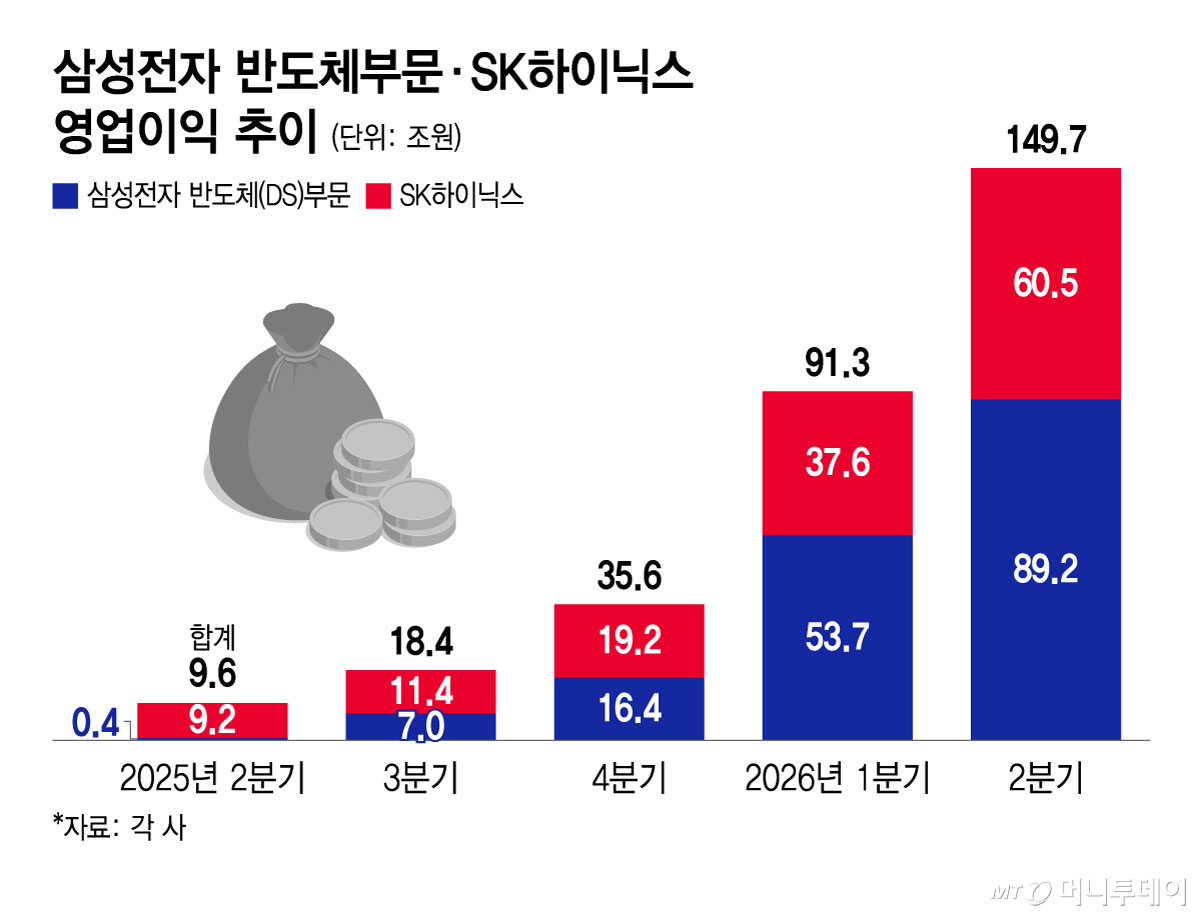
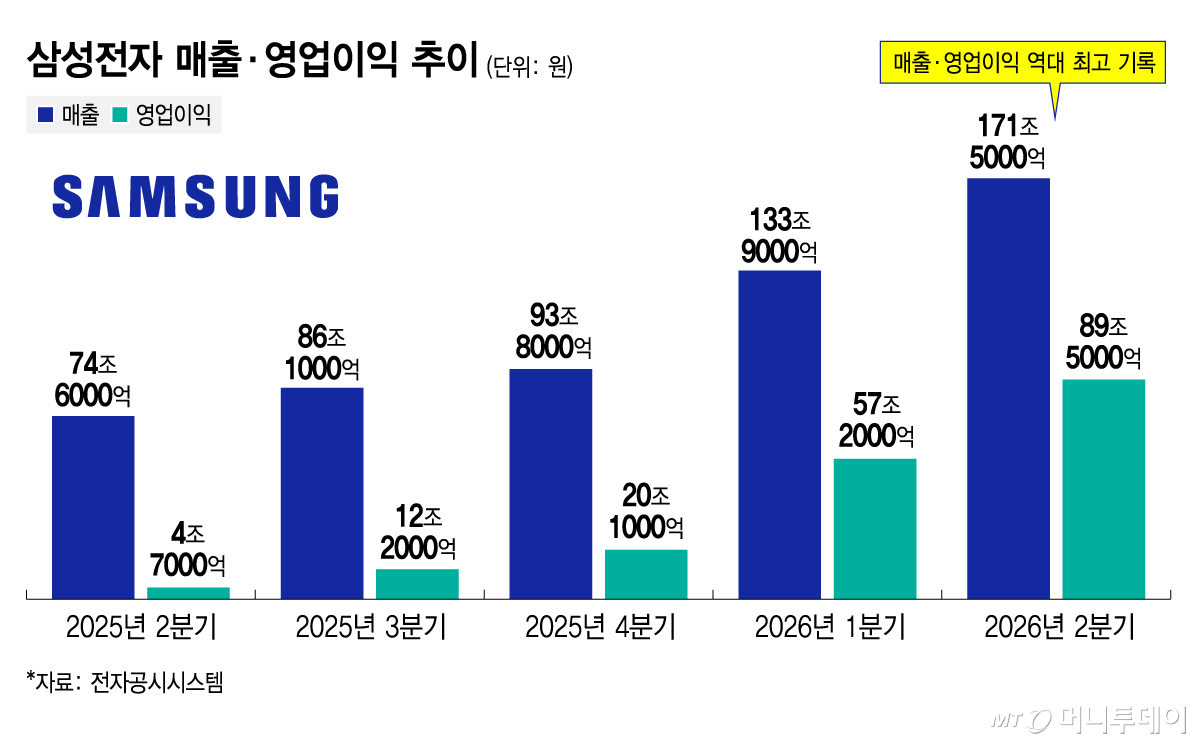
On the 30th, Samsung Electronics announced that its DS (Device Solutions) division's operating profit reached 89.2 trillion won in the second quarter this year, a 66.1% increase from the previous quarter. This means the DS division accounted for the majority of Samsung Electronics' total operating profit (89.5 trillion won). During the same period, DS division revenue increased by 56.1% to 127.5 trillion won.
The performance was led by the Memory business unit. Revenue reached 120.8 trillion won, accounting for approximately 95% of total DS division revenue. This shattered the record-high quarterly performance set in the first quarter just three months prior. Both DRAM and NAND flash (hereinafter "NAND") achieved record-high bit sales centered on products for AI servers, further boosted by price increases. The second-quarter average selling price (ASP) rose by mid-40% for DRAM and late-60% for NAND compared to the previous quarter.
Due to Samsung Electronics' record performance and receipt of advance payments from long-term contracts, its cash and cash equivalents as of the end of the second quarter reached 167.59 trillion won. Although it invested a record-high 16 trillion won in research and development during the second quarter, cash and cash equivalents increased by 48.35 trillion won within three months.
With the spread of agentic AI, token usage is surging, prompting not only hyperscalers but also neoclouds specialized in AI infrastructure and server manufacturers to join the race to secure memory semiconductors (hereinafter "memory"). Considering that it takes more than three years and six months from new fab (factory) construction to wafer production, the shortage of memory is expected to continue until 2028.
Vice President Kim Jae-jun, head of the Memory Strategy Marketing Division, stated, "Considering current customer demand, this year's demand is being pushed into next year, leading to additional supply burdens," and predicted, "Next year will see even more severe shortages than this year."
The surge in AI infrastructure demand and constraints on production capacity are also changing the transaction structure of the memory industry. Long-term order structures similar to those in the shipbuilding, defense, and energy industries are being introduced into the memory business, which previously repeated booms and busts according to smartphone and PC demand. This approach involves pre-determining supply volumes with customers for several years and proceeding with investments and production accordingly, thereby reducing earnings volatility.
Samsung Electronics has already signed LTAs with five major global data center operators including Amazon, Google, and Microsoft, and negotiations with five large customers related to AI are in the final stages. LTA volumes are expected to account for 60% to 70% of memory production capacity. The company decided not to tie up all production capacity with specific customers but to reserve spare capacity to respond to short-term demand and new customers.
Contracts are based on a five-year term, renewed annually through negotiations in a "rolling" manner that extends the contract period by one year each year. To enhance contract fulfillment, Samsung Electronics also included advance payments of an escrow nature as a condition. About one-quarter of the total advance payments have already been received. For general-purpose memory contracts, price floors were also set to reduce investment risks even if market prices fall.
By securing confirmed customer demand through LTAs, cleanroom and equipment investments can be executed gradually, reducing the risk of over-investment. Vice President Kim stated, "Large customers who need to secure large-scale AI service infrastructure are continuing to request multi-year supply contracts," and added, "We are negotiating contracts centered on customers who can guarantee definite future demand."
While memory is driving performance, signs of recovery are also emerging in the foundry business. In the second quarter, revenue and utilization rates rose together as demand increased for base dies (the bottommost layer) used for HBM (high-bandwidth memory). The company explained that results improved significantly before reflecting provisions.
Orders for advanced process nodes are also increasing. Samsung Electronics has secured 2-nanometer (nm·one-billionth of a meter) projects from major cloud service providers (CSPs) and AI/HPC (high-performance computing) customers. Recently, Samsung Electronics announced plans to pursue strategic cooperation with Broadcom in the memory and foundry sectors worth more than 200 billion dollars through 2030.
Vice President Kang Seok-chae, head of the Foundry Strategy Marketing Division, said, "The 2-nanometer order task this year will expand more than twice compared to last year," and added, "Currently, the pace of expanding advanced process production capacity cannot keep up with demand growth."
To respond to advanced process demand, Samsung Electronics will begin construction of its Taylor Plant No. 2 (Fab 2) in the U.S. by the end of this year. The goal is Yangsan by 2030. Taylor Plant No. 1 is scheduled to start operations by the end of this year and gradually expand 2-nanometer production capacity. Additionally, with increased inquiries for 1.4-nanometer customers, securing additional production space is also under review. For existing mature process lines, the company plans to restructure them into high-margin advanced processes.
Most importantly, utilization rates are improving across all processes. In processes of 8 nanometers and below, factory utilization rates have reached maximum levels. Yield, which is key to foundry profitability, is also rising. Samsung Foundry plans to fully operate its second-generation process in the second half of the year based on experience from the first-generation 2-nanometer process at Yangsan.
Vice President Kang stated, "The combined effects of improved foundry utilization rates and profitability, along with price increases, are at play," and expressed confidence by saying, "While it is difficult to pinpoint an exact timing for turning profitable due to the nature of the order-based industry, it should be possible in the near future."

 in INDUSTRY


