

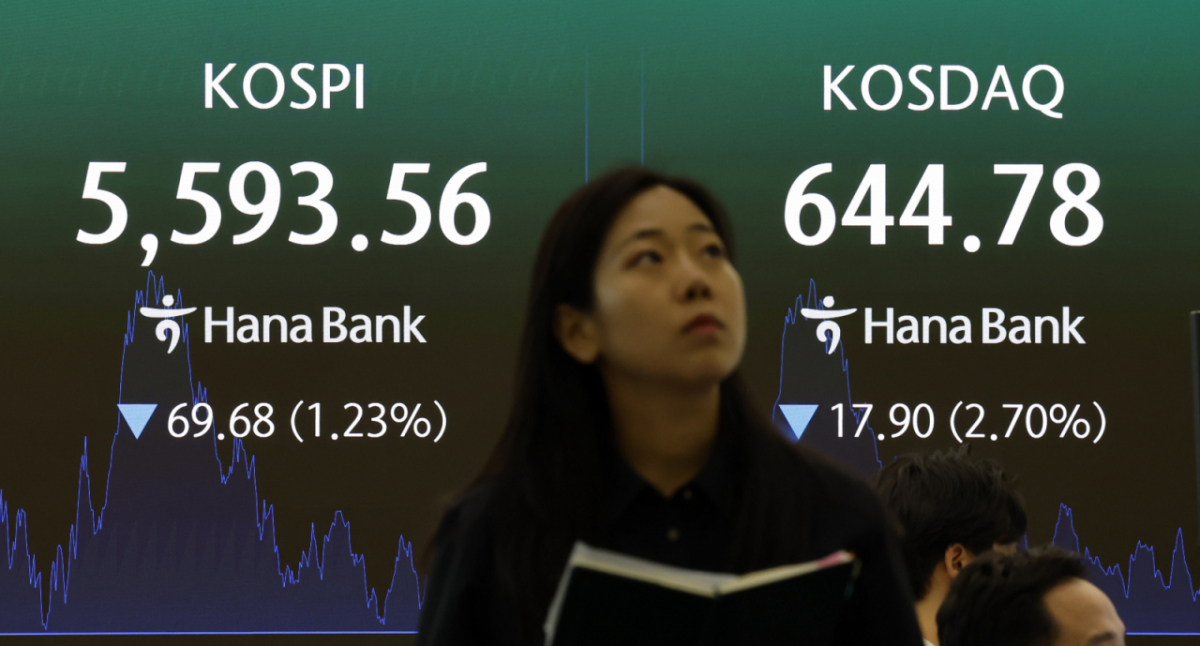
As the delisting reform aimed at removing weak companies from the domestic market enters its first month, the number of listed firms facing delisting risks due to falling below the minimum market capitalization threshold has risen to 208. This marks an increase of five firms in just one month, suggesting that the recent sharp decline across both KOSPI and KOSDAQ markets has expanded the risk zone.
According to data released by Korea Exchange on the 30th, a total of 208 stocks fell below the minimum market capitalization threshold (KOSPI: 30 billion won; KOSDAQ: 20 billion won) for ordinary shares as of that day, representing an increase of five firms (2.5%) compared to the end of the previous month.
In the KOSPI market, 47 stocks (a 2.2% increase from the prior month) failed to meet the market capitalization standard, while in the KOSDAQ market, 161 stocks (a 2.6% increase) fell short. Newly added firms at risk of delisting include Chai Communication, Daedong Metal, Rynix, Seehwa P&C, and Sigetronics. Monaime, a key figure in this month's "patriotic buying" frenzy, also saw its market capitalization drop to 27.4 billion won, leaving it among the non-compliant firms.
Concerns over delisting began intensifying in February when the Financial Services Commission announced an accelerated plan for stock market advancement, stating that minimum price and market capitalization thresholds would take effect starting this month. Unlike "dongJeonju" stocks (those trading below 1,000 won per share), which could avoid delisting through reverse stock splits, the market capitalization threshold was seen as a more difficult hurdle to overcome without substantial corporate valuation support from the Bank of Korea.
Even firms that barely managed to stay above the minimum threshold are walking on thin ice. Financial authorities plan to raise the market capitalization thresholds again next January to 50 billion won for KOSPI and 30 billion won for KOSDAQ, representing increases of 66.7% and 50.0%, respectively, compared to current levels.
Stocks that fall below the minimum threshold for 30 consecutive trading days will be designated as "management target stocks." If they fail to meet the threshold for at least 45 out of the following 90 trading days, they will proceed through delisting procedures. Korea Exchange, which has already disclosed a list of "stocks at risk of management designation" this month, plans to officially begin designating market capitalization-based management target stocks starting next month.
Potential self-help measures against delisting risks include rights offerings (paid-in capital increases) and mergers between listed affiliated companies. In practice, WinHiTech conducted a third-party share allocation, while Hyux and Hyux Holdings have pursued merger plans. However, depending on market assessments, market capitalization could decline again, leaving ultra-small-cap stocks in a state of persistent anxiety.
Experts in the securities industry are closely watching the moves of ultra-small-cap firms standing at the crossroads of delisting. They argue that rapid improvements in corporate governance could serve as a positive momentum driver. However, it was noted that there is a risk that major shareholders might choose delisting for reasons such as inheritance, posing investment risks.
Eom Soo-jin, a researcher at Hanwha Investment & Securities, stated, "If signs are detected indicating that a company is extremely passive in returning value to shareholders despite having sufficient financial resources, transferring wealth to affiliated companies while eroding its own corporate valuation, creating overhang burdens that plant seeds for stock price declines, or even distorting performance and financial health to appear worse than reality and dragging down the stock price, then such firms would not be suitable investment targets."
Researcher Eom added, "Companies that intentionally maintained or induced undervaluation or sought delisting have found it easier and more natural to exit the listed market under the raised market capitalization standards and newly introduced dongJeonju requirements compared to before."

 in STOCK
