

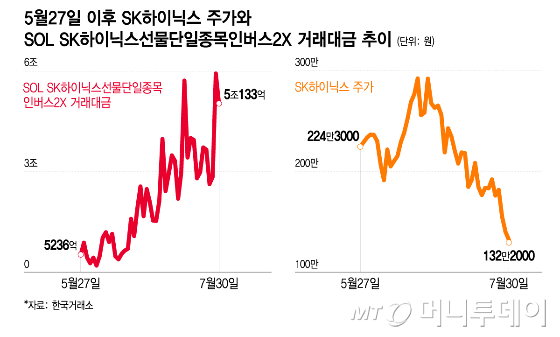
On the 30th, trading volume for a single SK Hynix leveraged inverse ETF (exchange-traded fund) exceeded 5 trillion won. As volatility in semiconductor leaders such as Samsung Electronics and SK Hynix has increased, investors are seeking 'leveraged inverse ETF (inverse 2x)' products. The KOSPI also fell by 34% over the past month, drawing trading volume into index leveraged inverse ETFs as well.
Attention is also focused on whether the overheating will subside once the financial authorities' regulatory measures take effect on the 31st. In the securities industry, opinions are emerging that while raising the entry threshold may reduce trading demand, long-term countermeasures are also necessary.
According to Korea Exchange, trading volume for 'SOL SK Hynix Futures Single-Stock Inverse 2X' on this day was recorded at 5 trillion 13.3 billion won. This is the third-largest trading volume since its listing on May 27. The top spot was held by yesterday's record of 5 trillion 903.2 billion won. All positions from first to 17th in trading volume for this product were occupied in July. Although trading volume did not exceed 2 trillion won until the 2nd of this month following its listing, SK Hynix stock price fell by 15%, causing trading volume to break through 3 trillion won for the first time on the 3rd.
Samsung Electronics leveraged inverse ETFs also show a similar trend. On this day, trading volume for 'PLUS Samsung Electronics Futures Single-Stock Inverse 2X' was calculated at 491.1 billion won. This is the fourth-largest trading volume since listing, with July occupying seven of the top 10 positions.
The active trading of these leveraged inverse ETFs was influenced by stock price volatility in Samsung Electronics and SK Hynix. Since the beginning of this month, Samsung Electronics and SK Hynix have fallen by 38% and 50%, respectively. The KOSPI index also fell by 34%, recording its highest monthly decline rate ever. Trading volume for 'KODEX 200 Futures Inverse 2X', which tracks KOSPI 200 futures, was recorded at 2 trillion 82.7 billion won on this day and 2 trillion 385.5 billion won the previous day. These figures rank seventh and third in trading volume over the past year, respectively.
Kwon Min-kyung, a research fellow at the Korea Capital Market Institute, stated, "As stock price volatility of the underlying assets, Samsung Electronics and SK Hynix, has increased, short-term trading demand appears to have grown." She added, "There are only 14 single-stock leveraged ETFs, but there is only one leveraged inverse ETF for each, which also contributed to the concentration of trading demand."
The problem is that this surge in trading can lead to a vicious cycle that further increases volatility in the underlying assets. If investors hold single-stock leveraged inverse ETFs for more than one day rather than buying and selling on the same day, it has the same effect as selling stocks at twice the volume, thereby pulling down the price of the underlying assets. Han Ji-young, a researcher at Kiwoom Securities, commented on the unprecedented activation of circuit breakers for two consecutive trading days in the KOSPI market yesterday, stating, "The explosion of single-stock inverse trading is also contributing to increased output of secondary volatility."
As such, attention is focused on whether trading will stabilize with the implementation of the financial authorities' regulatory measures on the 31st, which raise the basic deposit requirement to 30 million won. Although trading volume for single-stock leveraged ETFs has decreased since the beginning of this month, overall ETF trading volume has also declined, resulting in little change in their share. On the 1st, single-stock leveraged ETFs accounted for about 36% of total ETF trading volume, but on this day, it only dropped by one percentage point to 35%.
As a second supplementary measure on this day, restrictions such as limiting individual investment limits to 20% were also announced. Researcher Kwon stated, "This plan imposes numerical limits and raises the entry threshold," adding, "It is expected to be an effective measure as short-term trading and demand for holdings exceeding one day will decrease significantly more than now."
Opinions have also emerged calling for long-term alternatives. Yang Ji-hwan, head of the Research Center at Daishin Securities, said, "It is necessary to review measures such as alleviating concentration in underlying assets, re-examining leverage multipliers and product design, and establishing mechanisms to reduce market impact from rebalancing trades when volatility spikes." He further judged that "expanding volatility hinders new entry by long-term funds such as institutional investors and foreign investors, weakening the overall market's strength, so institutional improvements will yield significant benefits."

 in STOCK
