

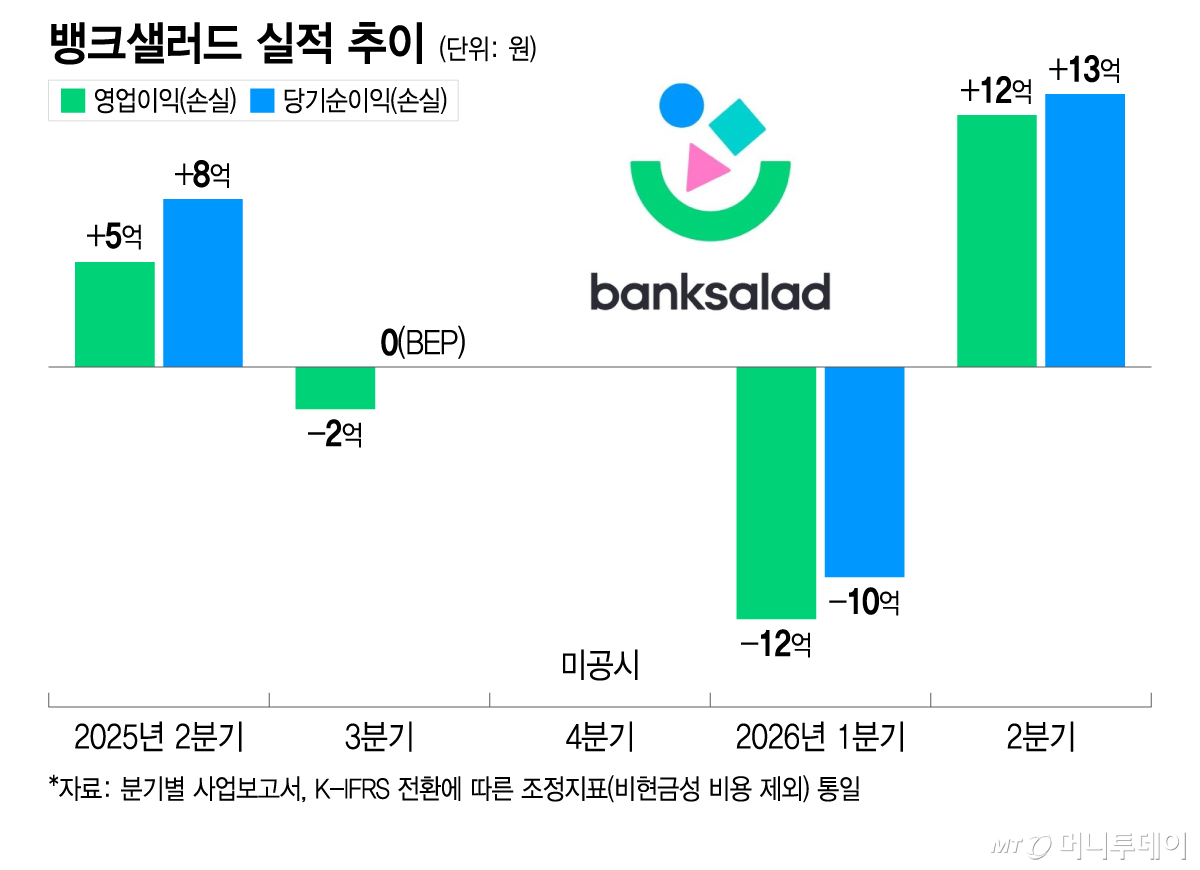
Fintech company Bank Salado reported a net profit for the second quarter of this year based on its separate financial statements. This marks the first quarterly profit since the accounting standard change. While it recorded a loss based on consolidated figures that include investment costs in its GA (insurance agency) subsidiary, the company plans to use AI (artificial intelligence) to bring forward the break-even point.
According to Bank Salado's semi-annual report released on the 26th, revenue for the second quarter based on separate financial statements was 7.6 billion won, representing a 17% growth compared to the previous quarter (6.5 billion won). The company's annual revenue reached 26 billion won last year and continues to trend upward this year.
Net profit for the second quarter was 330 million won, while net profit excluding non-cash costs such as stock-based compensation was approximately 1.3 billion won.
Bank Salado, which is preparing for an IPO, changed its accounting standards to K-IFRS starting from last year's business report. This quarterly profit is the first since the accounting standard change. Prior to the accounting standard change, the company recorded its first net profit in the second quarter of last year.
The company explained that the strong performance was driven by launching new financial services this year such as 'interest rate cut request right', 'interest reduction solution', and 'find the card that fits me best', thereby strengthening its competitiveness as a platform.
However, based on consolidated financial statements including the results of GA subsidiary 'Bank Salado Financial Services', the company recorded a loss of approximately 1.8 billion won for the second quarter. Bank Salado established the GA subsidiary last year to complete its core insurance analysis service and has begun full-scale business preparation this year.
Bank Salado Financial Services aims to be an 'AI-native' organization. Accordingly, parent company Bank Salado invested in Bank Salado Financial Services during the first half of this year for AI OS (operating system) and infrastructure construction. The company explained that the second quarter consolidated net loss was a temporary situation reflecting investment costs to build an AI-native structure.
As it is still in the initial investment stage, it is expected to take some time for Bank Salado Financial Services to become profitable. In fact, it takes about two years from when GA starts operations until reaching the break-even point. Toss's GA subsidiary, Toss Insurance, was established in 2018 and conducted business centered on TM (telemarketing). When it switched to face-to-face sales starting in 2022, it recorded its first annual profit in 2024.
Bank Salado Financial Services plans to significantly improve per-capita work efficiency based on AI. According to Bank Salado, as a result of operating an internship program involving new agents, the monthly initial premium per person reached 800,000 won, and the utilization rate—the proportion of counseling staff who secured at least one contract per month—reached 100%.
A Bank Salado official stated, "It seems we will need to invest in subsidiary infrastructure costs this year," but also added, "Performance indicators are showing good results when utilizing AI, so we expect to bring forward the break-even point compared to other GAs."

 in FINANCE
