

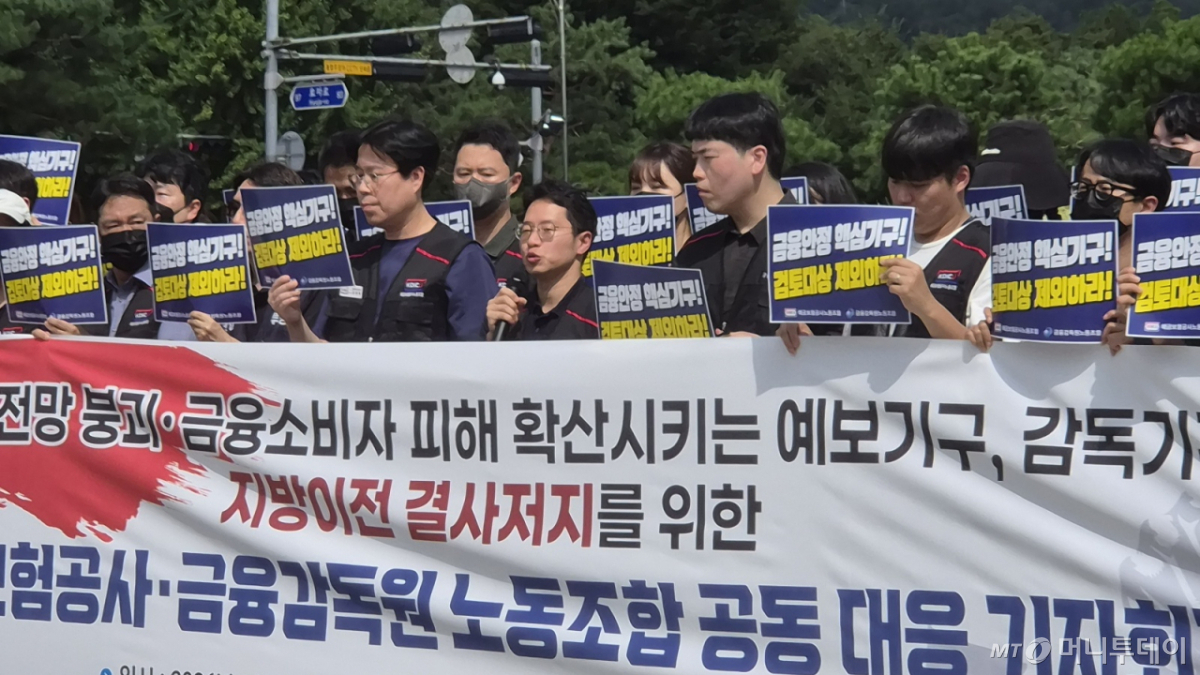
The Financial Supervisory Service union and the Korea Deposit Insurance Corporation union have jointly opposed the push to relocate institutional investors to local areas. They argue that since financial companies and related infrastructure are concentrated in the Seoul metropolitan area, relocating regulatory and supervisory agencies to local regions could delay responses to financial crises and lead to a loss of specialized personnel, thereby increasing harm to financial consumers.
On the morning of the 24th, the Financial Supervisory Service union held a joint press conference with the KDIC union in front of Cheong Wa Dae Sarangchae in Jongno-gu, Seoul, and delivered an opinion paper to the Office of the President's Chief of Staff for Policy Coordination, requesting that the review of relocating regulatory and supervisory agencies be halted and that these agencies be completely excluded from the list of relocation targets.
While both unions agree with the policy intent of balanced national development, they argue that the Financial Supervisory Service and KDIC must be approached differently from other public institutional investors in terms of financial stability and consumer protection. They explained that not only are the headquarters of financial companies—subject to inspection by the Financial Supervisory Service and protected by KDIC—concentrated in the Seoul metropolitan area, but so too are related financial infrastructure such as law firms, accounting firms, and IT specialized institutional investors.
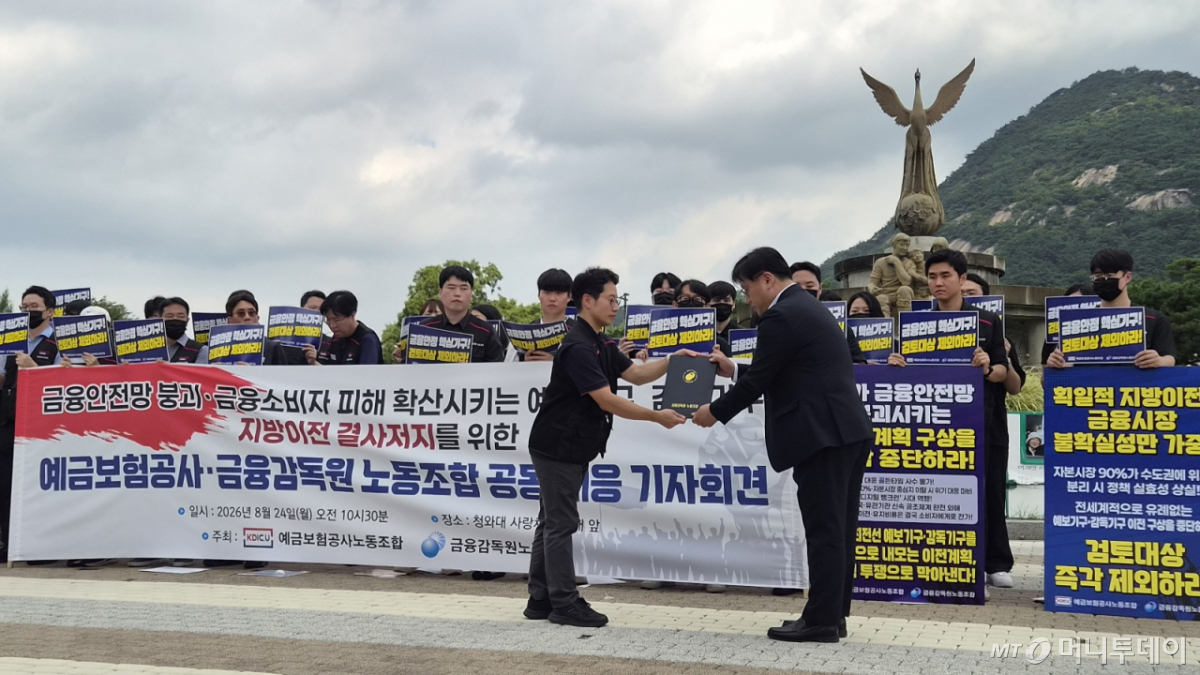
Kim Sang-woo of the Financial Supervisory Service Noh Jo-wi (Director) said on this day, "Just as shipyards must be located near the open sea and airports must be situated where air routes are accessible, all national core infrastructure must be placed at sites where their functions can operate effectively." He added, "While the goal of balanced national development is extremely important, stakeholders must engage in sufficient dialogue to reach a social consensus on how to approach this issue with equal importance."
Continuing, Kim (Chairman) stated, "As consultants and guardians of Korea's financial market, we take pride and feel a strong sense of mission. It is impossible for us to stand idly by as discussions on relocating the Financial Supervisory Service proceed, given that it is evident the financial industry will retreat and financial consumers will suffer."
Both unions pointed out that physical distance between institutional investors could also become an issue during financial crisis response. In their press release, they stated, "There is a golden time in responding to financial crises. The physical distance between institutional investors at moments of urgent crisis response means delays in decision-making, and such delays ultimately translate into losses for the people."
Concerns were also raised about the potential loss of specialized personnel due to relocation. According to union surveys, if relocation becomes a reality, only one out of every four employees indicated they would continue working there, while among frontline staff mostly in their 20s and 30s, only one out of ten expressed willingness to stay. They warned that if professionals such as accountants, lawyers, and auditors leave, the functions of supervision and deposit protection could be weakened.
Both unions requested that the government exclude the Financial Supervisory Service and KDIC from the second plan for relocating public institutional investors, and that an analysis be conducted on the costs, benefits, and impact of personnel loss resulting from the relocation of key financial safety net institutional investors, so that these findings can inform policy decisions.
The Financial Supervisory Service union will hold a rally to oppose relocation this afternoon from 2:00 p.m. to 2:40 p.m. in the second-floor auditorium of the Financial Supervisory Service building. Some members out of approximately 1,900 union members are expected to gather at the rally to reiterate their opposition to relocation.

 in FINANCE

