

The government and ruling party are considering a unanimous consent procedure by the Board Nomination Committee (Executive Candidate Recommendation Committee) within the board instead of limiting financial holding company chairpersons to three consecutive terms, as this approach may avoid constitutional controversies. There is no global precedent for legally capping the tenure of CEOs at financial institutions. However, if the independence of outside directors is not guaranteed, there remains a risk that Do Ri-eo (Chairman)'s prolonged tenure could be rationalized and misused as a tool. Accordingly, the government and ruling party are also considering expanding the National Pension Service's right to recommend outside directors, given its status as the largest shareholder in financial holding companies.
According to political sources on the 26th, the government and ruling party initially discussed prohibiting three consecutive terms for financial holding company chairpersons under the Financial Company Governance Act but shifted direction upon raising constitutional concerns. The core of the new proposal is that within the Board Nomination Committee composed of outside directors, re-election would require a 75% majority vote, while three-term re-election would demand unanimous (100%) consent before being submitted to the board and then to the shareholders' meeting as an agenda item.
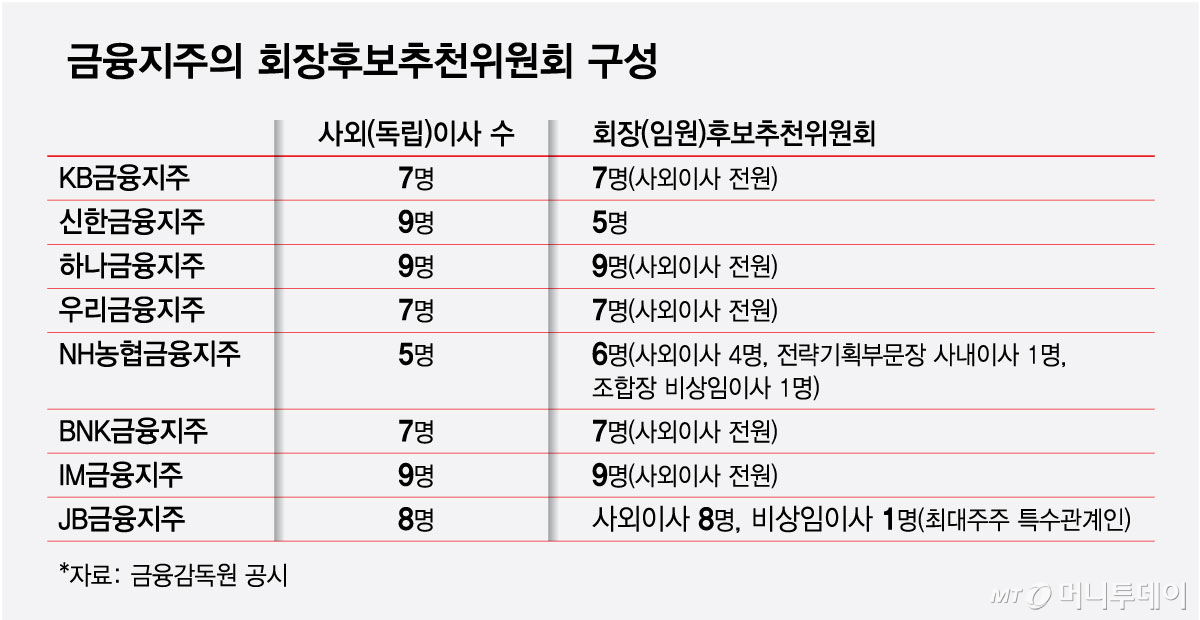
Board nomination committees for financial holding companies are mostly composed solely of outside directors. KB Financial Group (7 members), Hana Financial Group (9 members), Woori Financial Group (7 members), and BNK Financial Group (7 members) have all their outside directors participating in the committee, fully involved in CEO appointments. Shinhan Financial Group has 5 of its 9 outside directors as committee members, but when appointing a chairperson, it forms an 'expanded board nomination committee' where all outside directors effectively express their opinions. In the case of NH Nonghyup Financial Group, the committee consists of 4 outside directors, 1 inside director, and 1 non-executive director from the cooperative president's office, totaling 6 members.
If a unanimous consent procedure by the Board Nomination Committee is adopted instead of prohibiting three consecutive terms to prevent long-term tenure of financial holding company chairpersons, fewer than 10 outside directors could dictate Ji Ju (Chairman)'s term. This means a significant expansion of outside directors' authority.
The government and ruling party are reportedly discussing various measures to strengthen the authority of outside directors while also significantly enhancing their independence and accountability. One proposal under consideration is to record and transparently disclose the reasons for recommendations at each stage during the process of recommending candidates for Woo Seon (Chairman) or outside directors. Documenting who recommended a chairperson or outside director and on what grounds could partially resolve the issue of 'trench-building.'
Additionally, a new procedure may be introduced requiring the chairman of the Board Nomination Committee to publicly explain at the shareholders' meeting the reasons for individually recommending a candidate when submitting an agenda item for three-term re-election. Currently, there is no procedure for the committee to publicly explain the background of candidate selection at shareholders' meetings.
Especially to strengthen the independence of outside directors, the right of shareholders to recommend outside director candidates will be significantly enhanced. Currently, shareholders holding 0.1% of financial holding company shares have recommendation rights, but in practice, these are not accepted.
The National Pension Service, which has become the largest shareholder by holding 6-9% of financial holding company shares, is expected to see its outside director recommendation rights expanded. Financial authorities plan to issue a legal interpretation allowing the National Pension Service to actively exercise its recommendation rights. The content states that if the National Pension Service holds more than 5% of financial holding company shares for general investment purposes, exercising its recommendation rights will not be considered as management participation. This means the National Pension Service would not be subject to separate disclosure obligations (5%) or short-term trading profit recovery targets (10%), allowing it to exercise its outside director recommendation rights without burden.
A financial industry official stated, "It is practically unimaginable for a board of directors to reject an outside director recommended by the National Pension Service, which is the largest shareholder of financial holding companies." The official added, "If one outside director recommended by the National Pension Service casts a vote against Ban (CEO)'s three-term re-election, it would immediately block re-election. Therefore, introducing special resolutions for the Board Nomination Committee could achieve an effect similar to legally limiting three consecutive terms."
Meanwhile, discussions on amending the Financial Holding Company Governance Act have officially begun in the National Assembly. The National Assembly's Political Affairs Committee today considered a bill to amend the Financial Company Governance Act proposed by Democratic Party of Korea lawmakers Kim Hyun-jeong and Park Hong-bae. Following further discussions between the government and ruling party, plans for advancing financial company governance are expected to be announced as early as next month.

 in FINANCE

