

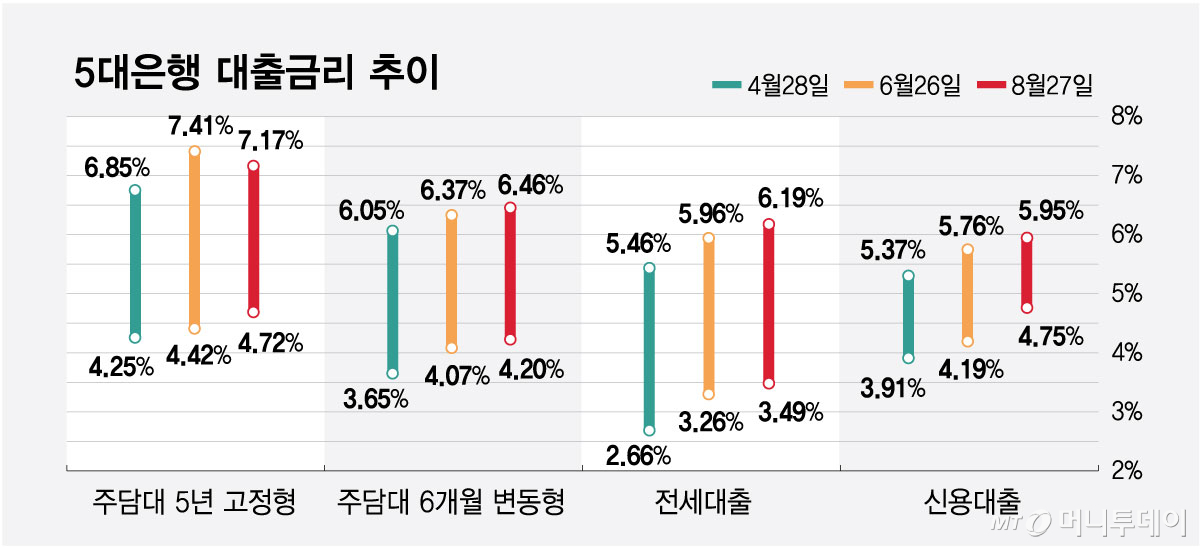
Bank loan interest rates are preparing to rise again. The upper limit of mortgage loan rates at the five major banks has already surpassed 7%, and credit loan rates are on the verge of entering the 6th% range.
According to financial sector data on the 27th, the 5th-year fixed-rate mortgage interest rates for KB Kookmin, Shinhan, Hana, Woori, and NH Agricultural Cooperative Bank were recorded at 4.72–7.17% as of that day. Compared to two months ago (4.42–7.41%), the lower end rose by 0.30 percentage points (P). The decline in the upper-end rate was due to Agricultural Cooperative Bank relaxing household loan restrictions on the 20th, which led it to reduce mortgage product rates by 0.4–0.5 percentage points.
With the Bank of Korea raising its base rate by 0.25 percentage points today, additional upward pressure is expected on loan interest rates. A bank official stated, "The combination of the base rate hike and rising market interest rates triggered by the U.S. makes it difficult for loan rates to drop significantly in the near term," adding, "There is also a possibility that the upper limit of mortgage rates could reach 8%."
The five-year bank bond yield, which serves as a benchmark for fixed-rate mortgages, has been trending upward recently due to movements in U.S. Treasury yields. Variable-rate mortgage rates may also rise further. Since the COPIC rate, which acts as a benchmark for variable-rate mortgages, is influenced by deposit rates, banks are likely to raise deposit rates simultaneously if the base rate increases.
Variable-rate mortgage loans at the top five banks reached 4.20–6.46% today, climbing into the mid-6% range. Compared to two months ago (4.07–6.37%), both the upper and lower ends rose by 0.09 percentage points and 0.13 percentage points, respectively. Notably, the share of variable-rate mortgages in new household loans from banks last month reached 68.1%, marking the highest level in about 12 years, suggesting borrowers will face increased interest burdens.
Credit loans are also on the verge of entering the 6th% range. The upper limit for credit loan rates at the top five banks has already risen to 5.95%. Credit loans have shorter adjustment cycles than mortgages, meaning market rate changes are reflected immediately.
Household loan management by banks is also a factor driving interest rate increases. Although financial authorities have relaxed this year's household loan volume control targets, banks must adjust their lending pace to meet annual goals. If loan demand surges, there is a possibility that rates will be managed by reducing preferential rates or increasing additional interest rates.

 in FINANCE
