

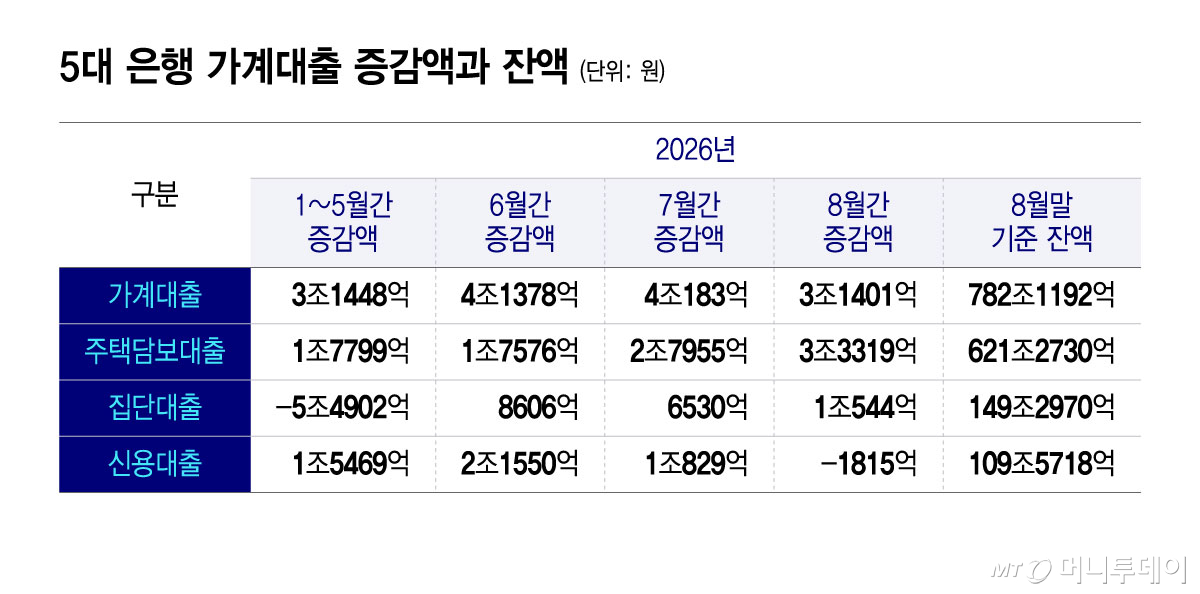
Residential Group loans for apartment at the five major banks increased by their largest margin in 23 months. This was influenced by the relaxation of total household loan limits by banks, aligning with an increase in housing delivery volumes in the Seoul metropolitan area during the second half of the year due to the impact of the the 13th real estate measures. In the first half of the year, personal credit loans driven by stock market investment demand had led the growth trend in household loans; however, since the second half, home mortgage loans centered on group loans have increased significantly. Demand for 'margin investing (investing with debt)' has declined, and funds are flowing back into bank time deposits, signaling a change in household fund flows.
According to financial sector data released on the 1st, as of the end of August, outstanding group loans at the five major banks (KB Kookmin Bank, Shinhan Bank, Hana Bank, Woori Bank, and NH NongHyup Bank) reached 149.297 trillion won, an increase of 1.0544 trillion won from the previous month's end. This marks the largest increase in 1 year and 11 months since a rise of 1.1771 trillion won in September 2024. Compared to the July increase of 653 billion won, the margin has widened by approximately 400 billion won.
Group loans are typically executed simultaneously for pre-contract buyers during new apartment sales and delivery processes, making them closely linked to new housing supply volumes. Outstanding group loans at the five major banks increased in September 2024 but then declined consecutively for 18 months from October 2024 through March 2026. This occurred because after the LegoLand crisis at the end of 2022, the real estate project financing market tightened, causing new housing projects to shrink and reducing the number of sites eligible for group loans.
The banking sector attributes the turnaround in group loan growth starting in April this year to an expansion in apartment delivery volumes in Seoul and the metropolitan area during the second half of the year. According to real estate platform Zigbang, apartment deliveries in Seoul during the second half are expected to reach 11,490 units, an 87% increase compared to the first half (6,151 units). Notably, high-end apartment complexes such as DH Bangbae and other Gangnam Three Districts projects have been included in significant numbers, further boosting loan volumes.
In particular, the the 13th measures influenced the expansion of group loan increases. With group loans excluded from household loan total management, banks gained room to expand funding supply focused on complexes scheduled for delivery in the second half. Complaints arose as pre-contract buyers who purchased apartments two to three years ago and were approaching delivery this year could not obtain balance payment loans due to tightened total management rules. In response, President Lee Jae-myung also called for an examination of the difficulties faced by actual homebuyers.
As group loans increased, outstanding home mortgage loans in August also rose by 3.3319 trillion won. This represents the largest increase in 12 months since August 2025 (3.7012 trillion won).
In contrast, personal credit loans have returned to a declining trend. Outstanding personal credit loans at the five major banks decreased by 181.5 billion won during August alone. This contrasts with the three consecutive months of trillion-won increases in May (2.1741 trillion won), June (2.1550 trillion won), and July (1.829 trillion won).
From May to July, personal credit loans led the growth trend in household loans. The banking sector believes that as funds flowed into the stock market, demand for 'margin investing (investing with debt)' drove an increase in personal credit loans. However, with the stock market plummeting since July, demand for overdraft accounts has sharply declined.
This change was also reflected in bank deposit trends. Outstanding time deposits at the five major banks as of the end of August reached 1,004.6645 trillion won, an increase of 19.7246 trillion won from the previous month's end. This marks the first time outstanding time deposits have exceeded 1,000 trillion won. It is interpreted that some funds previously heading to the stock market have returned to bank deposits.
A banking sector official stated, "Banks that gained flexibility due to the the 13th measures are expanding funding supply in line with group loan demand. While personal credit loans led household loan growth in the first half of the year, since the second half, home mortgage loans including group loans have been driving the increase."

 in FINANCE
