

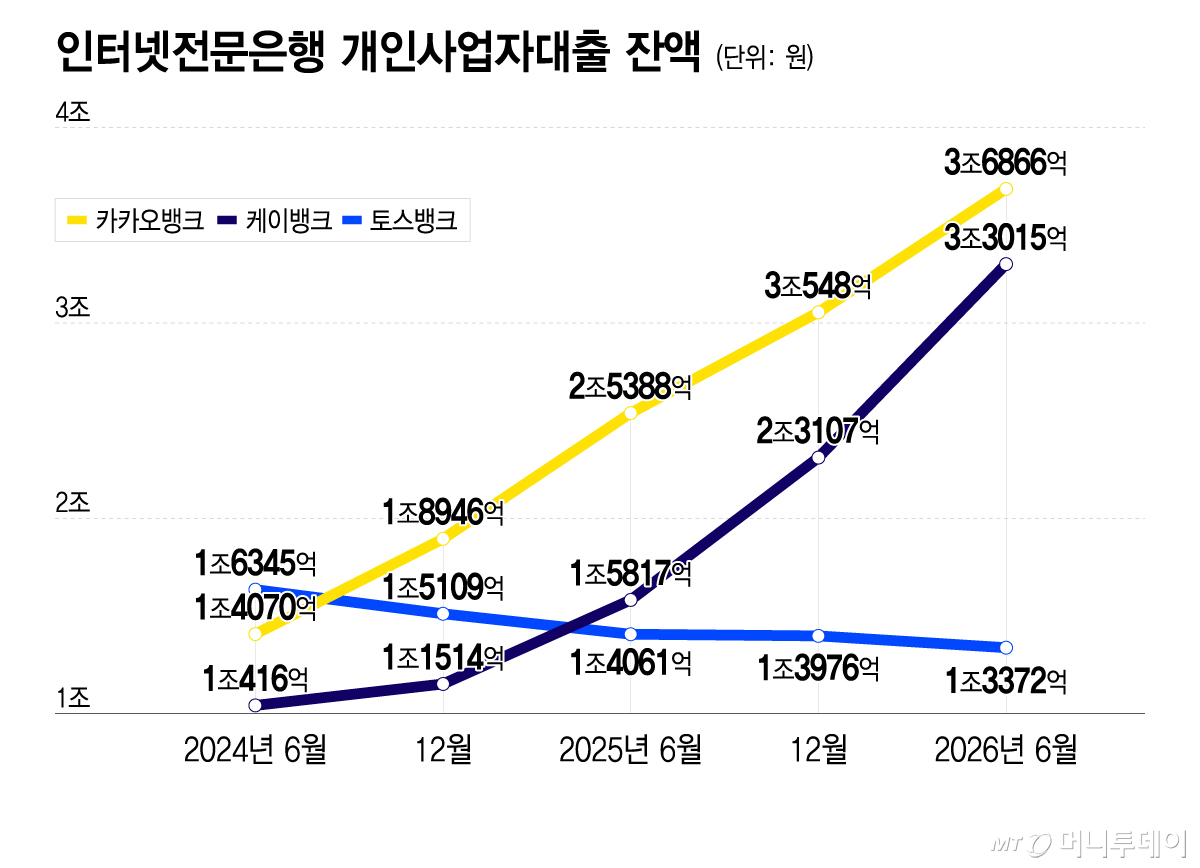
Three internet-only banks are pursuing divergent strategies in personal business loans. Toss Bank, the first to enter the business loan market, has reduced its outstanding balance and shifted focus to soundness management. In contrast, KakaoBank and K bank have overtaken Toss Bank by increasing their balances by 2.2 trillion won each over two years, centering on collateral loans.
According to financial industry data released on the 2nd, Toss Bank's business loan outstanding balance stood at 1.3372 trillion won as of the end of June, down 4.9% from the same period last year. Toss Bank, which launched business loans earliest among internet banks, had the largest balance among the three at 1.6345 trillion won in June 2024 alone. At that time, KakaoBank's balance was 1.407 trillion won and K bank's was 1.416 trillion won.
Toss Bank initiated management measures due to soundness indicators. As of the end of 2024, Toss Bank's corporate loan delinquency rate stood in the 3rd% range, a high level. Subsequently, as the bank reduced its balance, the delinquency rate also fell to the early 2% range, improving by 0.87 percentage points (P) within one year. At the same time, the non-performing loan (NPL) ratio improved by 0.57 percentage points from the same period last year to 1.78% as of June this year.
Meanwhile, KakaoBank and K bank are aggressively expanding their business loans. As of the end of June, KakaoBank's business loans increased 45.2% year-on-year to 3.5866 trillion won, while K bank recorded an 108.7% increase to 3.3015 trillion won. Both banks increased their balances by 2.2 trillion won each compared to two years ago.
The reason both banks were able to actively expand credit was the launch of collateral loans. K bank launched business real estate collateral loans in August 2024, and KakaoBank introduced a similar product in October 2025, the following year. Consequently, the proportion of collateral and guarantee loans within their business loan portfolios surged sharply. Collateral and guarantee loans accounted for 69% of KakaoBank's business loans, while K bank stood at 45%. Thanks to focusing on collateral loans, soundness indicators remain favorable. As of the end of June, KakaoBank's corporate loan delinquency rate improved by 0.07 percentage points from a year earlier, and K bank's improved by 0.42 percentage points.
Internet banks for which corporate lending has been challenging are expected to continue expanding business loans backed by collateral. K bank introduced a non-face-to-face switching service for business credit and collateral loans in March this year, and KakaoBank has also announced plans to launch the same service within the year.
It is also anticipated that Toss Bank will move into business-backed collateral loans as its next step once soundness management is completed. The bank currently does not offer a business collateral loan product. A Toss Bank official stated, "We are stably supporting self-employed individuals and plan to continuously expand our various product lines to broaden our support methods."
However, considering that the typical maturity period for business loans is one year, concerns are also raised that the sharply increased business loans this year could become a boomerang in the future. A financial industry official said, "There was a period two to three years ago when we significantly increased credit loans for self-employed individuals and had to increase loan loss provisions, so we are establishing safety measures." The official added, "However, there are limits to handling only collateral and guarantee loans for self-employed individuals. How much credit information data is utilized to execute loans will become a condition that widens the gap in terms of soundness and profitability."

 in FINANCE
