

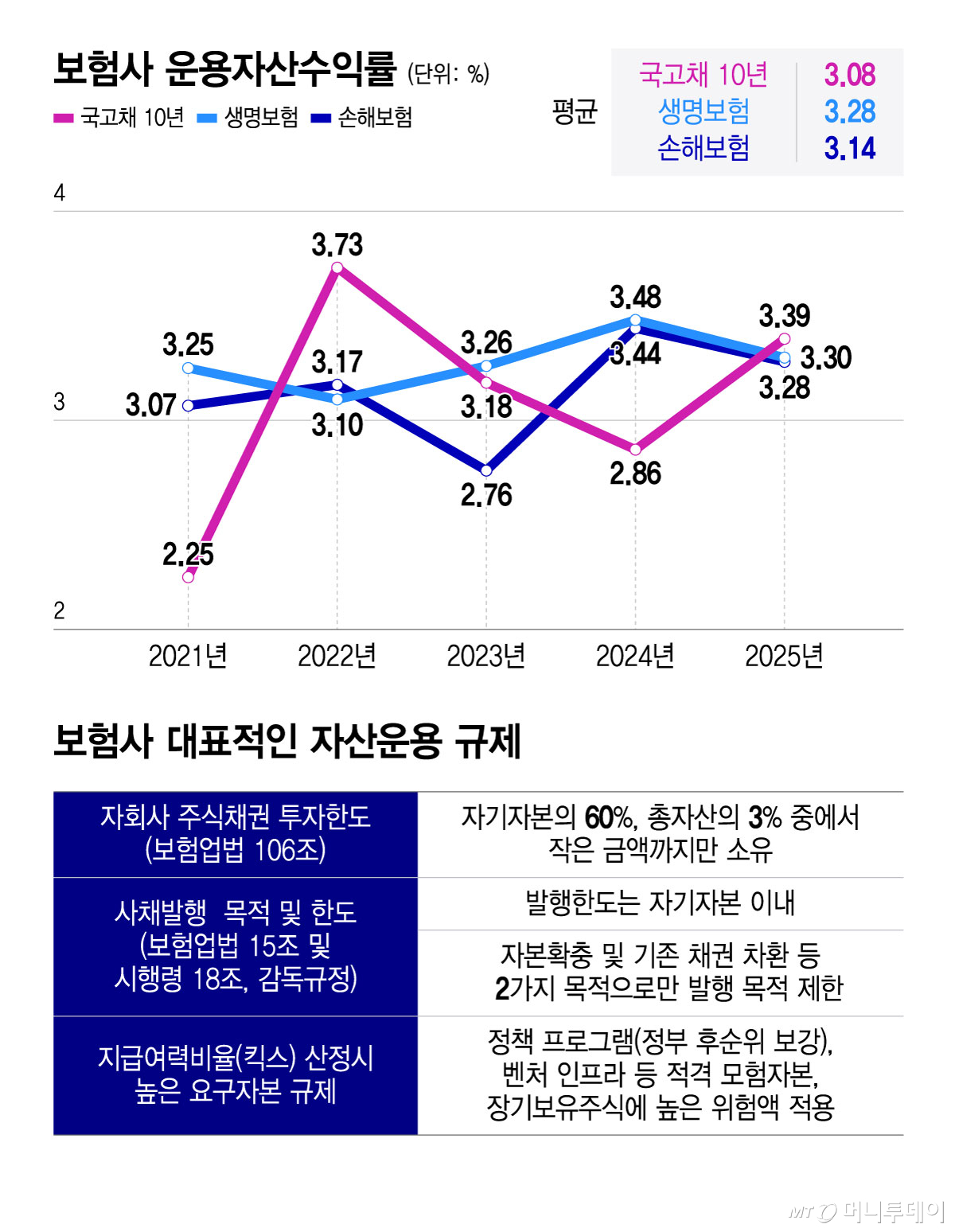
Financial authorities are reviewing insurance asset management regulations for the first time in 13 years. Insurers are major investors with over 1,000 trillion won in managed assets, yet they remain unable to escape low returns comparable to government bonds. Despite a buildup of financial company listings on the recent M&A market, insurers find it difficult to actively participate due to investment limit regulations. Criticism also arises that the fundamental reason Samsung Electronics could not finalize the timing for its share buyback despite announcing a 110 trillion won shareholder return policy lies in pre-emptive asset management regulations applied to its insurance group.
According to financial authorities and the insurance industry on the 2nd, the Financial Services Commission and the Financial Supervisory Service have received recent proposals from insurers for regulatory improvements and have begun work to rationalize asset management regulations aimed at boosting insurers' asset management returns and strengthening industry competitiveness. Priority items under review include investment limits on subsidiary stocks and bonds under Article 106 of the Insurance Business Act, as well as private bond issuance restrictions under Article 15 of the same law.
The investment limit for insurers' subsidiaries was introduced in 2003 during a comprehensive revision of the Insurance Business Act with the aim of protecting policyholders. It requires insurers to hold no more than the smaller of 60% of their own capital or 3% of total assets in bonds or stocks issued by subsidiaries in which they hold over 15% equity. The problem is that while insurer own capital has increased by over 40% over the past 13 years, total assets have grown only around 16%. With gross premiums stagnating and total assets remaining flat, most insurers are now subject to limits based on total assets rather than own capital.
Consequently, insurers are urging financial authorities to either exempt investment limits when acquiring insurance companies or other financial institutions, or to raise the "3% of total assets" threshold. In practice, investments in wholly-owned subsidiaries and overseas insurance subsidiaries are already excluded from investment limits. While exceptions are recognized abroad, domestic rules apply them, drawing criticism of "reverse discrimination."
Insurers find themselves unable to actively pursue equity investments, M&A, or the establishment of joint ventures despite having ample "ammunition" (capital). Last year, insurers participating in the bidding for Egi Asset Management were forced to submit low offers due to investment limit issues and ultimately failed. Insurance companies such as Yebal Fire & Marine Insurance, KDB Life Insurance, and Lotte Fire & Marine Insurance, which have been on the market for years, are being acquired by non-insurance financial institutions or are being discussed as potential acquirers.
Discussions are also underway to improve regulations on insurers' issuance of private bonds. Insurers may issue bonds only for two purposes: capital strengthening and refinancing existing bond maturities. The issuance limit is capped within their own capital. In contrast, banks, financial holding companies, and card issuers can issue bonds without restriction on purpose, up to 2 to 20 times their own capital.
Insurers also point out that capital regulations should be relaxed when investing in government or public institutional investor-backed policy programs, venture infrastructure, other forms of risk capital, or long-term equity holdings. Although managed assets have surpassed 1,000 trillion won, returns remain stuck at the low single-digit range (early to mid-3%) comparable to government bonds due to restrictions imposed by the K-ICS (Korean Insurance Capital Standard) solvency regulation.
There is also a need to shift asset management regulations from pre-emptive to post-event oversight. Not only does the subsidiary investment limit under the Insurance Business Act apply, but the Financial Industry Act (Act on Structural Improvement of the Financial Industry) — another representative example of post-event regulation — has directly impacted Samsung Life and Samsung Fire & Marine Insurance. Samsung Electronics recently announced a shareholder return plan worth 110 trillion won but could not finalize its share buyback plan. This is widely analyzed to be because the stake held by the insurance group in Samsung Electronics exceeds the limit (10%) set by the Financial Services and Securities Act.
A financial industry official stated, "Even though three years have passed since strengthened capital regulations such as K-ICS were introduced, pre-emptively restricting investments entirely is excessive compared to cases in Europe or the United States." The official added, "It is time to shift from a framework centered on pre-emptive regulation to one based on post-event regulation."

 in FINANCE
