

It is expected that regional Saemaeul Credit Cooperative members will find it easier to receive dividends in the near future. Once the Saemaeul Credit Cooperative Act is amended soon, regional credit cooperatives will be allowed to use their accumulated legally mandated reserves to cover deficits. If approximately 2.7 trillion won in cash is used for loss coverage, individual cooperatives can accelerate the resumption of dividends.
According to financial sector sources on the 3rd, the National Assembly’s Administration and Safety Committee held a plenary session on the 1st and passed an amendment bill to the Saemaeul Credit Cooperative Act. The bill allows regional Saemaeul Credit Cooperatives to use previously accumulated legally mandated reserves for loss coverage.
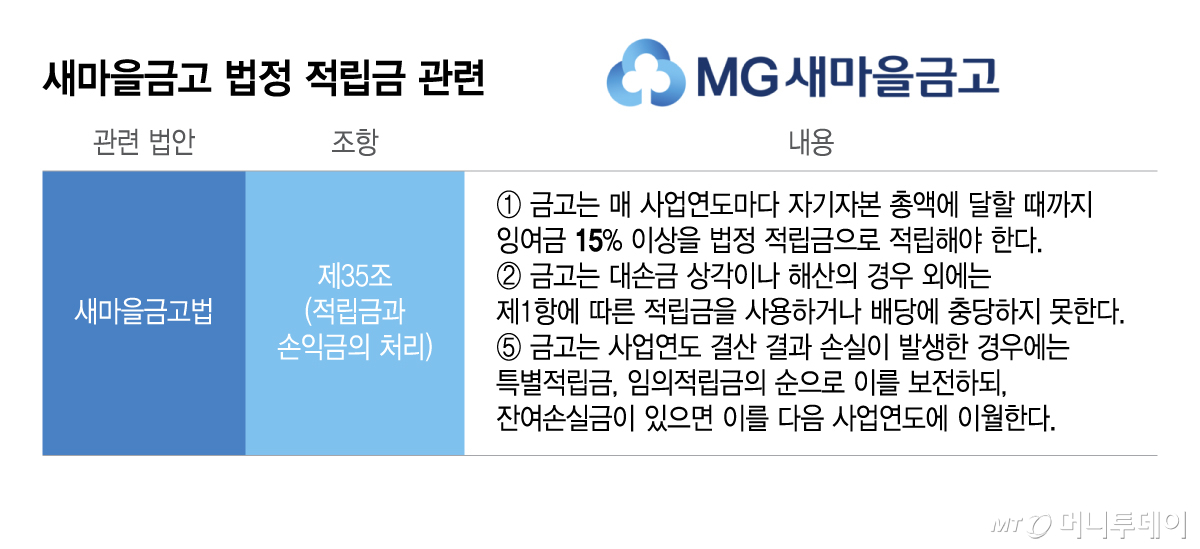
Under the current Saemaeul Credit Cooperative Act, each cooperative must accumulate at least 15% of its annual surplus as a legally mandated reserve. Accumulation continues until the total legally mandated reserve reaches the cooperative’s own capital as of the end of the previous fiscal year.
The problem is that these legally mandated reserves cannot be used except in cases such as writing off non-performing loans (NPLs) from the books or dissolving a credit cooperative. They cannot be used to cover deficits arising from a cooperative’s annual operating results. When a deficit occurs, it is first covered by special reserves and then by voluntary reserves; any remaining loss is carried forward to the next year.
The amount of legally mandated reserves held by regional credit cooperatives that remain unused stands at 2.7363 trillion won as of last year. In 2022, it was 2.2042 trillion won, an increase of over 500 billion won in just three years. Meanwhile, the number of cooperatives reporting deficits rose from 47 to 697 during the same period. Due to the current law, even as the number of deficit-incurring cooperatives increased, legally mandated reserves did not decrease but instead grew.
There is also an issue of fairness among mutual financial institutions. Other mutual financial institutions such as Nonghyup and Suhyup can use their legally mandated reserves for loss coverage. The Shinheung Credit Union (Shinhyup) was also permitted to do so after a law amendment in the relatively recent year of 2024. Among mutual financial institutions, only Saemaeul Credit Cooperatives are unable to cover deficits using legally mandated reserves.
Saemaeul Credit Cooperatives have suffered large-scale deficits in recent years due to failures in real estate project financing (project financing) and other issues. Regional credit cooperative members have not been receiving dividends well up until now. The high dividend rates that once reached around 7.0% are now a thing of the past.
If regional credit cooperatives use legally mandated reserves to cover losses, their capacity for dividends will expand. For example, if a cooperative incurred a deficit of 10 billion won this year and has only 6 billion won in special and voluntary reserves combined, it can use legally mandated reserves to handle the remaining 4 billion won loss. If that cooperative turns profitable the following year, it can then resume dividends.
There is also an indirect effect of improving the financial health of regional credit cooperatives. Once dividends are normalized, members’ withdrawal of their capital contributions can be prevented. Prolonged suspension of dividends may lead members to withdraw their funds, reducing the cooperative’s capital base.
The amendment bill that passed the Administration and Safety Committee is expected to proceed to a plenary session of the Legislation and Judiciary Committee before being submitted to the full National Assembly session. Given that there are not significant differences in opinion between the government and political parties, it may be passed at the plenary session scheduled for mid-month.
A Saemaeul Credit Cooperative official stated, “Once the amendment bill is passed, it will certainly help with capital strengthening and securing dividend capacity. It also has the merit of eliminating regulatory disparities among mutual financial institutions.”

 in FINANCE
