

Insurance managed assets enter the 10th quadrillion won era... Overseas expansion and productive finance become difficult under regulations
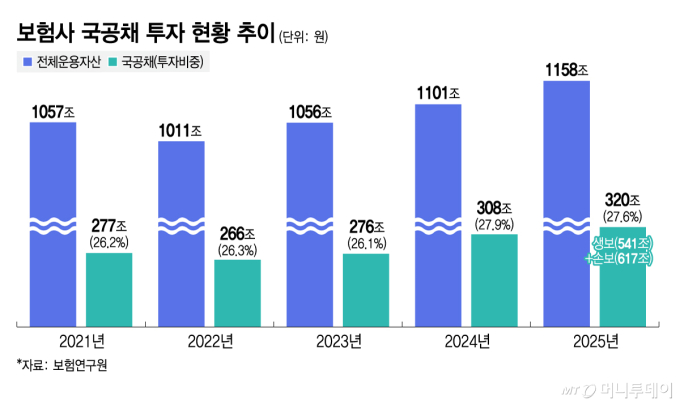
Although insurers manage assets exceeding 10 quadrillion won, they face difficulties in providing funds to growth industries and innovative companies through productive finance or in expanding overseas. Expanding investment destinations via the government-promoted productive finance or making equity investments in foreign financial institutions leads to deterioration of the solvency margin ratio (K-ICS) and additional capital burdens.
According to the insurance industry on the 2nd, total managed assets of all insurers reached 11.58 trillion won at the end of last year, an increase of 1.01 trillion won from 10.57 trillion won in 2021. During the same period, investments in government bonds increased by 430 billion won, accounting for 43% of the total increase in managed assets. The proportion of government bonds also expanded from 26% in 2021 to 28% in 2025.
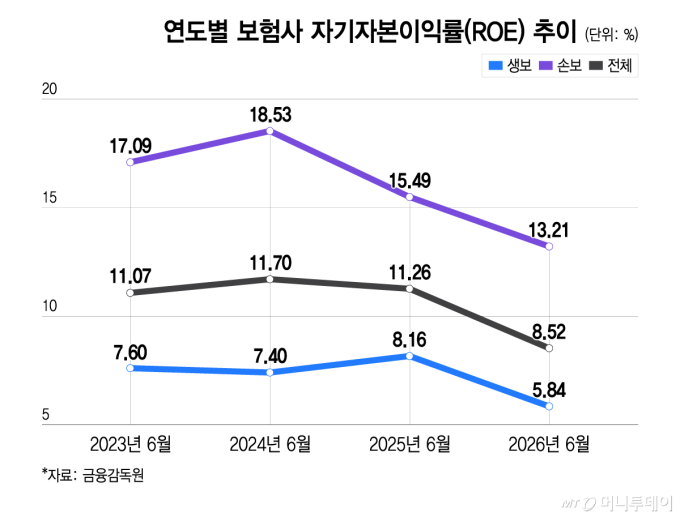
As insurers accumulate safe-haven assets like government bonds, profitability continues to decline. Looking at insurers' return on equity (ROE), it has fluctuated since the first half of 2023, falling below 10% to 8.52% in the first half of this year. In particular, life insurance companies saw their ROE drop to 5.84% in the first half of this year, while property and casualty insurers also fell to 13.21%. Although insurers' managed assets have grown to levels comparable to the National Pension Service, their ability to generate returns relative to capital is weakening. This is especially evident when compared with major overseas insurers' ROEs. At the end of last year, Allianz reported 18.1%, Aviva 17.5%, Chubb 15.0%, and MetLife 12.9%—far higher than domestic insurers.
While diversifying investment destinations into domestic and foreign stocks, venture capital, and infrastructure is necessary to improve profitability, this too is not easy. Since 2023, stricter K-ICS regulations on soundness indicators have triggered a chain reaction where expanding investments leads to increased capital burdens. In particular, direct or indirect equity investments in unlisted companies or projects are classified as "other stocks" under K-ICS, requiring insurers to bear high capital requirements.
Even when attempting to expand overseas beyond the saturated domestic market, capital burdens hold them back. DB Insurance acquired the U.S.-focused insurer Fortegra for approximately 2.3 trillion won last year, causing its K-ICS ratio to drop significantly. Just before acquiring Fortegra, DB Insurance's K-ICS was 232.1% in the first quarter of this year; after the acquisition, it fell to 204.3% in the second quarter—a decline of 27.8 percentage points (P). A drop of nearly 30 percentage points in K-ICS, which indicates payment capability for insurance claims, is unprecedented and inevitably places a heavy burden on the insurer.
Faced with capital burdens, DB Insurance was forced to improve its capital structure, including issuing 410 billion won worth of additional tier 1 capital securities in June. A DB Insurance official stated, "We understand that the issuance of additional tier 1 capital securities this year was undertaken to resolve capital burdens arising from overseas expansion."
Since various investments directly affect soundness indicators, insurers find it difficult to actively participate in government-led productive finance. According to a simulation by the Korea Insurance Research Institute assuming 24 trillion won in productive finance investments, K-ICS stood at 208% before investment but dropped to 196%, a 12 percentage point decline, due to increased capital requirements before profits were generated. This means the more actively insurers participate in government-promoted productive finance, the greater their capital burden becomes. This is why there are calls to lower equity risk amounts for policy programs or qualified venture investments and to relax regulations on long-term holdings and infrastructure investments.
Insurers argue that pathways should be opened for active investment in artificial intelligence (AI) and healthcare industries. An industry official stated, "We hope for more investment opportunities even in specific areas such as AI or healthcare," adding, "If insurers' profitability improves, it will ultimately lead to lower insurance premiums or expanded coverage for consumers."
Samsung Electronics' value-up program also blocked... The trap of pre-emptive insurance asset management regulations
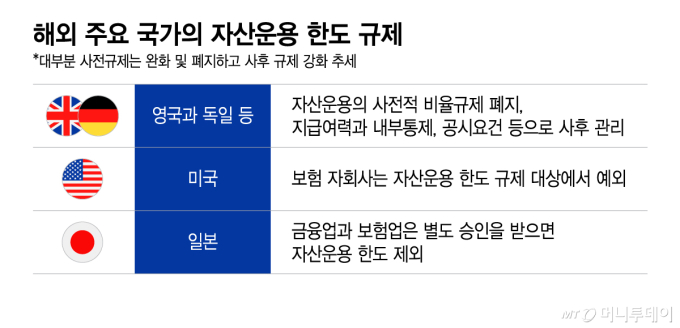
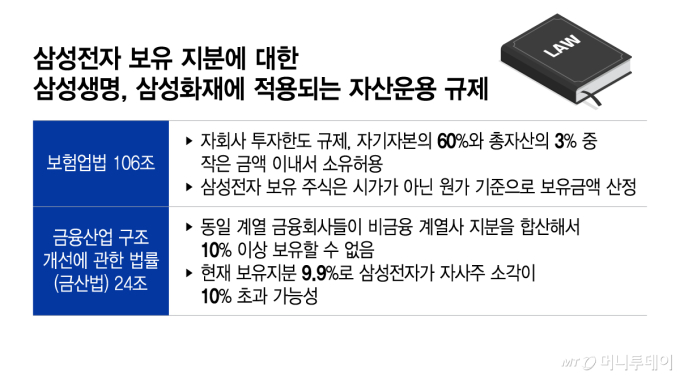
Criticism arises that pre-emptive asset management regulations, which essentially say "do not invest at all," fail to reflect changing times. Representative examples include the Insurance Business Act, which limits investments in insurance subsidiaries to 3% of total assets, and the Financial Services Act (Financial Industry Structure Improvement Act), which restricts financial group companies from holding more than 10% of shares in non-financial affiliates within the same group. These are "pre-emptive regulations" established in 2003 and 1997, respectively.
Strict pre-emptive regulations also act as a setback for Samsung Electronics' value-up program. Samsung Life and Samsung Fire & Marine Insurance currently hold up to the maximum limit (10.0%) permitted by the Financial Services Act in non-financial affiliates like Samsung Electronics. Although Samsung Electronics recently announced a shareholder return policy worth 11 trillion won, it did not immediately confirm share buyback or scrap plans as expected by the market. This is because scrapping treasury shares could cause the largest shareholder, the Samsung financial group, to exceed the 10th% limit allowed under the Financial Services Act. Without separate approval from financial authorities, any portion exceeding 10% must be sold immediately—a matter directly tied to the group's corporate governance structure.
As strengthening shareholder rights clashes head-on with the Financial Services Act, voices calling for exceptions specifically for share buybacks are growing. While re-examination of the Financial Services Act, created during the foreign exchange crisis over 30 years ago, is necessary, many remain skeptical about whether it can pass through the National Assembly.
The regulation on investment limits in subsidiary stocks and bonds under Article 106 of the Insurance Business Act is also an "Achilles' heel" for Samsung's financial group. The remaining capacity for affiliate investments by Samsung Life and Samsung Fire & Marine Insurance is ample, nearing 6 trillion won (5.8 trillion won). However, if the 10th% stake in Samsung Electronics were valued at market price rather than acquisition cost, it would far exceed investment limit regulations. Insurers avoid exceeding limits because they value stocks at acquisition cost rather than market price—a practice unique to the insurance industry—but accusations of "Samsung privilege" have persistently been raised.
However, critics argue that reviewing whether pre-emptive investment limits are necessary is more important than debating "market price versus acquisition cost." The European Union's Solvency II does not set separate asset management limits but instead regulates the risks of asset management post-event. In Korea, this corresponds to regulation via K-ICS. Additionally, there are multiple layers of strict post-event regulations, including supervision of financial conglomerates, the Monopoly Regulation and Fair Trade Act, and corporate governance laws.
A financial industry official noted, "The Financial Services Act emerged from experiences after the Great Depression in the U.S., where industrial capital and banks became entangled and suffered simultaneous insolvency. However, given that financial authorities now manage things meticulously, we must re-evaluate whether applying past logic dogmatically is appropriate." The official added, "We need a broad discussion on whether pre-emptive regulations like 'you should not even date' are necessary, or if we should allow relationships but impose strong accountability for problems through post-event regulation."

 in FINANCE


