

As personal credit information was leaked from major commercial banks due to what is presumed to be an AI-driven hacking attack, speculation is emerging that the incident could influence the appointment of the next bank presidents. Since financial authorities have effectively issued a warning against selecting bank presidents based on "personal relationships" or "factions" with Ji Ju (Chairman), fairness and transparency are bound to be highlighted more prominently in the process of appointing the next bank presidents. It is assessed that the scale of leadership turnover may turn out to be larger than anticipated.
According to political and financial circles on the 5th, the hacking incident in the financial sector is expected to become a key agenda item at the National Assembly's Political Affairs Committee audit scheduled for this month. While it was initially predicted that there would be no significant agenda items beyond single-stock leverage ETFs (Exchange-Traded Funds) in the financial sector, the hacking incident that erupted at the end of last month has spread from commercial banks to the second-tier financial sector, turning into a matter of national concern.
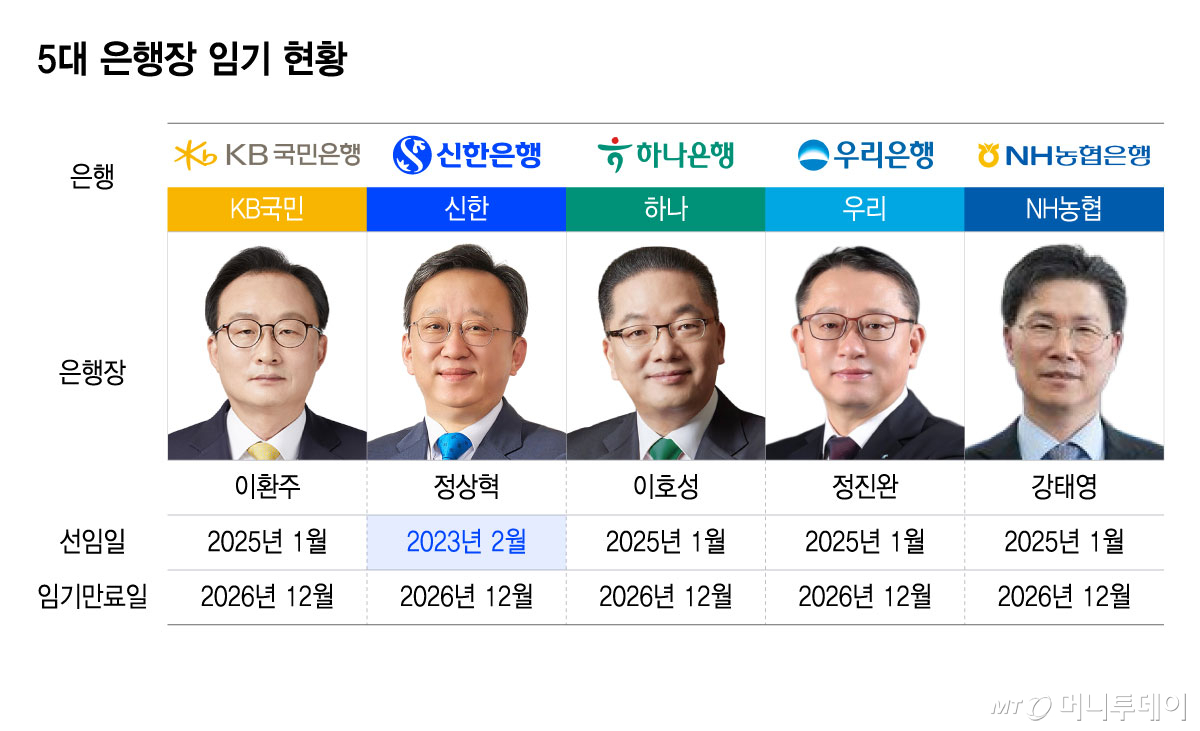
It is reported that the Political Affairs Committee is highly likely to designate major bank presidents as witnesses, including Lee Hwan-ju, president of KB Kookmin Bank; Chung Sang-hyuk, president of Shinhan Bank; Lee Ho-seong, president of Hana Bank; and Kim Sung-joo, president of BNK Busan. All are CEOs of financial institutions affected by the hacking incident and were successively summoned to an emergency briefing chaired by Financial Services Commission Chairman Lee Eui-won on the 4th. Park Sang-hyuk, a Democratic Party of Korea lawmaker serving as the committee's ruling party secretary, stated on his social media (SNS) on the 2nd, "Regarding the recurring leakage of personal information at banks, we will summon the presidents of the five major commercial banks as witnesses to this National Assembly audit and rigorously question the causes and responsibilities."
The designation of bank presidents as witnesses is highly likely to occur either at the Financial Supervisory Service audit on the 19th or during the comprehensive audit on the 22nd. Although a Financial Services Commission audit is scheduled for the 8th, the deadline for resolving witness designations has already passed. President Lee Jae-myung also instructed on the 4th to "maintain a serious awareness and make every effort to conduct thorough investigations and formulate countermeasures" regarding consecutive personal information leakage incidents at financial institutional investors and public institutional investors. Financial authorities have also emphasized "strict punishment" for personal information leakage incidents, taking the Lotte Card hacking incident as an opportunity.
Of course, this financial sector hacking incident is a breach utilizing AI, and account information or passwords required for transfers, remittances, and payments were not stolen. While the possibility of sanctions against institutional investors cannot be ruled out, alongside a maximum fine of 5 billion won under the Credit Information Act, it is assessed that the likelihood of severe sanctions extending to the representative director (CEO), similar to the Lotte Card case, is currently low.
However, attention is focused on whether the repercussions of the hacking incident will affect the reappointment of bank presidents, given that the terms of office for the five major commercial bank presidents all expire simultaneously at year-end. A financial industry official said, "Judging by the extent and method of the information leakage, while it may not amount to severe sanctions from financial authorities, national concerns over the hacking incident could be amplified in conjunction with the timing of the National Assembly audit, potentially giving rise to arguments regarding CEO responsibility," adding, "The Subsidiary Candidate Recommendation Committee of the financial holding companies, which recommends bank president candidates, will inevitably take this into consideration."
Moreover, Financial Supervisory Service Chairman Lee Chan-jin recently convened the chairs of financial holding companies and effectively issued a warning against appointing subsidiary CEOs based on "factions" or "personal relationships." He also requested an expansion of the recommendation authority for bank president candidates by the bank's board of directors (Executive Candidate Recommendation Committee). This amounts to demanding strengthened formal and procedural transparency in the bank president appointment process. Whether reappointing the incumbent bank president or appointing a new one, from Seon Chul-ha-deun (Chairman)'s perspective, they are bound to be conscious of the justification for personnel selection and procedural legitimacy more than before. It is assessed that the hacking incident will become an element that cannot be excluded among the requirements for appointing a bank president.
The calculations for each bank are also complex. At Kookmin Bank, with Lee Jae-geun, candidate for the next chair of KB Financial Group, being selected, discussions about generational turnover are emerging. The focus is on whether the trend of change observed in the process of choosing this candidate over Yang Jong-hui (Chairman)'s reappointment will extend to the personnel decision regarding President Lee Hwan-ju. For Hana Bank, the "reappointment convention" is a variable. Since Ham Young-joo, Ha Na-geum-yung (Chairman), took charge as the unified Hana Bank president, former presidents Jeong Seong-gyu, Park Sung-ho, and Lee Seung-yeol were all not reappointed. In the case of NH NongHyup Bank, there has never been a single instance of a bank president being reappointed, raising interest in whether this convention will continue. Woori Bank is in an atmosphere where expectations for reappointment are relatively high. Within Woori Financial Group, there is an expectation that if Lim Jong-ryong (Chairman) is reappointed and President Jung Jin-wan also secures a second term, the stability of the governance structure can be enhanced.

 in FINANCE
