

[For more diverse corporate information on startups mentioned in this article, visit the Unicorn Factory big data platform 'Data Lab'.]
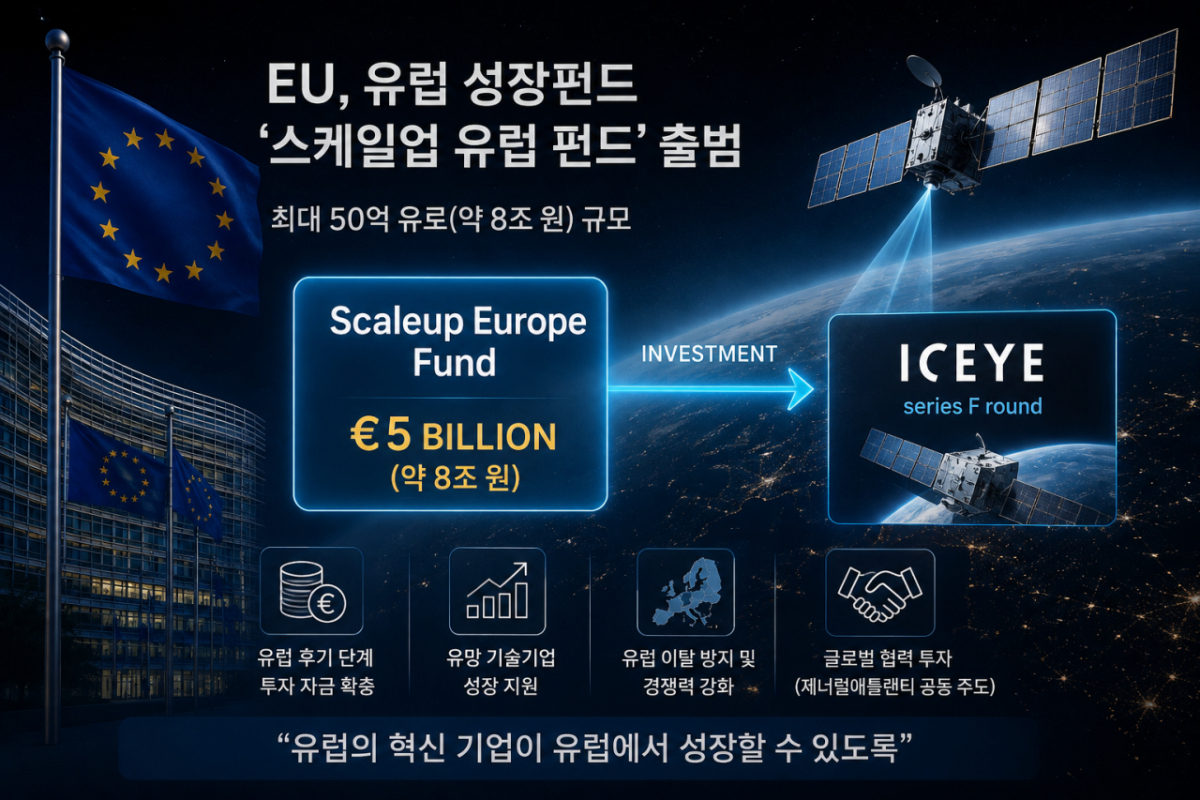
The European Union (EU) has officially launched its "Scale-Up Europe Fund," targeting a total size of up to 5 billion euros (approximately 8 trillion won). The initiative aims to bolster late-stage investment capital, which has been lacking compared to the US and Asia, to prevent promising technology companies from leaving Europe in search of funding.
According to multiple international media outlets including TechCrunch on the 14th, the European Commission officially launched the "Scale-Up Europe Fund" and selected Finnish satellite company ICEYE as its first investment target. The fund co-led ICEYE's Series F round alongside US investment firm General Atlantic.
Unlike existing EU support programs, the Scale-Up Europe Fund is characterized by combining public and private capital. The European Commission contributed 10 thousand won euros (approximately 1.6 trillion won) in the first funding round, while major European institutional investors including Germany's Allianz (the world's largest insurer), Dutch pension fund manager APG, and Denmark's Novo Holdings also participated.
Fund management will be handled by EQT, a Swedish global private equity firm with assets under management (AUM) exceeding 300 billion dollars (approximately 430 trillion won). EQT is a global private investment company established by investor AB and other entities from the Wallenberg family, Sweden's prominent business dynasty. EQT will contribute its own capital while also attracting additional private funds to continue fund formation through 2027.
Investment targets include deep tech, life sciences, advanced manufacturing, and digital technologies in Europe at the late-stage growth phase (Series B and beyond). Key investment areas are expected to be sectors strategically nurtured by Europe, such as AI (artificial intelligence), biotech, energy, robotics, semiconductors, and the space industry.
Meanwhile, ICEYE, the first investment target, is a space startup that uses synthetic aperture radar (SAR) satellites to observe Earth regardless of weather or day/night conditions, providing relevant information to governments and companies. Amid growing geopolitical tensions, the importance of satellite-based information and surveillance technologies has increased, leading to ICEYE's corporate valuation exceeding 11 billion dollars (approximately 15.5 trillion won) in its recent Series F round.
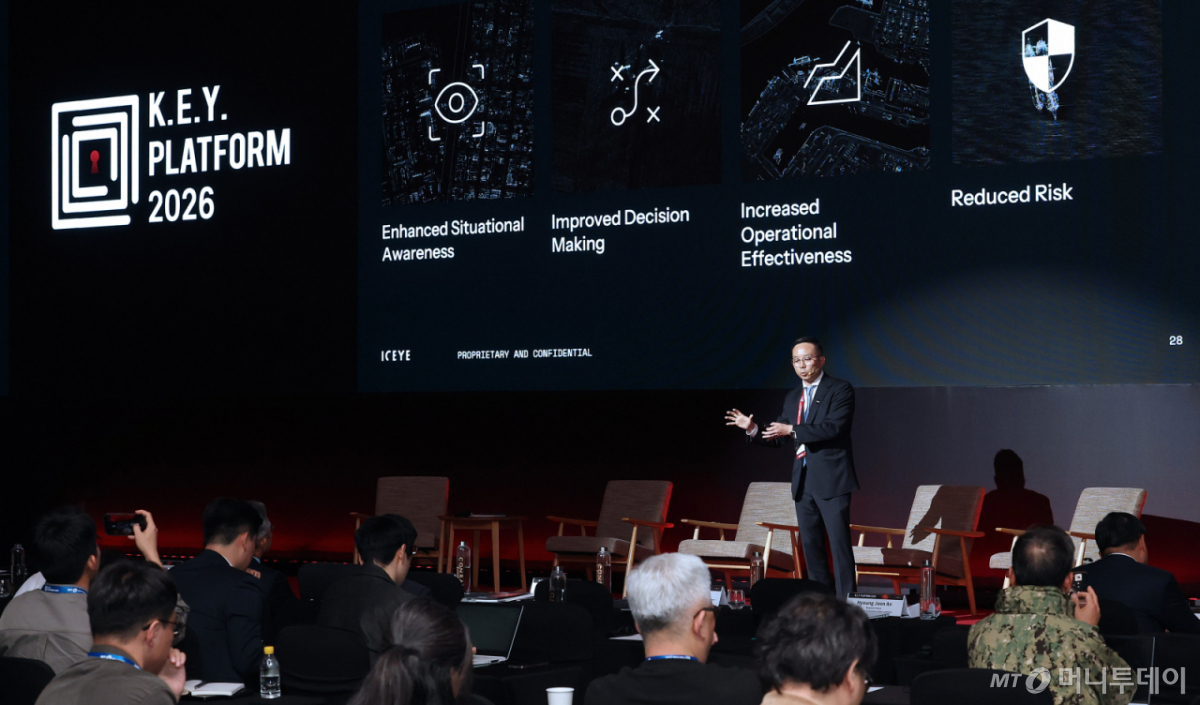
Earlier, Erik Lee, CEO of ICEYE, stated in an interview with MoneyToday last April that "Finland's venture investment ecosystem, which invests large sums in promising startups, created today's ICEYE," emphasizing Finland's venture capital ecosystem. The Scale-Up Europe Fund's selection of ICEYE as its first investment target aims to supply the large-scale funding necessary for deep tech companies like ICEYE to grow into global enterprises.
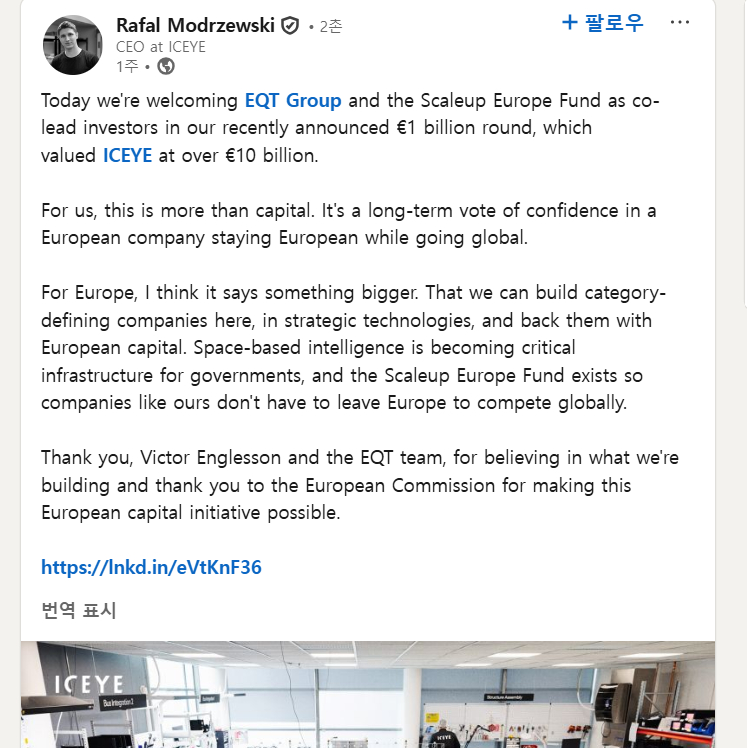
Rafal Modrzejewski, CEO of ICEYE, shared his thoughts on social media regarding this investment: "Space-based information is becoming core infrastructure for governments worldwide," and added, "The Scale-Up Europe Fund aims to ensure that companies like ours do not need to leave Europe to compete in the global market."
The EU is also considering expanding the fund's size up to 25 billion euros (approximately 4.1 trillion won) in the future.
US data and AI company Databricks secured 5 billion dollars (approximately 7 trillion won) in new funding, five times its original plan. Although it initially aimed to raise only 1.6 trillion dollars, investment interest totaling 15.5 trillion dollars (approximately 21 trillion won) poured in from investors, prompting a significant adjustment of the fundraising scale.
According to international media including TechCrunch and CNBC on the 14th, Databricks recently completed a 5 billion dollar investment round. Its corporate valuation reached 190 billion dollars (approximately 263 trillion won), jumping approximately 42% from 134 billion dollars just six months ago.
This investment round was led by global VC CoTune. Blackstone and MGX participated, while Six Street Growth, Bond, Clearlake Capital, Point72, and TPG joined as new investors.
Founded in 2013, Databricks is a data and AI infrastructure company that enables enterprises to analyze corporate data and develop AI models and agents using it. The company was co-founded by researchers from UC Berkeley who developed the large-scale data processing technology "Apache Spark."
The surge of investor interest in this round stems from Databricks' steep performance growth and expansion of its AI business. In the second quarter of this year, Databricks grew over 80% compared to the same period last year, surpassing an annualized revenue of 7 trillion dollars (approximately 9.9 trillion won). Its AI agent database "Lakebase," launched last year, also exceeded an annualized revenue of 1.6 trillion dollars.
Despite strong performance, Databricks is seeking additional funding due to the massive costs required for its AI business. The company has signed usage contracts worth billions of dollars with major global cloud providers and operates an AI research team of about 100 people. It is also actively pursuing M&A (mergers and acquisitions), having acquired startups such as AI security firm Panther.
Databricks has raised funds totaling 20 billion dollars in the private market over the past 20 months. Ali Ghodsi, CEO of Databricks, stated in an interview with CNBC that while it plans to go public in the future, "for now, we want to focus on investing in AI."
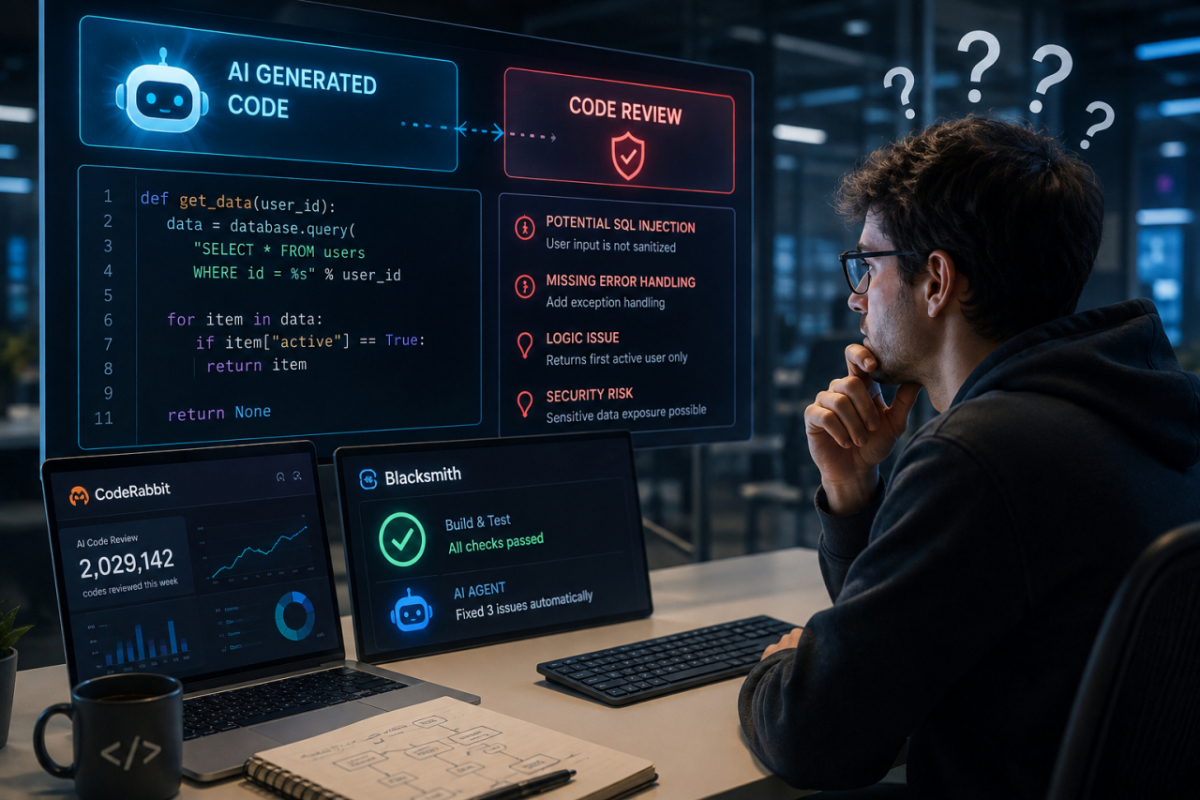
As "vibe coding," where AI generates code, spreads and the volume and speed of code produced by companies increase significantly, global VC funds are now pouring into technologies that verify such code.
According to Reuters on the 14th, US AI code verification startup CodeRabbit recently secured a Series C investment round totaling 143 million dollars (approximately 20 billion won). Its corporate valuation reached 1.5 billion dollars (approximately 2 trillion won).
This investment was jointly led by European VC Atomico and US VC Smash Capital. BMW's corporate venture capital arm, BMW i Ventures, and US cloud software company Datadog joined as new investors.
Founded in 2023, CodeRabbit provides a service that automatically reviews code written by developers or generated by AI using AI, identifying errors and security vulnerabilities. It currently reviews over 2 million lines of code weekly and has secured more than 17,000 clients globally, including NVIDIA (a global GPU manufacturer), BMW, and JFrog.
The rapid growth of CodeRabbit is driven by the spread of AI coding tools. As AI moves beyond assisting developers in coding to actually mass-producing code, demand for software that verifies this output is increasing.
Luca Eisenstucken, a partner at Atomico, which co-led this investment, told Reuters: "As AI becomes core infrastructure for the global economy, companies will increasingly need an independent system to verify software regardless of which AI model generated the code."
Indeed, investments in code verification startups are continuing.
According to multiple international media outlets including TechCrunch, AI coding infrastructure startup Blacksmith also recently secured a Series B investment round totaling 45 million dollars (approximately 64 billion won). This investment raised its corporate valuation to 550 million dollars (approximately 78 billion won). Its corporate valuation was approximately 60 million dollars (approximately 8.5 billion won) during the Series A round last year, meaning it increased more than ninefold in less than a year.
Blacksmith provides services that build, test, and verify code generated by AI before deploying it into actual services. Recently, it even introduced an AI agent that automatically corrects code that fails testing.
Aditya Jayaprakash, CEO of Blacksmith, told TechCrunch in an interview: "Code verification remains a bottleneck, and as people write more code, this bottleneck is growing larger."
$Ta0$[MoneyToday Startup Media Platform Unicorn Factory]$Tb0$

 in FUTURE


