

[For more diverse corporate information on the startups mentioned in this article, please visit 'Data Lab' on the Unicorn Factory Big Data Platform .]
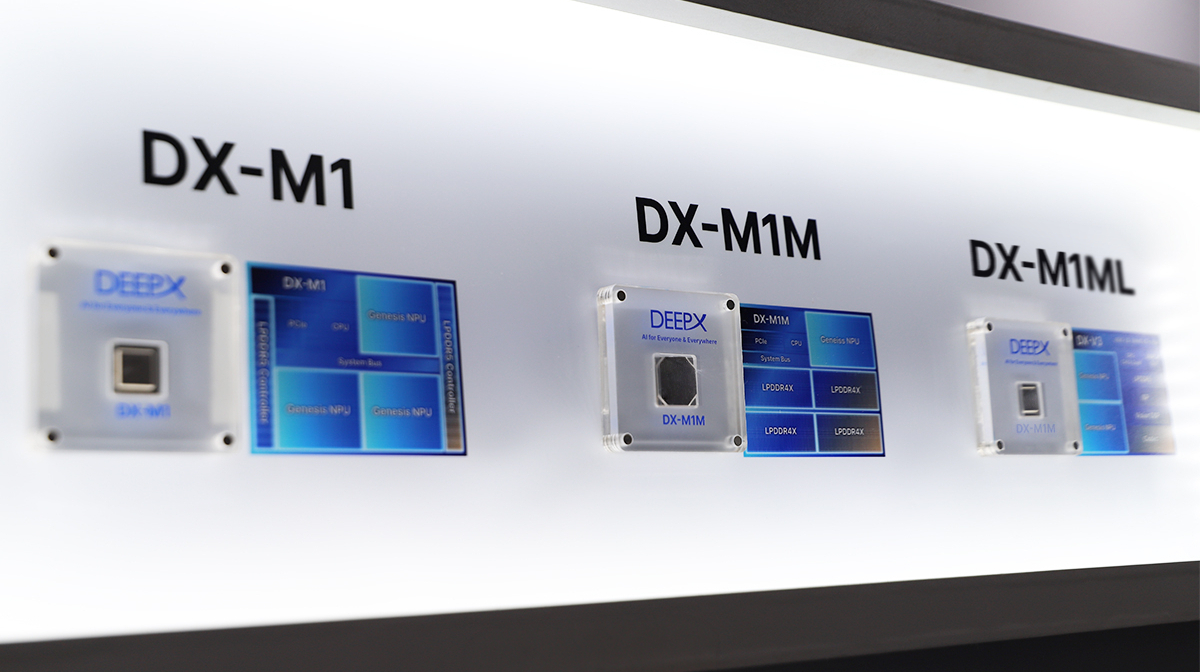
On the 17th, low-power AI (artificial intelligence) semiconductor company DeepXannounced that it secured commercial purchase orders (POs) totaling 77 orders worth $13 million (approximately 18.3 billion won) across more than 10 countries and regions over the past year, centered on its on-device AI semiconductor 'DX-M1' Yangsan.
Founded in 2018, DeepX develops foundational technology for neural processing units (NPUs) used in high-performance, low-power on-device AI semiconductors. Through this, it supports edge devices such as smart cities, robots, industrial equipment, and home appliances to perform AI computations on-site without relying on the cloud.
DX-M1 is the first on-device AI semiconductor to undergo Yangsan. It is designed to perform AI computations directly on the device without a cloud connection. Major application targets include CCTV, smart factories, and robotics that must drive video and vision AI in low-power environments.
Since starting DX-M1 Yangsan last August, DeepX has achieved order records in major markets including South Korea, the United States, China, Europe, Taiwan, Hong Kong, Japan, Singapore, and India. As of late July this year, based on cumulative sales, more than half of total sales were generated overseas.
Cumulative POs increased from 2 orders in the third quarter last year when Yangsan began, to 6 orders in the fourth quarter, 29 orders by the end of March this year, 56 orders by the end of May, and 77 orders by the end of July. Among these, 48 orders occurred over the four-month period from April to July this year, accounting for approximately 62% of total orders.
As new overseas customers placed their first orders, some initial customers also placed follow-up orders after delivery. This indicates that the AI semiconductor business is moving beyond technology validation and PoC (proof of concept) into customer product development and production and supply stages.
The sectors where commercialization is underway include robotics, smart factories and manufacturing automation, smart mobility and ITS, mission-critical and aviation, AIoT, medical, AI IT services and edge computing, and video surveillance and security—totaling eight industries.
Applied products include drones, machine vision cameras and AI boxes, robots and industrial equipment, medical AI devices, OCR servers for document recognition, VMS (video management system) servers for video control, and edge boxes for security cameras.
In China, projects related to Baidu's document recognition and machine vision are underway, along with AI edge server projects involving IT and server companies such as Lenovo. In Taiwan, application sites have expanded to local customers including industrial computing company AAEON.
Before Yangsan, DeepX conducted pre-evaluations based on sample products for over 400 companies over a period of two to three years. After Yangsan, it signed contracts with 27 global semiconductor distribution partners to build an overseas supply chain and collaborated with more than 50 hardware and module companies to expand its portfolio of application module products.
Kim Nok-won, CEO of DeepX, stated, "The competitiveness of AI semiconductors is only proven when they are applied to customers' actual products and lead to continuous orders." He added, "Orders and repeat orders are occurring in various markets around the world, not limited to specific countries or industries."
[MoneyToday startup media platform 'Unicorn Factory']

 in FUTURE
