

[For more diverse corporate information on the startups mentioned in this article, visit the Unicorn Factory Big Data Platform 'Data Lab'.]

Automation in the foodservice industry has remained limited to dining halls and checkout counters. While kiosks, point-of-sale (POS) systems, and serving robots have become commonplace, the kitchen—where labor costs account for the largest share—remains a blind spot for automation. This is because each restaurant has its own cooking methods and standards of taste, making automation difficult.
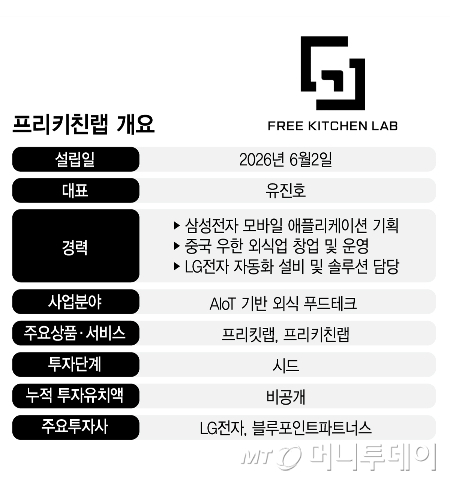
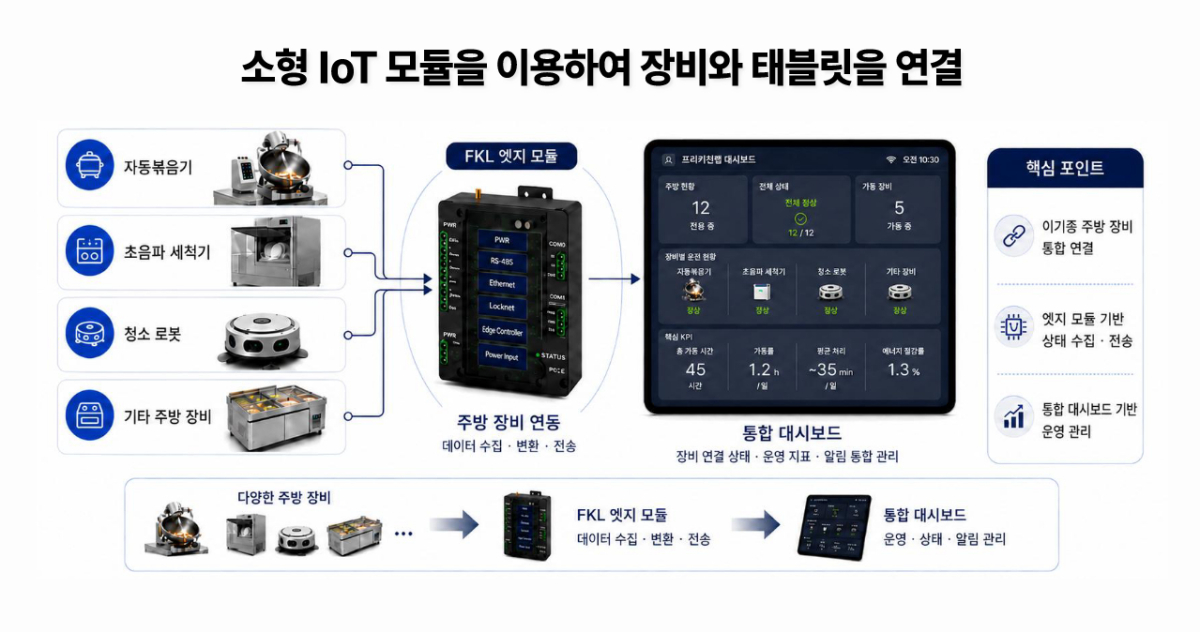
Foodtech startup Free Kitchen Lab, which aims to solve this structural problem, recently secured seed investment from LG Electronics and accelerator Bluepoint Partners. The investment amount and corporate valuation remain undisclosed. Free Kitchen Lab develops an integrated control solution that connects kitchen equipment—such as automatic stir-fry machines, frying robots, and automatic noodle cookers, each manufactured by different companies—using small-scale artificial intelligence Internet of Things (AIoT) modules.
Restaurant owners can monitor and control the operational status of all equipment in the kitchen through a single tablet screen. Furthermore, the system integrates order intake, sales data, and cooking progress to reduce unnecessary repetitive tasks on-site. Rather than replacing all kitchen equipment at once, the company adopts a phased approach: starting with data collection and status verification, then gradually expanding control functions within the scope supported by manufacturers.
The company is an alumnus of the second cohort of 'Studio341 (STUDIO341)', an in-house venture incubation program jointly operated by LG Electronics and Bluepoint Partners. It spun off as an independent legal entity to secure this investment. Free Kitchen Lab CEO Yoo Jin-ho previously led mobile application planning at Samsung Electronics, then directly operated a foodservice restaurant in Wuhan, China, for seven years, before joining LG Electronics to lead automation equipment and solution planning. This unique background combines system engineering expertise accumulated at two major domestic electronics companies with hands-on experience from the self-employment sector.

Park Jeong-soo, Senior Reviewer at Bluepoint Partners who led this investment, cited the company's accurate identification of structural bottlenecks in the foodservice industry as a key reason for the investment. Park stated, "Existing automation solutions in the foodservice sector have been concentrated on ordering and serving, while the kitchen—where most manual labor occurs—has been neglected." He added, "Free Kitchen Lab directly tackled this most challenging problem."
Free Kitchen Lab identified several reasons why the adoption of kitchen automation equipment has been slow: △difficulty in selecting equipment suitable for each restaurant, △high initial investment costs, and △lack of actual operational data. The analysis suggests that there was no clear assurance of how much revenue improvement could be achieved by introducing automated machinery.
Of course, kitchen automation equipment itself did not previously exist. However, Park noted, "Existing companies remained stuck in hardware distribution, bundling individual machines into packages without developing control systems to organically manage the equipment." He continued, "Even with new machinery, cooking processes often resulted in inconsistent food quality or frequent breakdowns, creating heavy after-sales service (A/S) burdens. Free Kitchen Lab differentiates itself by precisely tuning detailed machine settings based on on-site data to achieve consistent taste."
Accordingly, Free Kitchen Lab meticulously analyzes store size, menu composition, and order volumes during peak hours to design customized packages that specify the types and optimal quantities of robots. This strategy considers that automating only one process while manual labor remains required for preceding or subsequent steps would halve the labor cost savings. The company has currently built a portfolio comprising over 200 products across 28 equipment categories.
Free Kitchen Lab's primary targets are small and medium-sized franchises with fewer than 100 stores and single-owner delivery-only restaurants. It is currently conducting proof-of-concept (PoC) projects with two relevant franchise companies. Park explained, "Large franchises have large store sizes and highly specialized divisions, making it difficult to immediately demonstrate the effects of automation adoption. In contrast, single-owner stores where the owner handles cooking, packaging, and order processing alone are most urgently facing labor shortages." Free Kitchen Lab is sequentially applying equipment connectivity to stir-fry menus with relatively easy standardization of cooking methods, such as cup rice, Chinese cuisine, and chicken skewers.
Regarding concerns about entry barriers, Park highlighted the company's rapid on-site penetration and procurement competitiveness. He stated, "The self-employment market is so broad that the first mover who establishes early standards can quickly capture the market." He added, "Yoo (CEO)'s experience operating foodservice businesses in China is a strength, as it enables the company to secure a supply chain for cost-effective and durable components."
He further predicted, "Meal kit and home meal replacement (HMR) manufacturing processes are also areas where automation transition is urgently needed due to labor shortages and quality maintenance issues. After building on-site trust through individual cooking modules, we expect to expand into full-store control and eventually food processing factory solutions."
Yoo Jin-ho, CEO of Free Kitchen Lab, stated, "Automation in the foodservice industry requires stable connection between different equipment and order/operation data on-site. We aim to become a company that prepares for the moment when self-employed owners transform into managers who oversee robots and data."
[MoneyToday startup media platform Unicorn Factory]

 in FUTURE


