

[For more diverse corporate information on startups, you can view it on the Unicorn Factory big data platform 'Data Lab'.]
The center of gravity in the space industry is shifting from the "distant universe," such as the Moon and Mars, to just above Earth. "Low Earth Orbit (LEO, 160 to 2,000 km above Earth)," which was once a stage for exploration, has now transformed into an "extended version of the Earth economy" where communication, observation, manufacturing, and logistics are intertwined.
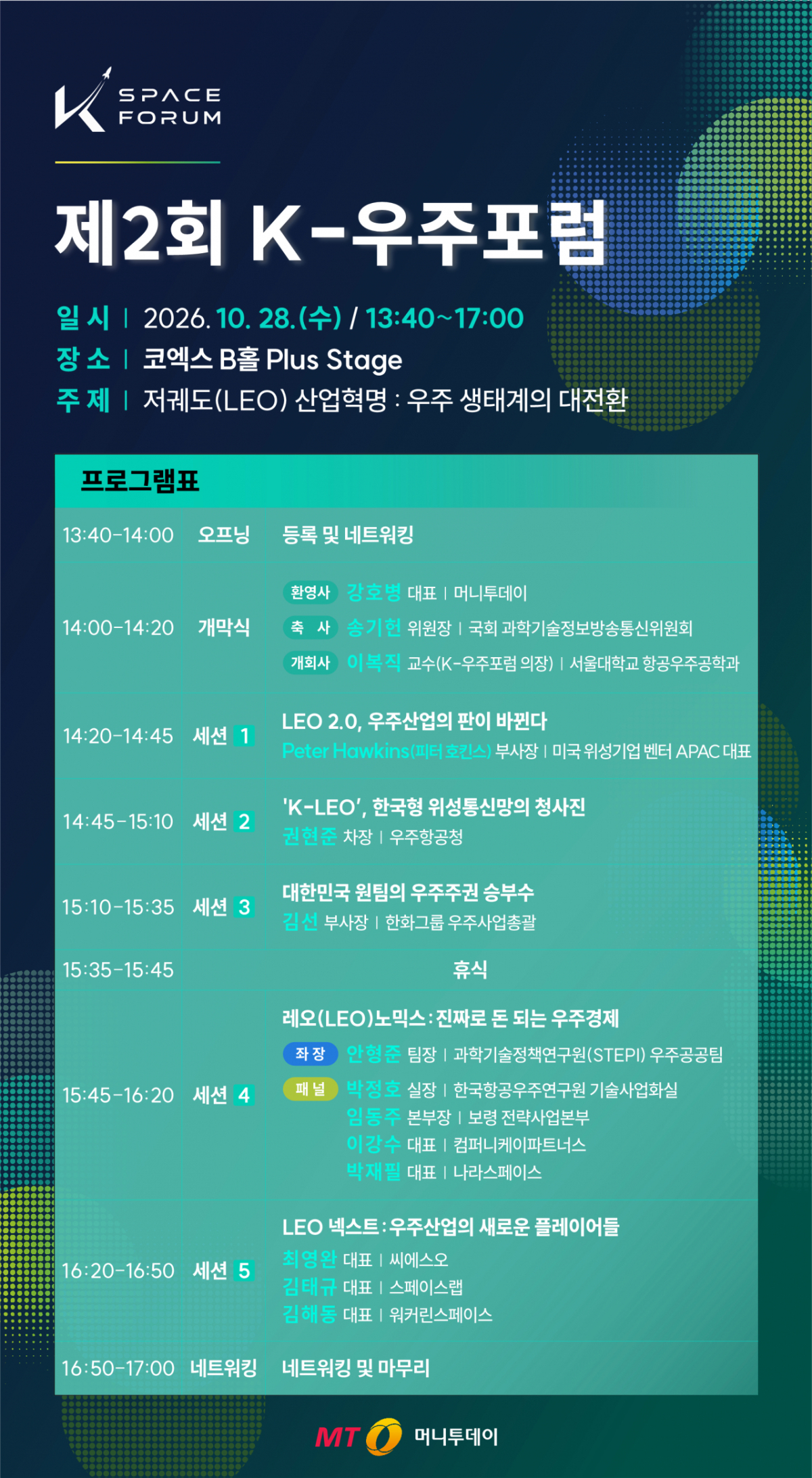
That is why the theme of the 2nd K-Space Forum flagship forum, to be held from 2 p.m. to 5 p.m. on the 28th at Seoul COEX in Samsung-dong, Seoul, by the "K-Space Forum" involving industry, academia, research, and government, and MoneyToday's startup media platform "Unicorn Factory," has been set as "Low Orbit Industrial Revolution: The Daejeon of the Space Ecosystem."
This forum focuses not on the launch vehicle itself, but on what is carried on top of it, what kind of data is created, and who will purchase it. It is being promoted as a venue to find ways for domestic space companies to secure demonstration track records and customers by connecting technology, capital, policy, and markets, and how they can grow.
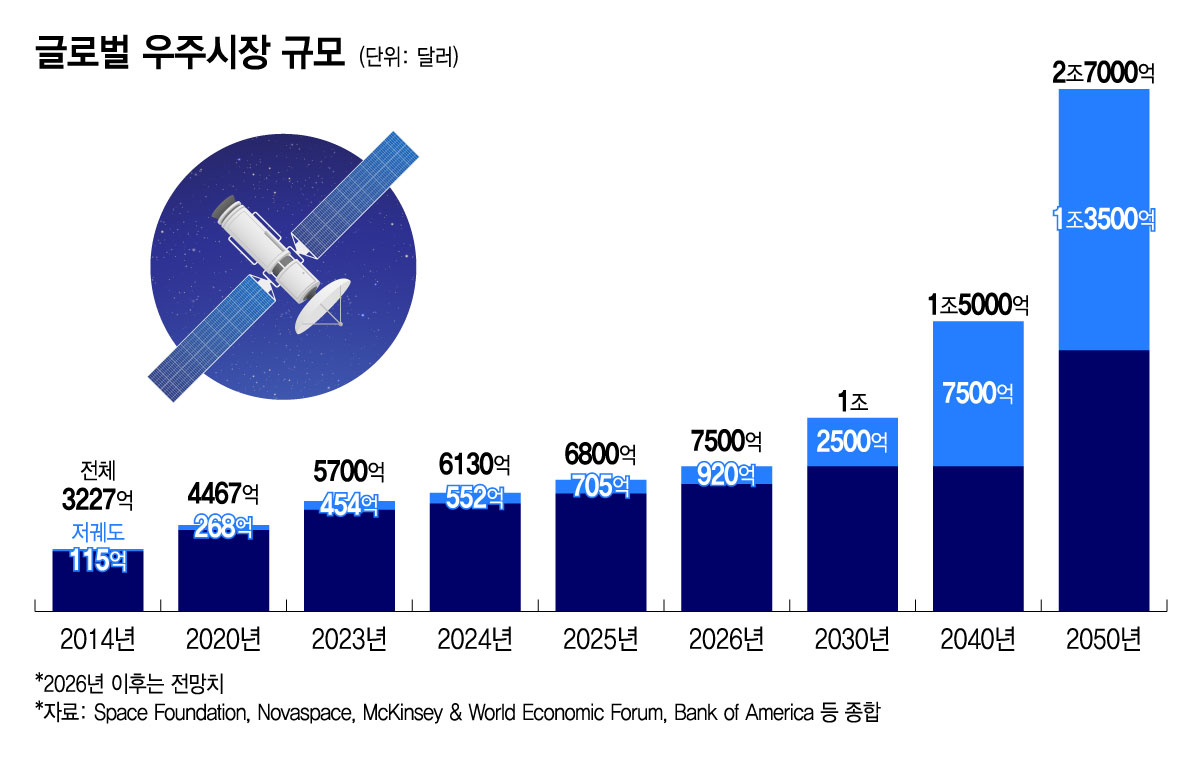
According to a comprehensive analysis by Unicorn Factory of materials from major global investment banks (IBs) such as McKinsey, the World Economic Forum (WEF), NovaSpace, and Bank of America, the global low orbit market size grew 163% in five years, from $26.8 billion (approximately 39.3 trillion won) in 2020 to $70.5 billion (approximately 103.4 trillion won) last year.
The forecasts are even more dramatic. Major institutional investors see the low orbit market expanding to $250 billion (approximately 366 trillion won) in 2030, $750 billion (approximately 1,100 trillion won) in 2040, and $1.35 trillion (approximately 1,980 trillion won) in 2050. Its share of the entire space market is expected to be 25% in 2030 and over 50% after 2040.
This means that the center of gravity of the space economy is rapidly shifting from geostationary orbit (GEO, an altitude of approximately 36,000 km above ground) to low orbit, which has shorter radio wave delays and lower launch costs.
LEO does not remain limited to communication and observation. "Space bio," which experiments with new drug candidate substances and creates protein crystals in a microgravity environment, optical communication that exchanges large-capacity data between satellites, and the expansion of terrestrial industry technologies such as on-orbit data centers and all-solid-state batteries into low orbit are underway.
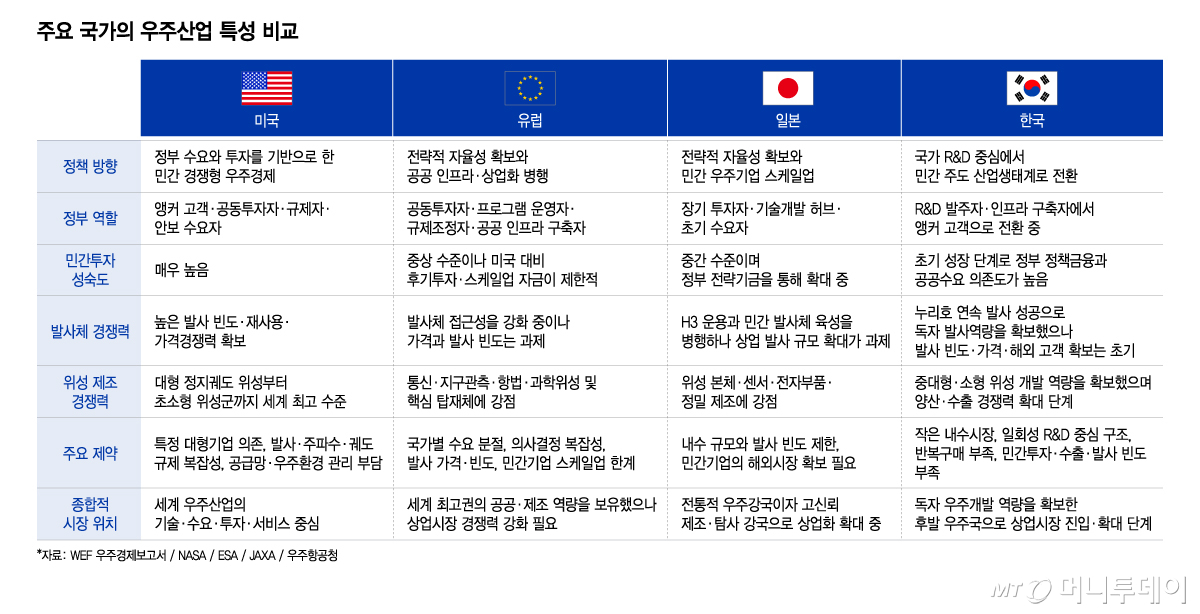
The issue is Korea's position. Korea has a very weak market where private companies can repeatedly generate revenue. The structure where revenue cuts off along with the end of a project after completing government R&D (research project) tasks, and the lack of "heritage" to verify performance in space, are cited as the biggest bottlenecks for growth.
Experts speak with one voice regarding structural problems. Lee Bok-jik, K-Woo Ju-po-reom (Chairman) (Aerospace Joo Gong-hak-gwa (Prof.), Seoul National University), pointed out, "When it comes to space business, customers ask, 'Has it been verified in space?' The fact that there is no experience itself to answer that question is the biggest barrier for K-space companies."
Ahn Hyeong-jun, Woo Ju-gong-gong (Team Lead) at the Science and Technology Policy Institute (STEPI), emphasized, "If space policy is tied to a government procurement structure, private-led initiatives are impossible," adding, "There is a need to boldly shift from a structure where the government controls all processes to a direction that grows the private market."
The K-Space Forum on the 28th will intensively discuss conditions for such a transition. It plans to bring together companies and investors across the entire space industry value chain, as well as policy and research institutional investors, in one place to address not just "what to develop," but "who will buy it, where it will be verified, and how to create recurring revenue."
[MoneyToday startup media platform 'Unicorn Factory']

 in FUTURE


