

[For more diverse corporate information on the startups featured in this article, please visit the Unicorn Factory big data platform 'Data Lab'.]
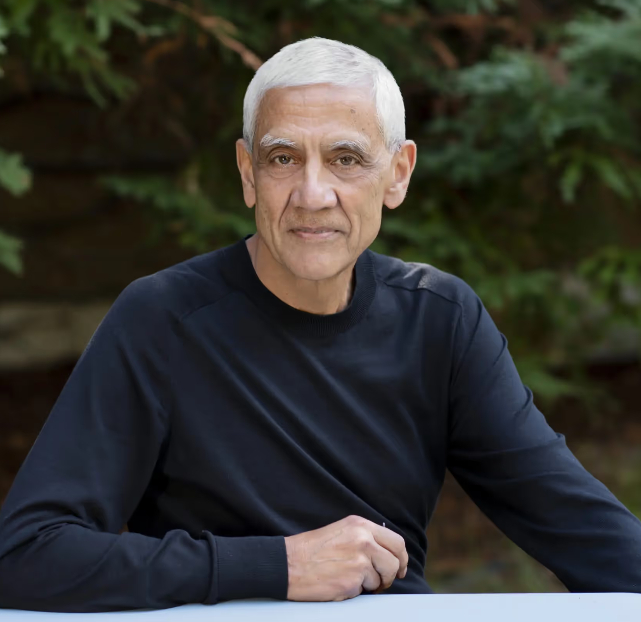
"It is a second-tier company struggling in competition. It is unethical and even lies."
Silicon Valley's prominent venture capitalist Vinod Khosla has publicly criticized an artificial intelligence (AI) coding startup he invested in, causing ripples through the U.S. startup ecosystem. The unusual situation of an investor disparaging a portfolio company is fueling growing controversy over investment ethics and conflicts of interest within the VC industry.
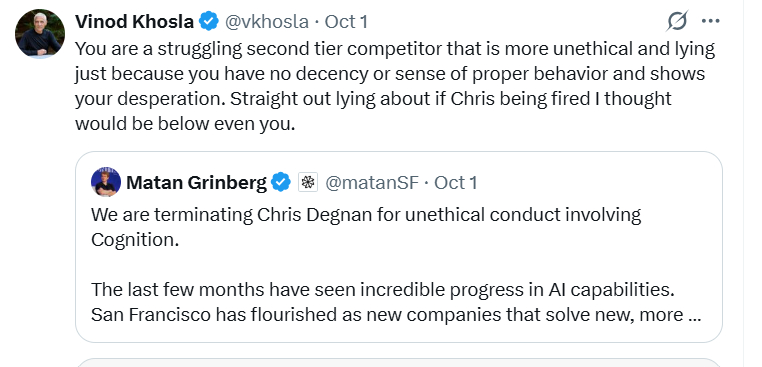
According to foreign media outlets such as Business Insider and TechCrunch on the 8th, Khosla, founder of Khosla Ventures, recently criticized AI coding startup Factory as a "struggling second-tier competitor" on social media platform X (formerly Twitter). He also accused Factory's founder and CEO Matan Grinberg of lying.
The controversy has intensified because Khosla Ventures is a major investor in Factory. Khosla Ventures led Factory's Series C funding round of $150 million (approximately 200.8 billion won) in April this year, and participated in a $200 million investment round last month. At the time, Factory was valued at $5 billion (approximately 6.7 trillion won).
Khosla Ventures has also invested in Factory's competitor, Cognition. Cognition, which developed the AI coding agent "Devin," raised over $2 billion last month and was valued at $48 billion (approximately 64 trillion won). Factory provides an AI agent called "Droid" that automates software development tasks.
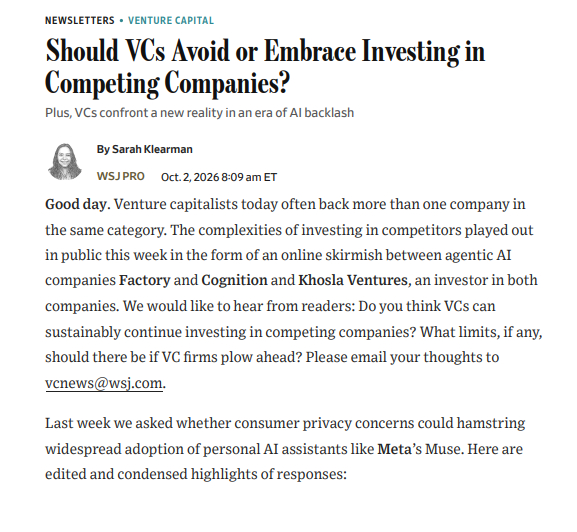
In a situation where one VC has invested in two competing companies, it effectively means he publicly criticized one side while defending the other.
Truth Dispute Joins Khosla... VC Double Investment Issue Surfaces
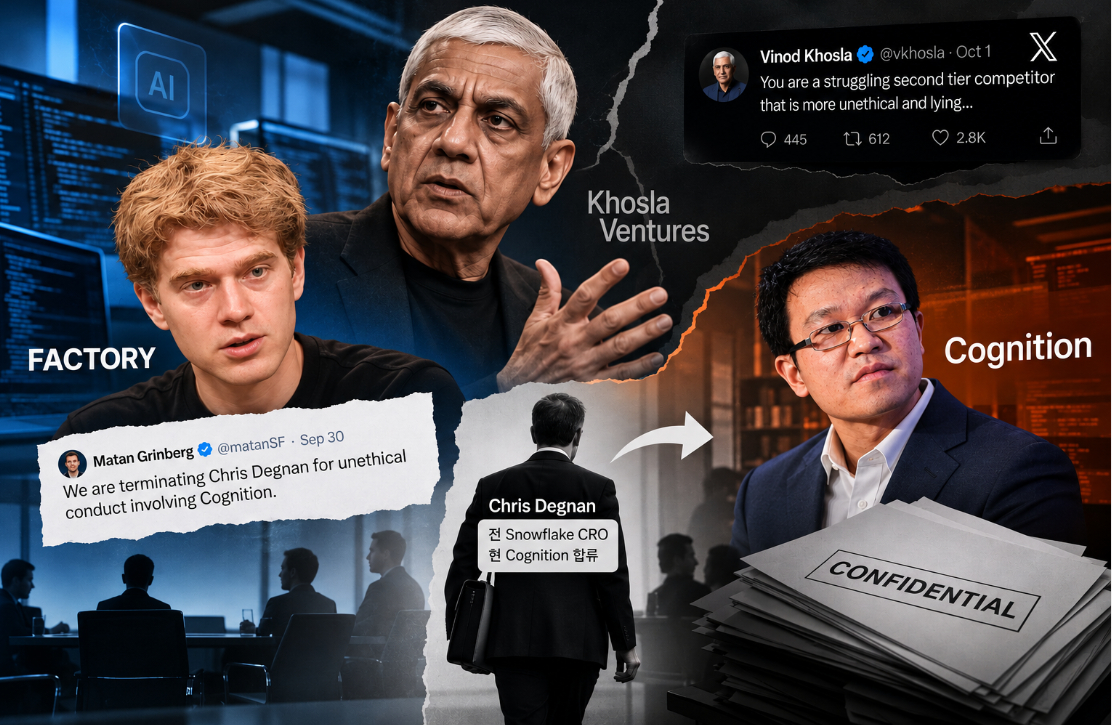
The conflict began with Chris Deegan, who served as an advisor to Factory's board of directors, moving to Cognition. Deegan had served as Chief Revenue Officer (CRO) for approximately 11 years at cloud data company Snowflake. He subsequently joined Factory investor RPT Partners as a partner and provided advice to Factory's board.
On the 30th of last month, CEO Grinberg raised the possibility of confidential information leakage, claiming that Deegan contacted Cognition executives while attending a Factory board meeting. He stated that he had dismissed Deegan from his role as board advisor. Meanwhile, Deegan categorically denied the allegations. He countered that he voluntarily resigned after informing them of his move to Cognition, rather than being dismissed, and that he had never leaked confidential information. Scott Wu, CEO of Cognition, also stated that he was not interested in obtaining Factory's internal information.
The controversy grew as Khosla joined the dispute. He defended Deegan, criticizing CEO Grinberg for falsely claiming to have dismissed him. In response, Silicon Valley founders and investors successively pushed back.
Palmer Luckey, co-founder of defense startup Anduril Industries, asked, "If they are a struggling second-tier company, why did they receive an investment at a multi-billion dollar valuation just weeks ago?" Spencer Skates, CEO of Amplitude, also criticized the incident as another reason why founders should avoid seeking investment from Khosla.
Divided voices emerged even within Khosla Ventures. Keith Rabois, Managing Director, supported Factory's side, stating that it is unethical to attend a competitor's job interview while having access to board confidential information.
This incident has brought the conflict of interest issue regarding VCs investing in competing startups to the forefront amid the AI investment boom. In the past, the VC industry considered double investment in competitors a matter requiring caution, but recently, as competition to secure promising companies intensifies in the AI market, such cases are increasing.
A representative example is OpenAI and Anthropic. Sequoia Capital and Founders Fund have invested in both companies, which compete in the AI foundation model market. According to an analysis of PitchBook data by Wired in June last year, approximately 90 investors had invested in both sides. Salesforce Ventures has also invested in both Cohere and Mistral AI, which are in a competitive relationship.
"SpaceX Alumni Who Built Rockets Now Innovating Railways"... Raises $100 Million

A U.S. startup founded by engineers from Elon Musk's space company SpaceX has successfully secured large-scale investment with its autonomous freight train technology.
According to TechCrunch, U.S. autonomous rail startup Parallel Systems recently raised $100 million (approximately 133.8 billion won) in Series C funding. The investment was led by AVP, with new investors including Hillspire, Agility Global, and Cobalt Capital. Existing investors such as Antos Capital, Congruent Ventures, Riot Capital, and Collaborative Fund also participated in the follow-on investment.
Founded in 2020, Parallel Systems was established by CEO Matt Soul, who designed rocket avionics systems at SpaceX, along with fellow engineers. The company is developing battery-powered autonomous rail vehicles that operate without institutional investors.
Its core product, "Panther," can carry several tons of cargo and travel up to 500 miles (approximately 805 km) autonomously. It supports both individual operation and swarm driving, where multiple vehicles move while maintaining a constant interval without being physically connected.
Existing freight railways have operated long trains consisting of multiple wagons coupled together according to scheduled timetables. While this method lowers transportation unit prices by spreading fixed costs over large-volume transport, it has been difficult to ensure profitability in segments with low cargo volumes or short distances. In fact, approximately 60% of all U.S. freight shipments occur on short-distance routes under 500 miles, a significant portion of which is handled by trucks. Parallel Systems aims to target the short-distance market where existing railways have struggled to maintain competitiveness, leveraging autonomous driving technology.
Panther lacks inter-vehicle coupling devices, allowing it to separate into individual vehicles and move without manpower upon arriving at rail hubs. It detects obstacles ahead on the tracks using sensors and is powered by batteries, producing no emissions during operation.
The company is also pursuing cooperation with trucking companies. The model involves transporting cargo via autonomous rail from ports to rail hubs near customers, with trucks handling final delivery. Trucking companies can reduce time spent navigating congested ports, thereby increasing daily transport trips. It is explained that railways can serve as a cooperative means to enhance the transportation efficiency of existing logistics providers.
Commercialization preparations are also underway. Parallel Systems has received operating approval from the U.S. Federal Railroad Administration (FRA) for operations near Savannah Port in Georgia, and is verifying safety on approximately 160 miles (257 km) of track. The company plans to undertake its first commercial freight transport soon. It intends to use the raised funds to build the Yangsan system for third-generation Panther vehicles and expand commercialization.
"Will Blocked Bio Investment Channels Open Up"... Dutch VC Secures 3.5 Trillion Won in Ammunition
Forbion, one of Europe's largest bio VCs headquartered in the Netherlands, has successfully raised a large new fund. This is the largest life sciences VC funding round in Europe this year, achieved amid concerns over the weakening competitiveness of the European biotech industry.
According to The Wall Street Journal (WSJ) and bio-specialized publication Fierce Biotech, Forbion recently raised a total of 2.3 billion euros (approximately 3.5 trillion won). The funds were raised through two funds, "Forbion Growth Opportunities Fund IV" and "Forbion Ventures Fund VIII," and are expected to be invested in approximately 30 biotech companies.
Sixty percent of the capital was secured from European investors, and 40% from North American investors. Key limited partners (LPs) include Dutch pension fund managers MN and PGGM, German state-owned investment institutional investor KfW Capital, and global pharmaceutical company Eli Lilly. With this fund raise, Forbion's Assets Under Management (AUM) reached 7.5 billion euros (approximately 11.2 trillion won), an increase of approximately 50% compared to two years ago.
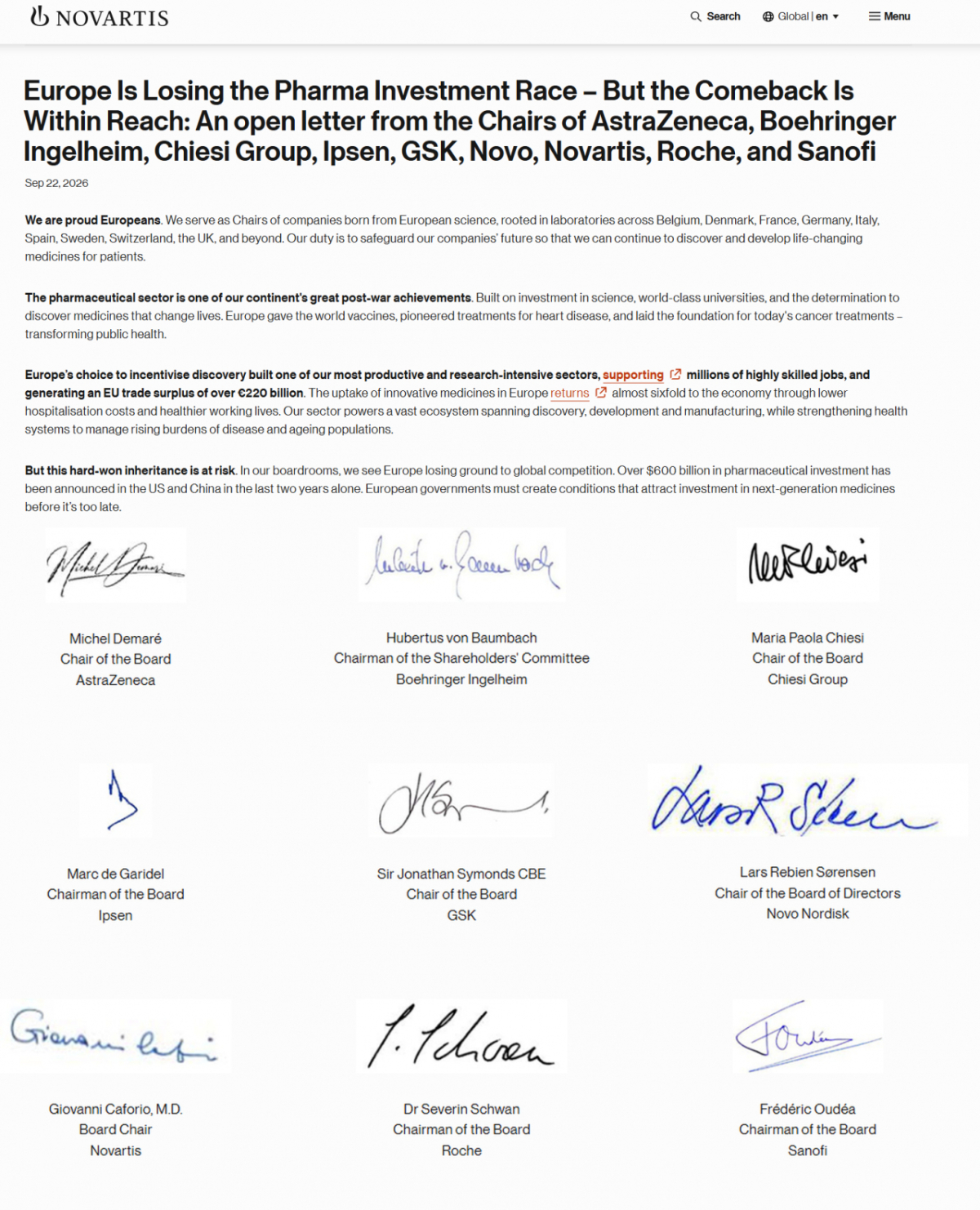
This funding round took place as concerns grew over the weakening competitiveness of Europe's pharmaceutical and biotech industries. Last month, the Lee Sa-hoe (Chairman) of nine major European pharmaceutical companies, including AstraZeneca, GSK, Novartis, Roche, and Sanofi, released a joint open letter titled "Europe Is Losing the Pharma Investment Race."
They warned that Europe's share of global pharmaceutical R&D (Research and Development) has declined from 43% in 1990 to 31% currently, and its share of commercial clinical trials has dropped to 9%, half of what it was a decade ago. Analysts suggest that Europe's position has weakened amid the competition between the U.S. and China to foster their biotech industries. They urged European governments to expand investment in the pharmaceutical sector.
Sander Slootweg, co-founder and Managing Partner of Forbion, stated, "There is an active discussion about the need to supply more capital in Europe," adding, "This funding round is an early signal that such changes are beginning to appear."
[MoneyToday Startup Media Platform Unicorn Factory]

 in FUTURE


