

[For more diverse corporate information on the startup featured in this article, visit Data Lab, the big data platform of Unicorn Factory.]

23 food and beverage brands, 10 directly operated stores, 15 billion won in revenue, and a shift to profitability.
This is the report card that Blitz Dynamic achieved last year without a single franchise location. Unlike typical food and beverage companies that grow by expanding their franchise networks, the company rapidly expanded its scale while directly operating all of its stores.
The key lies in a "multi-category" strategy that produces various types of food from a single kitchen. The company groups dishes with similar cooking processes or equipment requirements—ranging from samgyeopsal and kimchi jjim to dakgangjeong, gukbap, jeyuk, and fried rice—and manufactures them at one production base. It handles everything in-house, from brand planning and menu development to production and sales.
Operating multiple brands in one location increases the complexity of inventory, ordering, production, and personnel management. Blitz Dynamic addressed this by digitizing all aspects of store operations over the past five years and integrating AI (artificial intelligence). By entrusting operational tasks such as inventory checks and ordering to AI, the company created a structure that allows it to operate and expand multiple brands with directly operated stores alone, without relying on franchises.
Park Jun-ha, Blitz Dynamic Lee Na-mik-seu (CEO), recently met with Unicorn Factory, MoneyToday's startup-focused media platform, and said, "In the food and beverage industry, it was considered common sense that growing in scale with only directly operated stores was difficult." He added, "I believed that if we digitized inventory, production, quality, education, and human resources and entrusted them to AI, we could expand sufficiently even with directly operated stores."
"Problems of the Franchise Kingdom Seen Through a Science and Engineering Lens"
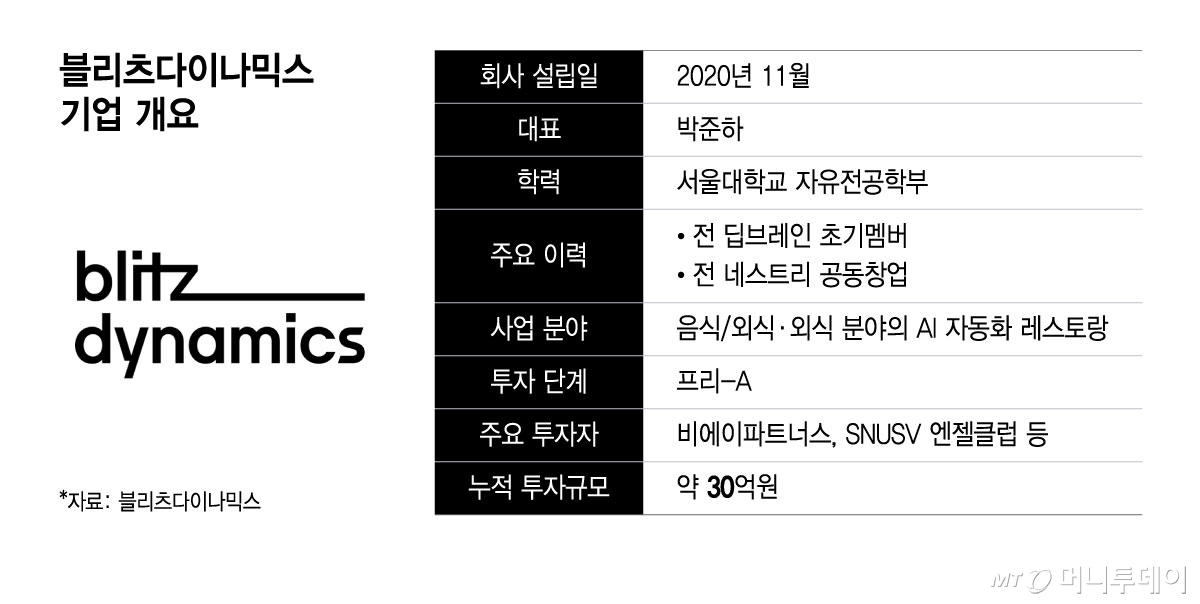
The reason Park (CEO) chose a path different from existing food and beverage businesses stems from his unique background as a developer. He entered the startup scene through his involvement in a university entrepreneurship club, joined AI company Deep Brain as an early member in 2016 to develop AI chatbot technology, and later co-founded the blockchain project "Nestree."
After experiencing AI and blockchain, he surprisingly chose the food and beverage industry for his next startup venture. Park (CEO) said, "After experiencing glamorous industries like AI and blockchain, I actually wanted to try a business that was more fundamental and closer to tangible assets."
Coinciding with this, the delivery market grew rapidly due to the COVID-19 pandemic. He noted that while online infrastructure such as Baemin and Coupang Eats had developed, the offline infrastructure for making food remained stuck in traditional methods. Although shared kitchens and robot kitchens emerged, he believed that innovating only part of the space or cooking process was insufficient to fundamentally change the low-margin and cost structure of the food and beverage industry.
Lacking experience in the food and beverage industry actually became a catalyst for questioning existing formulas. Industry experts advised that as stores increase, managing directly operated stores becomes complex, necessitating a shift to franchising. Park (CEO) said, "When I met industry insiders, they told me that if it were 100 directly operated stores, expansion would be difficult, so I should go with franchises." He added, "If we operate within the grammar of the existing food and beverage industry, franchising is correct, but we are a company trying to break that formula itself."
Judging that digitizing all operations could overcome the expansion limits of directly operated stores through technology, Park (CEO) founded Blitz Dynamic at the end of 2020.
23 Brands in One Kitchen…Revenue Jumps from 3 Billion to 15 Billion Won
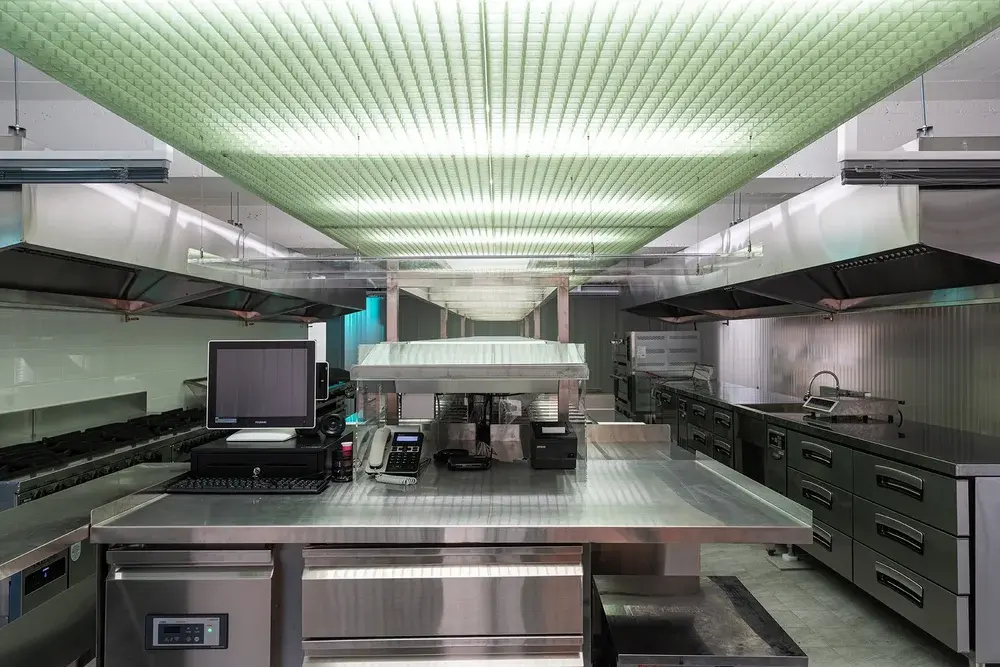
Blitz Dynamic groups menus with similar cooking processes and equipment requirements, processing orders for multiple brands simultaneously at a single production base. The company currently develops and operates 23 food and beverage brands in-house.
To achieve this, the company standardized work processes such as inventory, production, quality, education, and human resources from the early stages of its founding and moved them into systems. With the rapid development of LLMs (large language models), it has recently integrated AI. Currently, an AI-based system calculates necessary inventory and food ingredient delivery times to determine ordering timing and quantities.
This structure also lowers the cost of experimenting with new brands. While a failed new brand at a typical food and beverage company can lead to store closure, Blitz Dynamic can add or withdraw brands while maintaining its production base.
Park (CEO) described this as "Fast Food 2.0." He said, "If the Fast Food 1.0 created by McDonald's was about producing food quickly, Fast Food 2.0 is about releasing content itself rapidly, like fast fashion." He added, "We can launch brands quickly and withdraw immediately if customer response is poor."
Results are showing. Blitz Dynamic's revenue surged fivefold from approximately 3 billion won the year before last to approximately 15 billion won last year. During the same period, the company increased its directly operated stores from two to 10 and successfully turned a profit.
According to the company, more than 70% of newly introduced brands at each location enter regional gourmet rankings on delivery platforms. Currently, most revenue is generated by listing the brands from directly operated stores on Baemin and Coupang Eats to receive delivery orders.
"In the AI Era, We Will Secure a First-Mover Advantage in Fully Autonomous Restaurants"
The ultimate goal is a "fully autonomous restaurant." This structure involves AI predicting demand and managing inventory, ordering, and production, while automation equipment and future humanoid robots handle cooking. Once domestic operations stabilize, the company plans to enter overseas markets such as the United States as early as 2028.
Park (CEO) also predicted that the market structure centered on delivery platforms would change with the emergence of AI. Currently, consumers directly search for and order from restaurants via delivery apps, but in the future, AI assistants may find restaurants and place orders on behalf of consumers.
He said, "If AI assistants become commonplace, the way consumers currently find and order from restaurants directly through delivery apps may change." He added, "Our goal is to secure sufficient offline production bases now so that we can connect directly with consumers at that time. The point when the delivery market is restructured around AI will be a huge opportunity for us."
[MoneyToday Startup Media Platform Unicorn Factory]

 in FUTURE


