

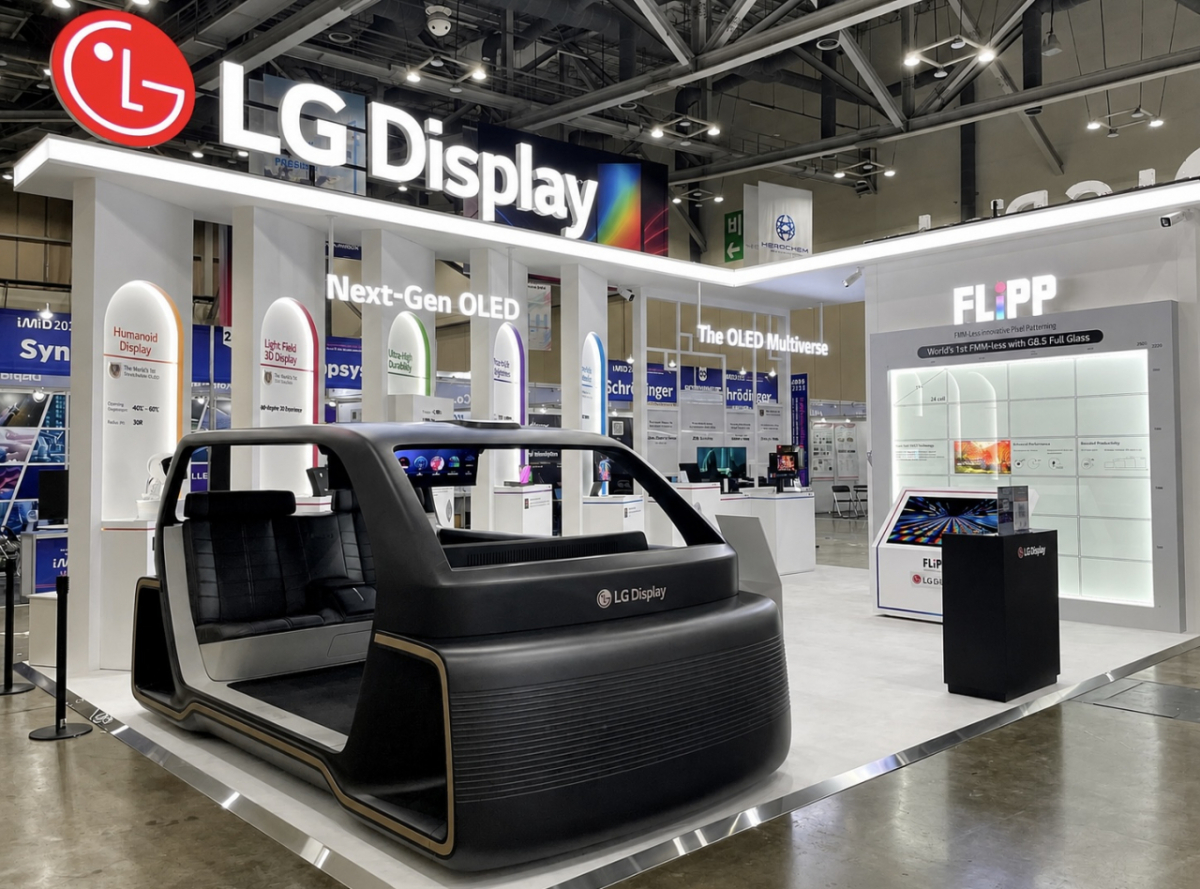
Domestic display companies are stepping up efforts to solidify their "super-distance" lead by showcasing next-generation technologies. From new technologies that surpass the limits of OLED manufacturing processes to panels that improve foldable weaknesses, they aim to counter China's pursuit through technological gaps.
According to the electronics industry on the 19th, LG Display and Samsung Display participated in the 26th International Information Display Conference (IMID 2026) held at Busan BEXCO, showcasing next-generation OLED technologies and more. IMID is Korea's largest display academic conference.
First, LG Display unveiled its self-developed next-generation OLED patterning technology, "FLiPP," for the first time in the world. Generally, in OLED manufacturing, a thin metal plate called FMM (Fine Metal Mask) with tiny holes is closely attached to the substrate, and red, green, and blue organic materials are sequentially deposited into the holes to form pixels. However, since high-cost FMMs must be separately manufactured depending on display size and resolution, there are limitations such as high cost burdens and potential defects due to hole positioning errors.
LG Display independently developed "Flip," which forms OLED pixels without using FMM by applying photolithography processes used in semiconductor production. The method involves sequentially coating and fixing red, green, and blue pixels across the entire substrate, then precisely removing unnecessary parts using UV (ultraviolet) light. By eliminating FMM, it reduces defect risks while minimizing the space previously occupied by FMM between pixels, increasing the aperture ratio (the area actually emitting light) by approximately 55% compared to before. This brings effects such as △1.6 times higher brightness, △2.4 times longer lifespan, and △13% reduced power consumption.
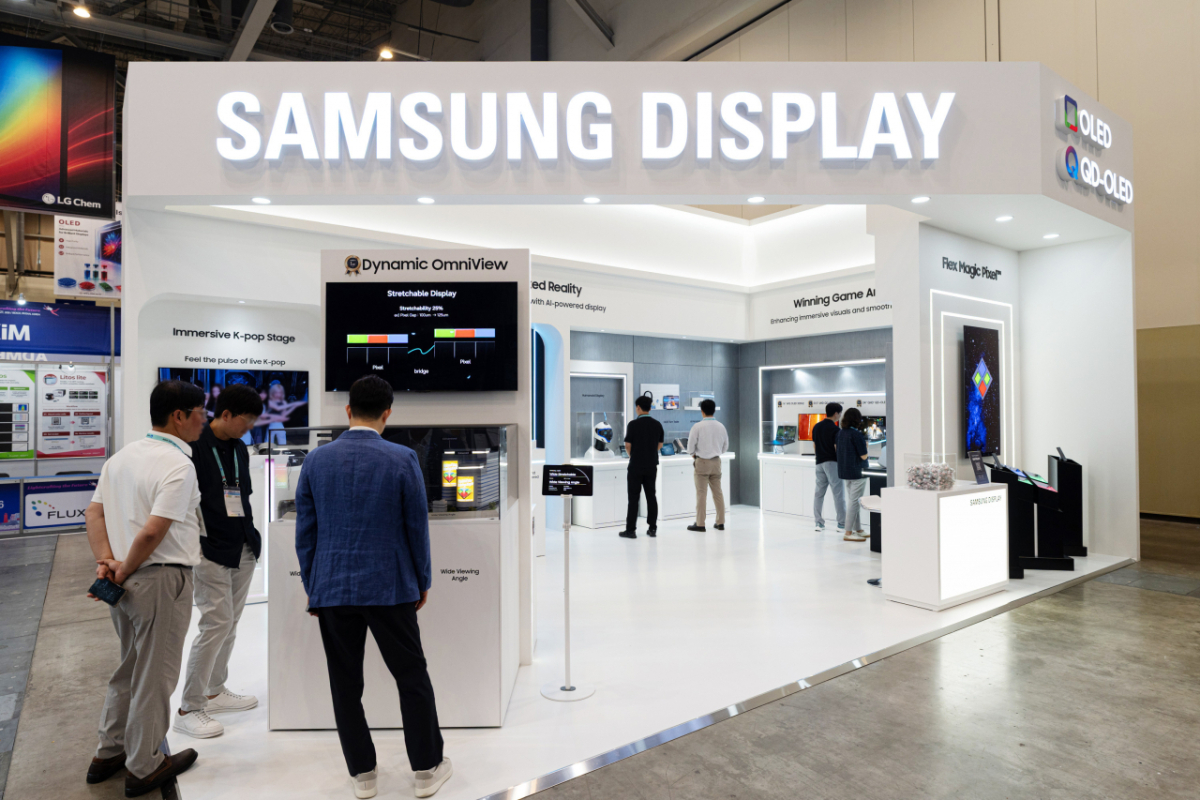
Samsung Display unveiled next-generation OLED technology that overcomes limitations in screen size, shape, and viewing angle. It introduced "Wide View," which improves the viewing angle of foldable displays, and for the first time revealed the world's largest (20-inch) stretchable display called "Wide Stretchable."
Currently commercialized foldable displays have a structural limitation where brightness on both sides of the central folding area drops to about 40% compared to the front view. "Wide View" completely redesigned the materials and structure of new organic light-emitting layers, minimizing brightness degradation even when viewing the curved part of the screen from the front, achieving bright and uniform display quality.
"Wide Stretchable" applied tiling technology that connects two existing stretchable displays as if they were one screen, increasing the screen size by more than twice compared to previous products. Two panels operate naturally as a single display.
On this day, Lee Cheong, Chairman of Samsung Display, met with reporters and said, "We have started construction of the A7 LINE project at Asan Site 2, which will replace existing LCD lines with OLED," naming flexible and foldable panels as priority production products. He added, "We will continue preparing to ensure sufficient production capacity."

 in INDUSTRY

