

As the United States has applied import restrictions to the Chinese solar supply chain, signs of production cuts are also emerging in China. Analysts suggest that the domestic solar industry, which has been struggling with sluggish market conditions due to oversupply from China, could reap indirect benefits by leveraging local U.S. production and non-Chinese supply chains.
According to relevant industry sources on the 24th, China's solar module production volume in the first half of this year reached 201 gigawatts (GW), a 35% decline compared to the same period last year. This marks the first time since record-keeping began in 2014 that module production in China has decreased. The move is attributed to the Chinese government's efforts to restructure the oversaturated solar industry, including capacity adjustments and measures to curb price-cutting competition.
This development brings welcome news for the domestic industry, which has long suffered from oversupply originating in China. Chinese companies have maintained aggressive low-price strategies by dominating key materials such as polysilicon within the solar value chain. As their pricing competitiveness weakens, downward pressure on global solar product prices is expected to ease, potentially improving profitability for Korean firms.
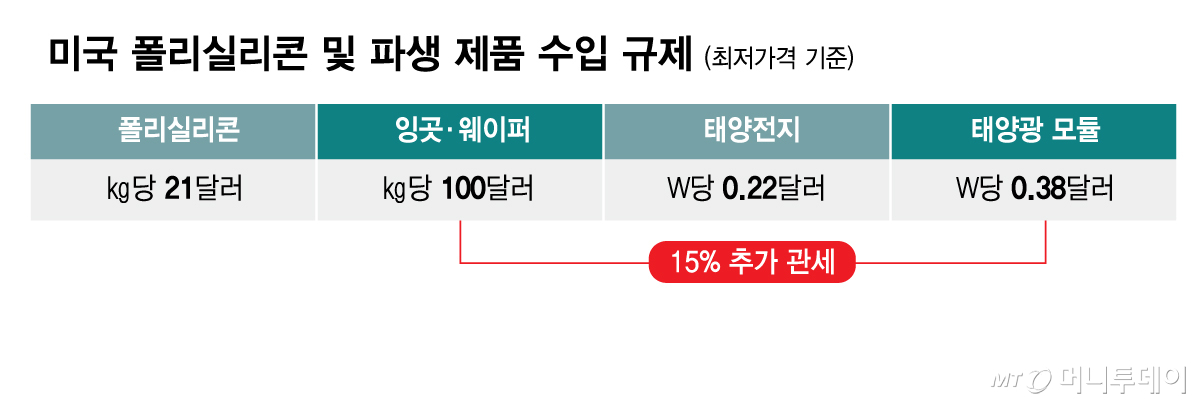
In the United States, efforts to counter China are intensifying. On the 6th (local time), the U.S. government announced import restrictions on polysilicon and its derivative products based on findings under Section 232 of the Trade Expansion Act. Starting December 4, minimum import prices (MIP) will be applied: $21 per kilogram for polysilicon, $100 per kilogram for ingots and wafers, $0.22 per watt for solar cells, and $0.38 per watt for solar modules. Additionally, a 15% supplementary tariff will be imposed on certain derivative products including ingots, wafers, cells, and modules. This appears to be a measure aimed at blocking circumvented exports of low-priced Chinese products and expanding the U.S. solar production base—which has been centered on module assembly—to include cells and wafers.
In response, domestic companies are emerging as alternative supply sources for replacing Chinese products. Hanwha Solutions' Q CELLS division (Hanwha Q CELLS), which operates an integrated solar production complex called "Solar Hub" in Georgia, U.S., covering ingots, wafers, cells, and modules, is highlighted as a key beneficiary. Previously, low-priced Chinese modules and wafers entered the U.S. market via Southeast Asia. With rising barriers to entry for such circumvented exports, Hanwha Q CELLS' competitiveness is expected to increase relative to others due to its direct local production in the United States.
OCI Holdings is also being watched as a beneficiary. OCI Holdings produces polysilicon through its Malaysian subsidiary, OCI TerraSus. As demand for polysilicon to replace Chinese products grows in the U.S., OCI's position as an alternative supplier in the global market is expected to strengthen. Furthermore, with restrictions on low-priced Chinese products entering the market and minimum pricing systems implemented, further declines in polysilicon prices are anticipated to be curbed. This could enhance the bargaining power of non-Chinese polysilicon producers, including OCI Holdings.
An industry official stated, "Given that China's supply reduction and U.S. efforts to counter Chinese supply chains are occurring simultaneously, there is a high likelihood of favorable market changes for domestic solar companies."

 in INDUSTRY
