

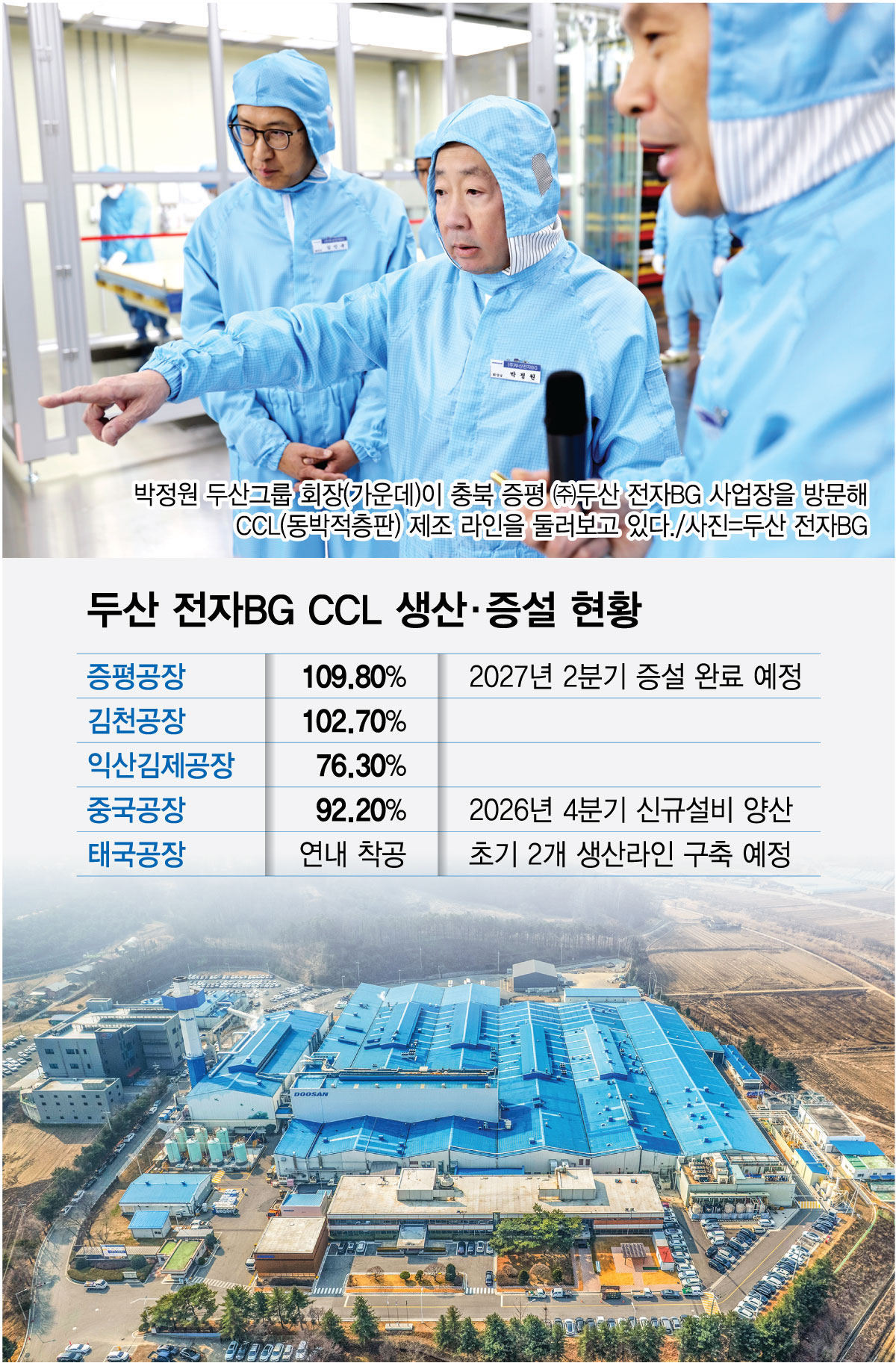
'109.8% and 102.7%'
Doosan Electronics BG's copper-clad laminate (CCL) production plants in Jeungpyeong, Chungcheongbuk-do, and Gimcheon, Gyeongsangbuk-do, have both exceeded 100% capacity utilization. This surge is attributed to the boom in investments for artificial intelligence (AI) data centers, which has driven a sharp increase in demand for high-value-added CCLs used in networking and semiconductor packaging. In response, Doosan Group is expanding its domestic and overseas production capabilities while simultaneously establishing a 'triangular alliance' in the semiconductor business through the acquisition of SK Siltron, covering everything from wafers (thin circular substrates used to manufacture semiconductor chips) to CCL and post-process testing.
According to industry sources on the 24th, Doosan Electronics BG plans to invest approximately 180 billion won to build a new CCL production plant in Thailand. The project aims to break ground by the end of this year and begin operations at the Yangsan site in the second half of 2028. Initially, two production lines will be established, with plans to expand up to eight lines depending on demand. The main products will be high-performance CCLs for AI infrastructure and networking equipment.
Existing production bases are also being expanded. New facilities at the China plant are scheduled to come online at Yangsan in the fourth quarter. It is understood that customer certification has already been completed, and orders have been secured. The expansion of the Jeungpyeong plant in Korea is expected to be completed by the second quarter of next year. As demand for high-performance CCLs rises rapidly due to increased investments in AI data centers, Doosan has taken preemptive measures to bolster production capacity both domestically and abroad.
Currently, technology for CCLs used in semiconductor packaging is advancing primarily around ultra-thin profiles, fine circuitry, and high-speed signal transmission. As semiconductors become more integrated and higher-performing, it becomes increasingly critical to produce thinner substrates while stably implementing fine circuit patterns and minimizing signal loss during data transmission. These technical requirements are expanding beyond memory chips to the broader non-memory semiconductor market.
Jeong Su-im, head of the P&AM Development Team at Doosan Electronics BG, stated, "As substrates continue to become thinner, developing such products is gradually becoming essential." He emphasized, "Beyond ultra-thin technology, ensuring fine circuit process stability and reliability under high-temperature and high-humidity conditions is necessary. The key lies in perfectly implementing specifications comparable to Yangsan-level performance within the environment of increasingly thin ultra-thin substrates."
Notably, Doosan Electronics BG applies different technologies depending on the application area of CCLs. For CCLs used in AI accelerators and networking equipment, the focus is less on reducing thickness and more on minimizing signal loss that occurs during high-speed data exchange. Given the need for mass supply, the ability to stably procure raw materials and deliver products on time is a decisive factor in securing orders, making supply chain management a key competitive advantage.
Doosan has established its semiconductor 'triangular alliance' with the successful acquisition of SK Siltron 19 years after Doosan Bobcat. In this structure, SK Siltron produces wafers—the starting point of semiconductor manufacturing—while Doosan Electronics BG supplies CCLs, and Doosan Tesna handles post-process operations such as wafer testing and package testing for system semiconductors. Park Jeong-won, Chairman of Doosan Group, is personally overseeing AI and semiconductor businesses. Following his visit to the Jeungpyeong plant in February this year to inspect CCL products, he also held discussions on cooperation with Jensen Huang, CEO of NVIDIA, during his visit to Korea in June. Doosan Electronics BG is currently supplying high-end CCLs for AI accelerators to NVIDIA.
A Doosan official remarked, "CCL products are the culmination of 50 years of accumulated product development experience and technical expertise." He added, "As package structures and designs become more complex, our strengths in controlling warping and ensuring long-term reliability will allow us to lead the industry as a partner that collaborates with customers to solve their development challenges."

 in INDUSTRY
