

![[Seoul=NEWSIS] Reporter Park Young-tae = On the afternoon of the 24th, dealers work at the Hana Bank headquarters dealing room in Jung-gu, Seoul, as the KOSPI closed down 215.99 points (3.12%) at 6,696.96. Samsung Electronics fell 8.7% and SK Hynix dropped 3.4%, both closing lower on the day. 2026.08.24. since1999@newsis.com /Photo=Park Young-tae](https://thumb.mt.co.kr/cdn-cgi/image/f=avif/21/2026/08/2026082415344234551_1.jpg)
An assessment suggests that the current situation facing Samsung Electronics and SK Hynix symbolically reflects a scenario where Chinese memory semiconductor companies are launching large-scale initial public offerings (IPOs) one after another, while Nvidia, the emperor of the AI era, is raising prices due to cost pressures. This occurs even as the industry faces its greatest boom in history, yet simultaneously sows the seeds of instability.
Consequently, voices are growing louder that given the critical opportunity for the national economy based on the massive profitability of the two domestic semiconductor companies known as 'Sanjeonix,' the government must adopt a more cautious approach than ever before to help these companies overcome such dilemmas.
According to foreign media and industry sources on the 24th, Chinese NAND flash manufacturer YMTC (Yangtze Memory Technologies Corp.) is pursuing an IPO on Shanghai's STAR Market (China's NASDAQ). This follows CXMT (Changxin Memory Technologies), which recently surged to become China's top stock market company by market capitalization immediately after its IPO, signaling that latecomers are beginning their full-scale challenge on the global stage.
Of course, their current technological level does not match that of Sanjeonix. There is a gap of at least two to three years in their core product lines. Nevertheless, the fact that they are proceeding with IPOs while promoting record-breaking fundraising plans demonstrates how optimistic the outlook for the memory semiconductor market has become.
The problem is that even Chinese companies with inferior technology are now making money thanks to a boom driven by shortages—"not being able to sell because there isn't enough." CXMT, which had been incurring losses since its establishment in 2016, turned profitable last year. If it secures additional investment through an IPO, latecomers will gain a more favorable environment to narrow the technological gap.
Nvidia's price hikes also fully reflect the dual nature of today's global semiconductor market. According to Bloomberg and others, Nvidia plans to raise AI server prices by at least 15% starting from shipments next year. This indicates that it could no longer bear skyrocketing costs caused by the memory shortage.
In other words, this means Sanjeonix's bargaining power has significantly increased as a supplier of core products like HBM (high-bandwidth memory) to Nvidia. While all major tech companies are pleading for "memory," Nvidia could not be given special treatment alone.
However, this too is a risk factor. If prices of key products such as Nvidia's AI accelerators rise, the burden on major tech companies that must purchase them to proceed with infrastructure investments will increase further. This could negatively impact profitability across the entire AI industry; if prolonged, it may even lead to market contraction.
This is also why Choi Tae-won, chairman of SK Group, said at last month's Jeju Forum, "I am worried prices will rise further," and added, "We must think about increasing supply and protecting the market by lowering profit margins so that we can grow together."
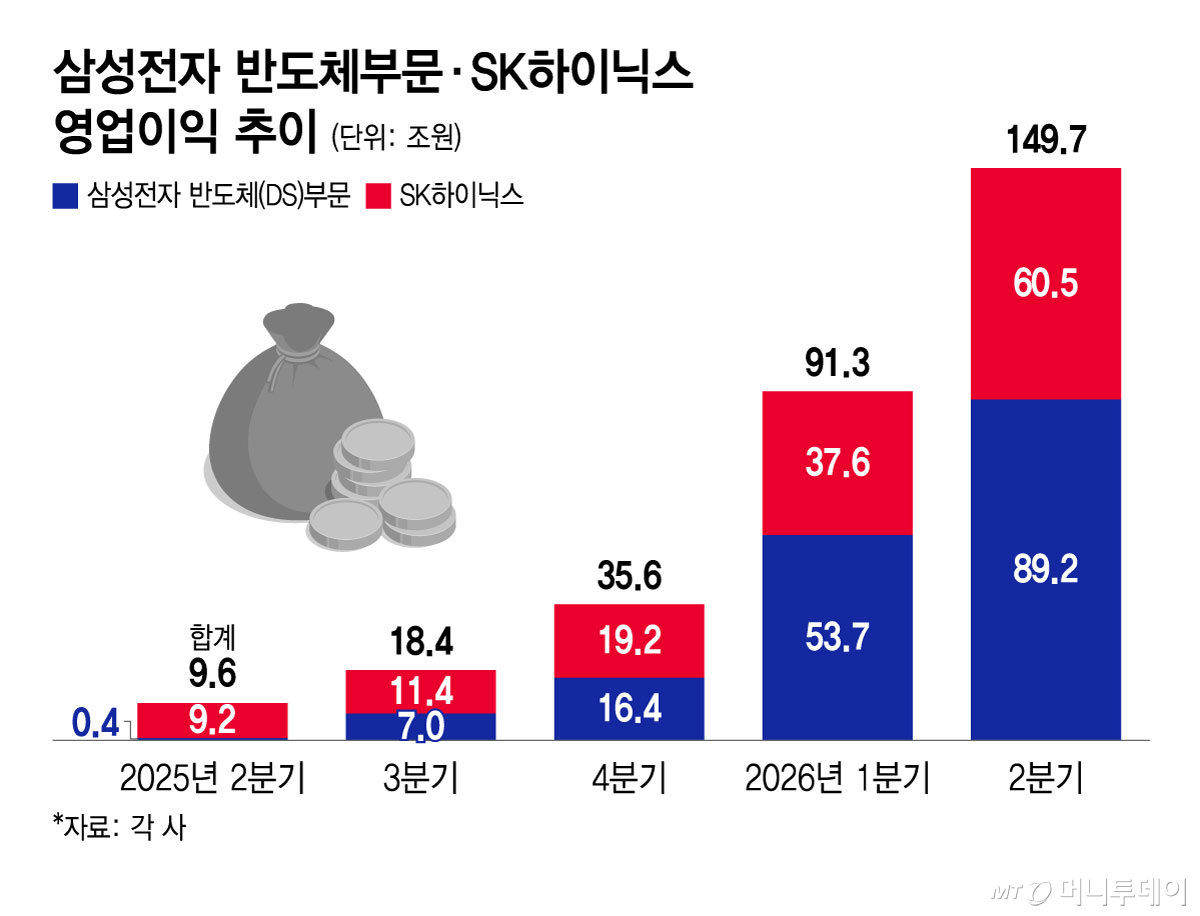
Moreover, the chaotic market situation adds to the burden. As unrealistic figures such as hundreds of trillions of won in profits and thousands of trillions of won in investments—numbers never experienced before—are poured out, abnormal market expectations are adding complexity. A representative example is Samsung Electronics' stock price plummeting 8.7% on the day despite announcing a shareholder return policy of up to 110 trillion won for this year after the market closed on the 21st.
An industry insider diagnosed, "It seems stakeholders are struggling to set rational standards because performance has improved so suddenly that there is no comparable past case."
Given these circumstances, this is a strategically very important moment for Sanjeonix to rapidly increase production capacity through the most efficient method, consolidate market dominance and stability, and build market trust.
![[Seoul=NEWSIS] Reporter Jo Seong-bong = President Lee Jae-myung speaks after listening to investment plan announcements by Samsung Electronics Chairman Lee Jae-yong (right) and SK Chairman Choi Tae-won at the 'Republic of Korea's Great Leap Forward 3 Mega Projects National Report Meeting' held at the Cheong Wa Dae Guest House on the 29th. 2026.06.29. suncho21@newsis.com /Photo=Jo Seong-bong](https://thumb.mt.co.kr/cdn-cgi/image/f=avif/21/2026/08/2026082415344234551_3.jpg)
However, concerns are being raised in the industry that the South Korean government is emerging as the biggest variable. As massive investments such as the Honam semiconductor industrial complex have been announced under government leadership, criticism has emerged that the government is dictating corporate decisions by saying things like "build X number of fabs (factories) here." Even rumors continue to circulate that just over a month after the Honam fab investment plan was announced, there will be "additional construction of N more facilities."
As noisy investment news emerges from South Korea's political circle and government, the Trump administration in the United States, which is betting its all on attracting semiconductor factories, is also increasing pressure on Sanjeonix by saying things like "build it in the U.S." There are repeated calls that industrial policy should be pursued reflecting only expert opinions and the urgent demands of our companies, without any intervention from political logic or the interests of specific groups.
Hanyang University Professor Hanyang In suggested, "For our country, this may be the last great opportunity we can seize." He added, "It is essential for the government to play an active role; what matters is how it does so. Currently, efforts should focus solely on long-term national growth strategies and strengthening corporate competitiveness."

 in INDUSTRY


