

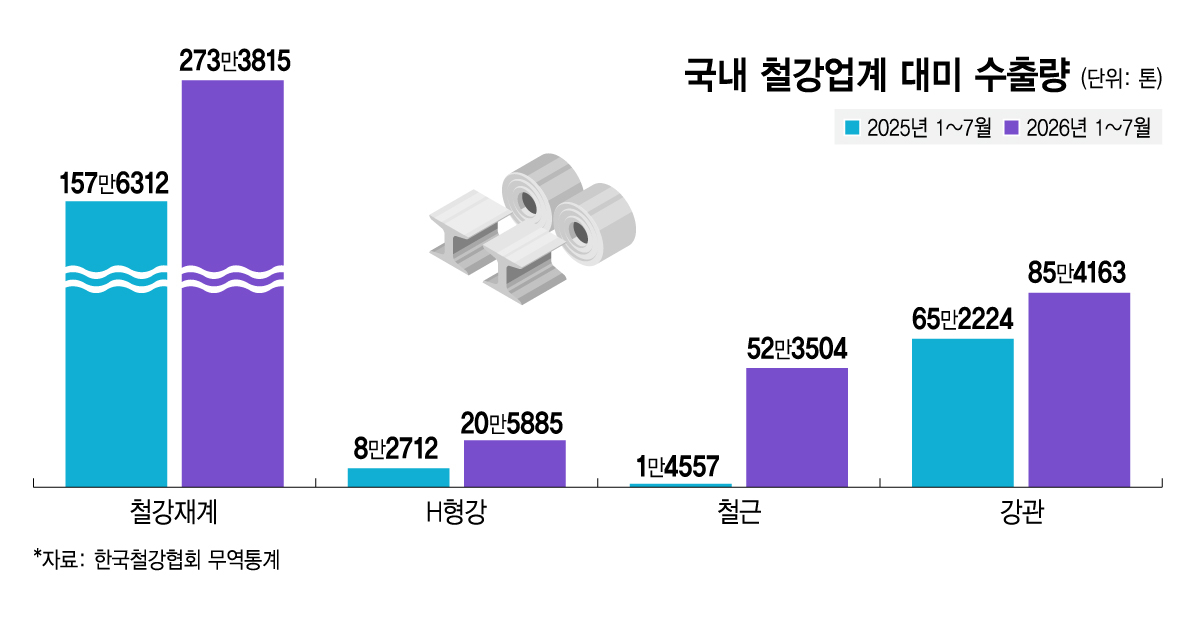
As the artificial intelligence (AI) data center industry grows, exports of related steel products such as rebar and H-beams from South Korea's steel sector to the United States have surged significantly. With the government's "three mega-projects" expected to boost domestic demand, the second half of the year is anticipated to bring improved performance for the steel industry.
According to trade statistics released by the Korean Steel Association on the 25th, South Korea's steel exports to the U.S. totaled 2.73 million tons (2,730,000 tons) from January to July this year, a 73% increase compared to the same period last year (1.58 million tons). Despite heightened U.S. tariff barriers on steel, export volumes have actually risen.
Analysis indicates that the surge was driven primarily by steel used in AI data centers. For example, rebar used for data center structural frameworks jumped from 14,557 tons in January–July last year to 523,504 tons this year. Similarly, H-beams, another key structural material, increased more than twofold from 82,712 tons to 205,885 tons during the same period. Steel pipes used for data center cooling systems and energy infrastructure rose by approximately 30%, from 652,224 tons to 854,163 tons.
In response, major companies have taken action, including establishing dedicated teams. POSCO launched its "Future Demand Development Office" in mid-July, while Hyundai Steel formed a "Next-Generation Power Infrastructure Core Industry Task Force (TF)" in March. Dongkuk Steel selected an executive responsible for exports within its sales division and consolidated sales, trade, and logistics functions under one unit to strengthen organizational capabilities. Most of these companies cited steel products related to AI data centers as a key factor for expected performance recovery in the second half of this year and next year during their Q2 earnings reports. It is reported that inquiries from construction firms regarding steel supply for data centers continue to reach major domestic steel producers.
Industry observers expect expansion beyond structural materials into areas such as energy storage system (ESS) enclosures and power grid infrastructure. This reflects the potential for steel companies to play a role across the entire value chain linked to data centers, not just within them. POSCO and Hyundai Steel are pursuing strategies to package related products. SeAH Steel plans to expand sales of stainless steel (STS) pipes and oil transmission lines in response to rising power demand from data centers. An industry official stated, "Given the strong U.S. policy of protecting its domestic steel industry, we will respond by differentiating ourselves from local companies."
Domestic demand is also expected to grow, with the government's announced "three mega-projects" serving as a prime example. New orders are anticipated to rise, particularly around semiconductor fabs and data centers. According to industry analysis, approximately 180,000–200,000 tons of steel are required per gigawatt (GW) of data center capacity, while one memory semiconductor factory needs about 100,000 tons. This means demand will inevitably increase for various steel products ranging from rebar to hot-rolled and cold-rolled sheets and plates.
An industry official said, "We are also developing high-value-added new materials related to AI and data centers," adding, "Given the expectation of sustained growth, we will strive to secure demand."

 in INDUSTRY
