

Samsung Electronics has received a double windfall from rising prices in HBM (high-bandwidth memory) and foundry (semiconductor contract manufacturing). As shipments of HBM4 expand, they are boosting the profitability of memory semiconductors (hereinafter referred to as memory), while the 4nm process (1nm = one-billionth of a meter) is operating at full capacity due to surging orders for AI (artificial intelligence) semiconductors.
According to the electronics industry on the 25th, Samsung Electronics has entered the final stage of negotiations for HBM supply prices in 2027. Samsung Electronics plans to finalize supply volumes and prices by reflecting customer-specific requirements and supply-demand conditions. With the production share of high-value-added products like HBM4 increasing, the overall average selling price (ASP) of HBM is also expected to rise.
Global investment bank Goldman Sachs forecasts that next year's HBM average selling price will reach $17 per gigabyte, a 44% increase from this year. With HBM demand projected to grow by 76%, the market size next year is expected to nearly double to $116.267 billion compared to this year. This reflects a structure where both prices and sales volumes are rising simultaneously.
In particular, Samsung Electronics' HBM shipment volume is expected to increase significantly. Goldman Sachs analyzed that Samsung Electronics' HBM revenue this year surged 234% from last year, rapidly recovering its market share. It was reported that Samsung Electronics is pursuing an aggressive sales strategy to expand its market share even in price negotiations.
Internally, Samsung Electronics expects HBM4 revenue in the third quarter of this year to more than triple compared to the previous quarter, with HBM4 accounting for over 60% of total HBM revenue in the second half of the year. The goal is to secure the number one market share in the HBM market during the second half. With general-purpose DRAM prices also continuing their upward trend, the company plans to optimize its portfolio toward high-value-added products in response to demand changes.
Growth foundations are being laid not only in memory but also in foundry. NVIDIA announced today that it has begun full-scale Yangsan of its AI inference accelerator 'Groq 3 LPX'. Groq 3 LPX, which will be mounted on NVIDIA's next-generation AI platform 'Vera Rubin', serves to enhance AI inference performance.
Groq 3 LPX will be produced entirely by Samsung Electronics' foundry business. Samsung Electronics is manufacturing the product using its 4nm process at the Pyeongtaek campus. The 4nm process is also used for producing base dies (the bottommost layer) of Samsung Electronics' HBM4. Entering its sixth year since adoption, the 4nm process has seen significant improvements in yield and process stability.
With orders for AI semiconductors and HBM4 base dies pouring in, Samsung Electronics' 4nm production line has effectively entered a state of full capacity. As supply capacity becomes tight, it was reported that Samsung Electronics has raised prices on some new orders by up to 15%. Price increases are also spreading to the 5nm and 8nm processes.
TSMC, the world's number one foundry provider, is pushing for price increases in its 2027 supply volumes, which also works in Samsung Electronics' favor. With the leading company initiating price hikes, Samsung Electronics can now reduce the burden of customer attrition and pursue a revenue-focused order strategy.
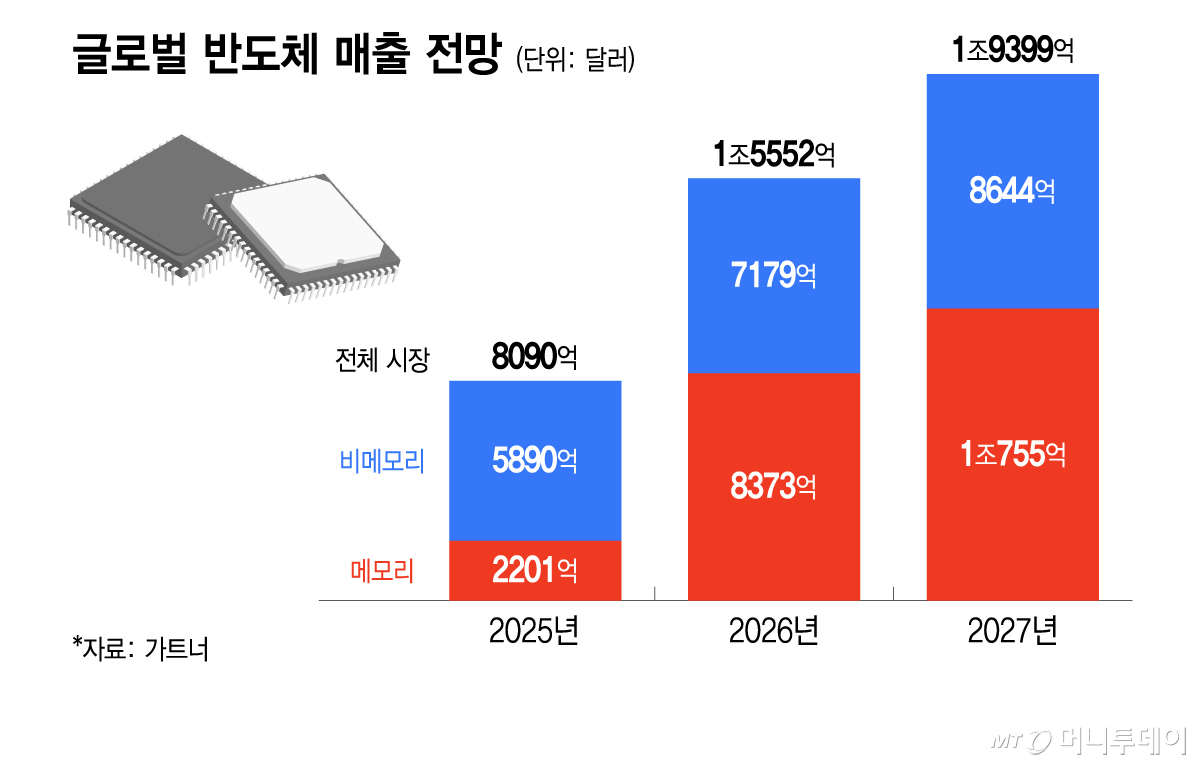
Driven by expanded AI infrastructure investment and rising memory prices, the global semiconductor market is also expected to grow sharply. Market research firm Gartner forecasts that global semiconductor sales this year will reach $1.5552 trillion (approximately 2,159 trillion won), a 92% increase from last year. Next year's growth is projected to reach $1.9399 trillion (approximately 2,693 trillion won).
Memory is identified as the key driver of semiconductor market growth. This year's memory sales are expected to reach $837.3 billion (approximately 1,162 trillion won), and next year they are projected to exceed $1.0755 trillion (approximately 1,493 trillion won). Memory sales are expected to account for 54% of total semiconductor sales this year, surpassing non-memory sales.
Gartner stated, "AI infrastructure has changed the dynamics of the memory market," adding, "AI is not just benefiting specific product categories but is expanding opportunities across the entire semiconductor market within the infrastructure stack."

 in INDUSTRY
