

Samsung Electronics is expanding its MLCC price hike targets from distributors to finished product manufacturers. The scope now includes not only general-purpose products but also high-specification models used in artificial intelligence (AI) servers. As price adjustments previously limited to distribution channels now extend to actual production customers, upward pressure on MLCC prices is spreading throughout the supply chain.
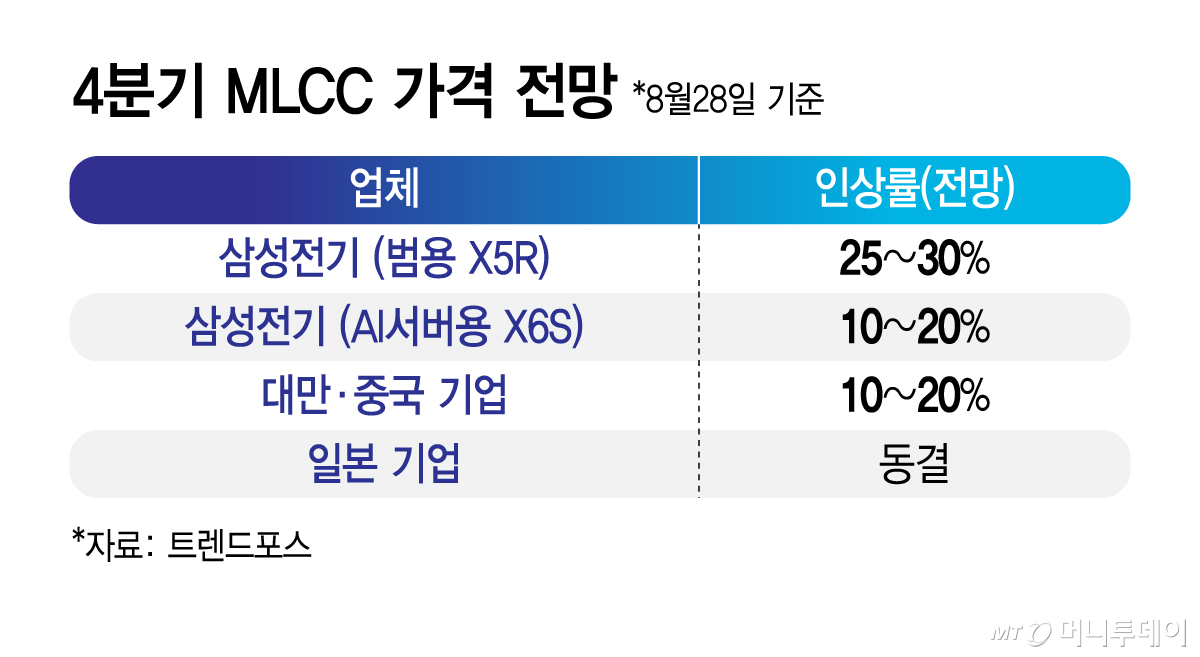
According to market research firm TrendForce on the 28th, Samsung Electronics plans to raise MLCC prices for OEM (original equipment manufacturer) and ODM (original design manufacturer) clients in the fourth quarter of this year. General-purpose consumer X5R products are expected to rise by an average of 25–30%, while high-specification X6S models used in AI servers are projected to increase by an average of 10–20%, depending on negotiations with customers.
This adjustment covers a broader scope than previous price hikes. Earlier this month, Samsung Electronics raised MLCC prices supplied to distributors by 30%. However, the fourth-quarter hike notably extends the price increase to OEM and ODM clients who actually produce products. In particular, high-specification X6S models used in AI servers have been included in the price adjustment scope.
The background for price increases differs between general-purpose X5R and high-specification X6S models. Samsung Electronics appears to be raising X5R prices significantly to regulate orders, then utilizing the freed production capacity to expand production lines for high-specification products. In contrast, AI server-grade X6S follows a structure where increased demand directly drives price increases. This is interpreted as part of Samsung Electronics' strategy to shift production focus toward high-specification models by adjusting orders for general-purpose products.
As some orders for medium- and high-capacity consumer MLCCs shift to Taiwanese and Chinese manufacturers, these firms are also expected to raise prices by an average of 10–20% in the fourth quarter. Some companies' production capacity utilization is already approaching 90%. With general-purpose demand dispersing to other manufacturers and available supply shrinking, upward pressure on prices is spreading across the entire market.
Additionally, growing MLCC demand centered around AI data centers is increasing supply burdens. Industry sources indicate that inventory levels for major MLCC products have fallen below 30 days. As AI-related demand continues, the gap between supply and demand is likely to widen further in the fourth quarter, with price increases expected to persist.
However, not all upstream industries relying on MLCCs are experiencing strong demand. The traditional ICT and automotive sectors may see weaker-than-usual seasonal demand in the second half of this year due to economic slowdowns in China and the United States and a decline in consumer sentiment. Ultimately, analysts suggest that this MLCC price increase stems less from a broad recovery in upstream demand and more from rising demand for high-specification products centered on AI and production adjustments by suppliers.
Whether the price increase trend will spread across the entire MLCC industry depends on the actions of Japanese manufacturers. Murata, Taiyo Yuden, and Kyocera are currently holding prices steady while monitoring market conditions. With Taiwanese and Chinese firms expected to follow Samsung Electronics in raising prices, if major Japanese companies also join the hike, it could signal a broader price increase trend across the entire MLCC industry.
An industry executive stated, "As demand for high-specification MLCCs centered on AI servers rises rapidly, suppliers are continuing to prioritize allocating production capacity to higher-value-added products." He added, "The future price policies of Japanese manufacturers and the supply-demand situation for AI-related products will determine whether the MLCC price increase trend continues."

 in INDUSTRY
