

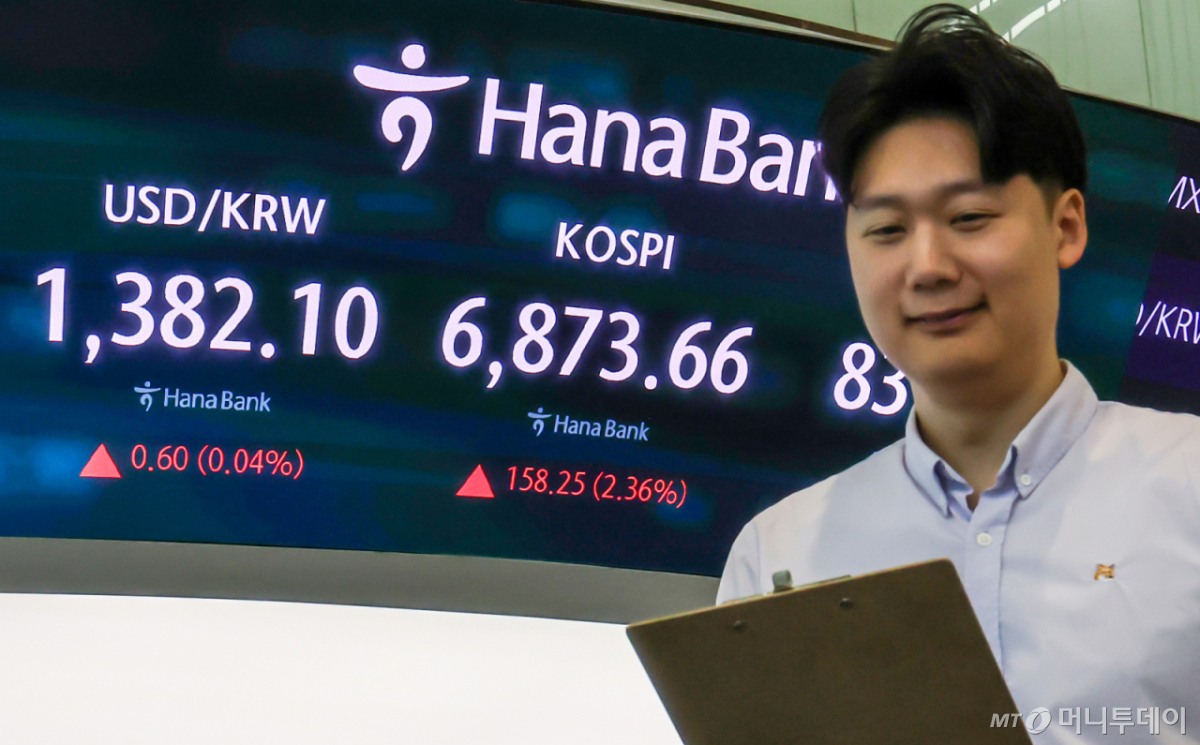
The won's appreciation is lowering expectations for the third-quarter earnings of domestic electronics companies this year. Despite improvements in business conditions such as semiconductors, displays, and components, as well as seasonal effects, there are predictions that the decline in the won/dollar exchange rate could limit the extent of earnings improvement. The electronics industry plans to respond through currency hedging and expanding the share of high-value-added products.
According to the Bank of Korea's Economic Statistics System on the 18th, the daily average exchange rate from July 1 to the previous day was 1430.37 won, a drop of about 4.8% compared to the second-quarter average of this year (1501.93 won). The won/dollar exchange rate, which surged to as high as 1561.5 won during trading on June 5, has been fluctuating in the 1300th-won range since the 21st of last month.
For the electronics industry with a high export share, a decline in the won/dollar exchange rate could act as an earnings burden. This is because even if products are sold at the same dollar price, the revenue converted into won decreases. While there are differences among companies, transaction rates or quarterly average exchange rates are typically applied to income statement items such as sales.
Exchange rates also affect the valuation of foreign currency-denominated assets. Foreign currency assets such as foreign currency deposits and accounts receivable are converted at the exchange rate at the end of the quarter; therefore, if the won/dollar exchange rate falls, the amount converted into won decreases.
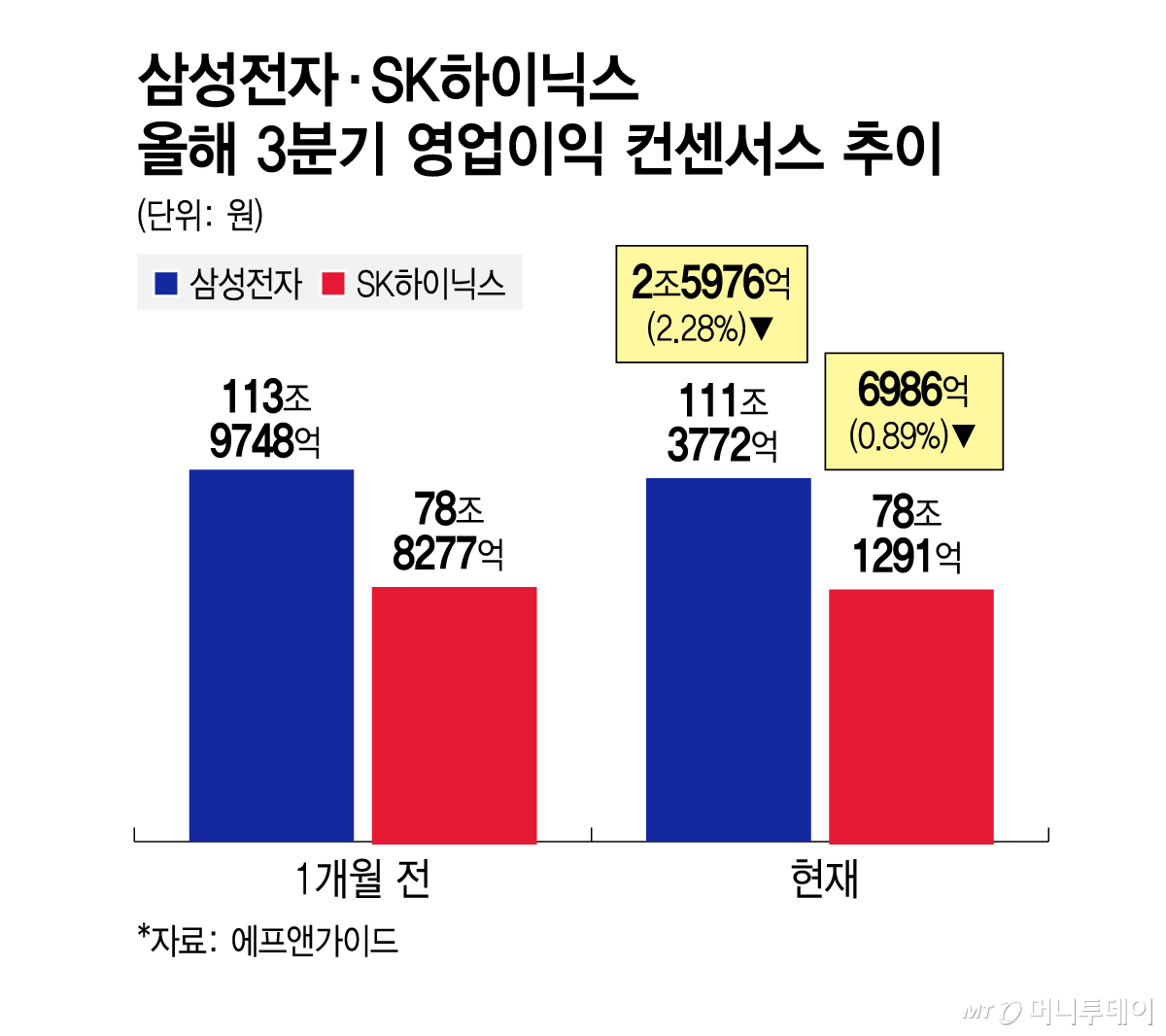
In fact, securities firms are also lowering their expectations for the third-quarter earnings of major domestic electronics companies by reflecting factors such as the decline in the won/dollar exchange rate. According to financial information provider F&Guide, Samsung Electronics' operating profit consensus estimate (average forecast by securities firms) for the third quarter of this year was adjusted downward by 2 trillion 597.6 billion won (2.28%) from a month ago to 111 trillion 377.2 billion won. SK Hynix also saw its estimate for the same period decrease by 698.6 billion won (0.89%), from 78 trillion 827.7 billion won to 78 trillion 129.1 billion won.
In its annual business report last year, Samsung Electronics estimated that a 5% decline in the won/dollar exchange rate would reduce net income (before corporate tax effects) by approximately 435.1 billion won. SK Hynix also analyzed that if the exchange rate falls by 10%, pre-tax profit would decrease by about 1 trillion 210.4 billion won. Lee Min-hee, a researcher at BNK Investment & Securities, stated, "The average won/dollar exchange rate is expected to fall from an initial 1480 won to 1420 won," and added, "Due to the slowing rise in memory semiconductor prices and the impact of the strong won, both Samsung Electronics and SK Hynix are likely to report third- and fourth-quarter operating profits below market expectations this year."
In the display industry, there are concerns that the strong won could halve the seasonal effect despite the launch of new products by major customers in the second half of the year. Additionally, the possibility of a slowdown in demand across IT (information technology) devices due to rising memory prices is cited as a concern. A display industry official said, "Display industry earnings typically follow a pattern of being low in the first half and high in the second half ('low in the first half, high in the second half'), but this year there is concern that the decline in exchange rates could offset this effect."
Component companies such as Samsung Electro-Mechanics and LG Innotek are also closely monitoring exchange rate fluctuations. Samsung Electro-Mechanics and LG Innotek accounted for 95.6% and 96.2%, respectively, of overseas sales in the first half of this year. Both companies operate overseas production bases, but since a high proportion of their key products is produced domestically for export, the strong won could act as a variable affecting earnings improvement.
An electronics industry official said, "Since exchange rates fluctuate continuously, each company uses currency hedging tools to manage volatility risks," and added, "As it is difficult to completely avoid the impact of exchange rates, we will strive to minimize the effect on profitability by expanding the share of high-value-added products and strengthening cost competitiveness."

 in INDUSTRY

