

Samsung Electronics is expanding its advanced process production capacity for foundries (semiconductor contract manufacturing) driven by the growth of the HBM (high-bandwidth memory) market. With surging demand for HBM4 (6th-generation HBM) base dies, the 4nm (㎚·㎚=1/10 billion meter) process has reached full operation, and expansion is under review. There are also discussions about the possibility of new investment in a 2nm production line to support HBM5 (8th generation).
According to the electronics industry on the 21st, Samsung Electronics is reviewing an expansion of its foundry 4nm process capacity to meet the growing demand for HBM4 base dies. Samsung Electronics' HBM4 consists of a core die using 10nm-class 1c (6th-generation) DRAM and a base die produced using the 4nm process logic semiconductor.
The base die serves as a connection at the bottom layer of HBM to rapidly exchange data with AI accelerators such as GPUs (graphics processing units). As HBM's operating speed increases and its capacity grows, the data processing performance and power efficiency of the base die have become increasingly important.
Unlike SK Hynix, which utilizes TSMC's 12nm process for HBM4 base dies in Taiwan, Samsung Electronics has adopted a strategy to enhance performance and power efficiency by applying its own 4nm process. Samsung Foundry's 4nm 4th-generation process, having fully verified performance and yield at the Yangsan facility after four years of operation, played a significant role in the early stabilization of HBM4.
Samsung Electronics' 4nm process is already operating production lines at full capacity. In addition to expanding HBM4 production, NVIDIA's AI inference semiconductor "Groq3 LPU (language processing unit)" is also being manufactured using Samsung Foundry's 4nm process. With demand surging, Samsung Electronics recently raised prices for new orders in the 4nm segment. Particularly, with the expected expansion of NVIDIA's next-generation AI platform "Ver Rubin" supply in the second half of the year, HBM4 demand is projected to increase significantly. Samsung Electronics expects its HBM4 revenue in the third quarter to more than triple compared to the previous quarter.
To respond to HBM demand, Samsung Electronics plans to allocate most of the additional expansion capacity at its P4 (Factory 4) facility in Pyeongtaek, Gyeonggi Province, to the production of 1c DRAM for HBM. It is also reported that Samsung Foundry has currently allocated more than half of its 4nm production capacity to HBM4 base die production. Additionally, the 4nm base die will be applied to HBM4E, which is the 7th-generation HBM. In May, Samsung Electronics became the first in the industry to supply HBM4E samples to customers and is currently discussing detailed specifications. The industry view is that if HBM4 and HBM4E become flagship products, the current 4nm production capacity alone will be insufficient to meet demand. Expansion of base die production capacity is also necessary.
Samsung Electronics is also reviewing the construction of a new 2nm production line to support HBM5. The HBM5 base die aims to utilize a 2nm process with a GAA (gate-all-around) structure and increase TSV (through-silicon via) integration density, targeting a more than 50% improvement in operating speed compared to HBM4E. This creates a structure where HBM demand in Daejeon leads to advanced process demand for foundries and new investments.
Samsung Electronics began operations at its Yangsan facility with the 1st-generation 2nm process in the second half of last year and has now started mass production of products based on the 2nd-generation 2nm process, which features improved yield and performance in the second half of this year. It is also expanding its customer base to include mobile APs (application processors) and Tesla. The strategy is to proactively introduce the 2nm process for HBM5 to solidify technological leadership.
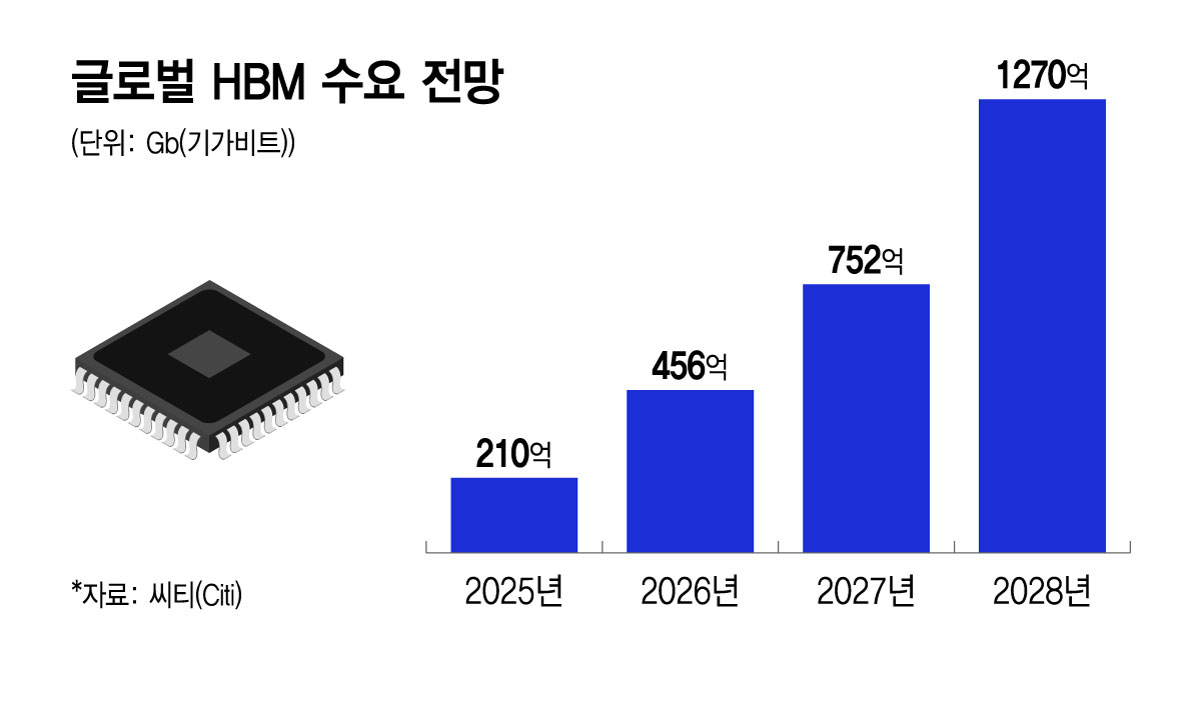
The speed of Samsung Electronics' HBM supply expansion is expected to accelerate. Citigroup forecasts that Samsung Electronics' HBM supply volume will increase by 2.3 times next year compared to this year, and its market share will rise from 30% this year to 42% next year, securing the top position.

 in INDUSTRY
