

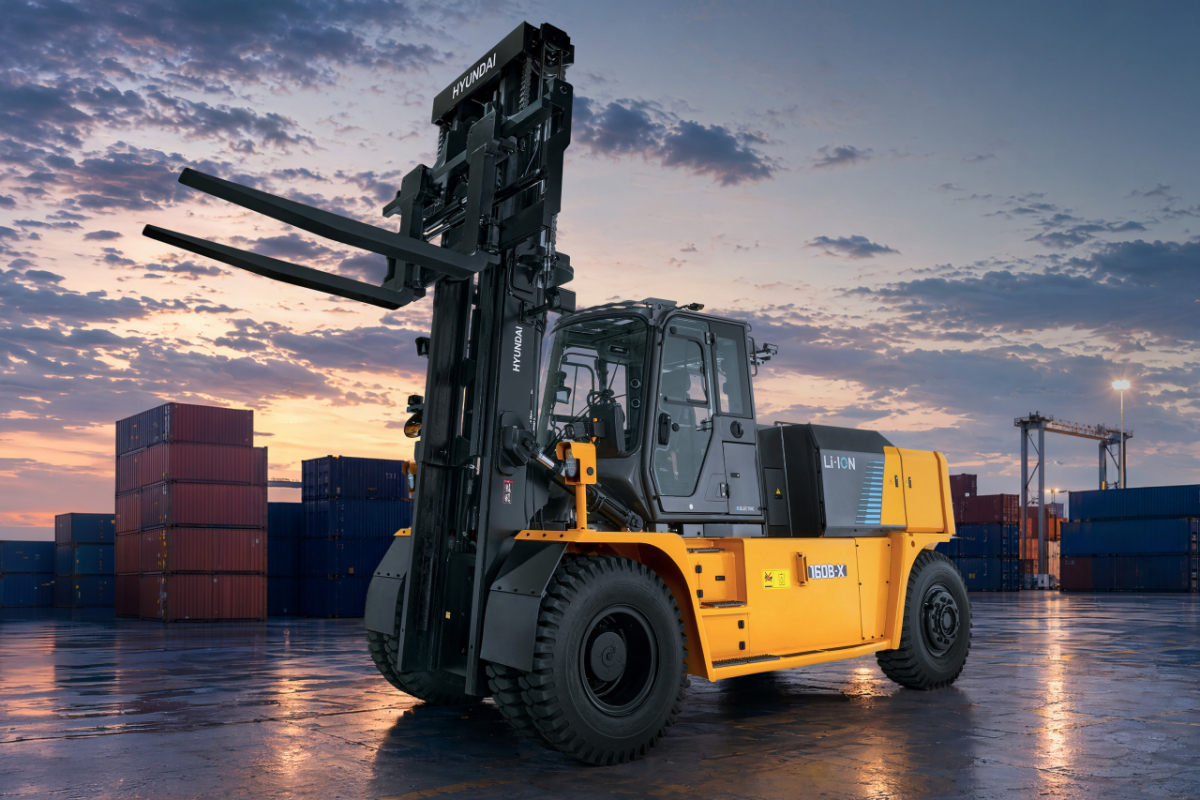
HD Hyundai Site Solutions announced on the 5th that it will expand its electric forklift product lineup to cover the 10th- to 18-ton class.
The company has established a full lineup by launching a wide range of large electric forklifts, marking the first time a domestic brand has done so. In Korea, HD Hyundai Site Solutions is the only manufacturer producing models classified as large, which are 10 tons or more. The company expects this move to serve as an opportunity to expand the scope of electrification to ultra-heavy-duty work sites such as shipyards and ports.
Until now, diesel forklifts have been predominantly used at heavy-duty work sites in shipyards, ports, and steel plants due to their high output and ability to operate for long hours, which are essential for productivity. Recently, with the strengthening of environmental regulations and growing demands to reduce carbon emissions, maintaining productivity comparable to internal combustion engine products while reducing exhaust gases has emerged as a core challenge in electrifying large forklifts.
HD Hyundai Site Solutions addressed this through high-voltage systems and fast-charging technology. Based on a high-voltage battery system, the company secured stable output as needed and enhanced electric motor performance, achieving work speed, gradeability, and high output comparable to internal combustion engine products.
In particular, even the largest 18-ton-class model can operate for up to nine hours on a single charge. With an optional 120-kilowatt fast charger, the battery can be charged to 80 percent in just 1.5 hours. Depending on the equipment, it can run for up to 14 hours on a single charge (based on the 4.5-ton class), allowing it to handle a full day’s workload with ease.
The company secured certification under “UL 2580,” the U.S. safety standard for battery systems, by applying safety designs such as real-time monitoring and control of high-voltage circuits and battery status. It also applied waterproof and dustproof design rated “IP67” or higher, enhancing stability so that the equipment can operate reliably even in outdoor environments frequently exposed to sea breezes and rain.
Economic efficiency has also been improved. An analysis of total cost of ownership (TCO) based on medium-intensity work showed that the initial price difference compared to diesel products can be offset within approximately two to three years.
According to market research firm Mordor Intelligence, the global electric forklift market is projected to grow at a compound annual growth rate of 5.12 percent from $52.55 billion (approximately 71.4 trillion won) in 2026 to $67.44 billion (approximately 91.6 trillion won) in 2031. Among this, the medium- and large-sized market segment of 5 to 15 tons is expected to grow at a faster pace, with a compound annual growth rate of 8.21 percent over the same period.
An official from HD Hyundai Site Solutions said, “The large next-generation electric forklift is a product that can respond to environmental regulations without compromising productivity, based on performance comparable to internal combustion engine forklifts.” The official added, “We will provide electrification solutions optimized for various work environments and further strengthen our competitiveness in the global market.”

 in INDUSTRY
