

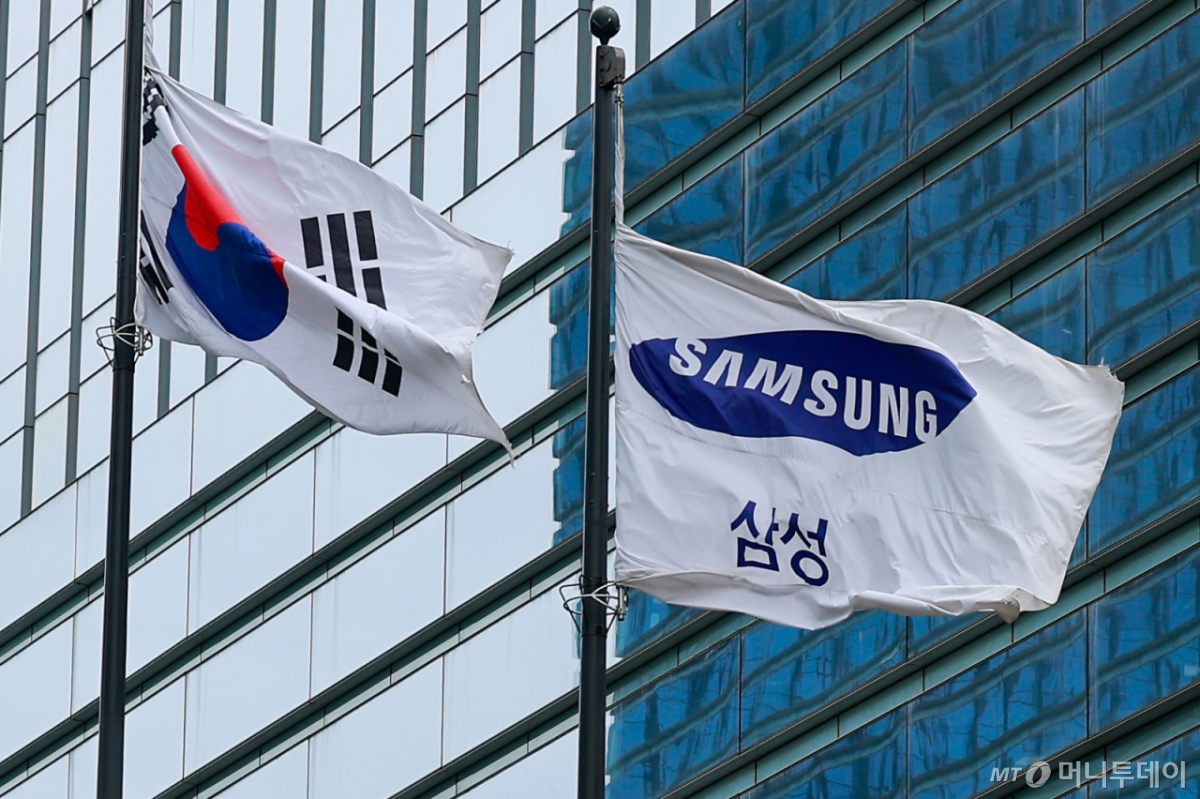
Samsung Electronics has written a new chapter in the history of global corporations. Amid the "super cycle" (boom) of memory semiconductors in the AI (artificial intelligence) era, it became the first tech company in Korea and around the world to surpass 100 trillion won in quarterly operating profit. As semiconductor shortages deepen, performance records are expected to continue being broken.
Samsung Electronics announced on the 8th its preliminary results for the third quarter of 2026: consolidated revenue of 195 trillion won and operating profit of 107.4 trillion won. Revenue surged 126.6% year-on-year, while operating profit jumped 782.5%, both marking all-time highs. Operating profit exceeded market expectations (approximately 106 trillion won) by more than 1 trillion won, surpassing the previous quarter's figure of 89.4924 trillion won to record its fourth consecutive quarter of all-time high performance since the fourth quarter of last year. Cumulative revenue also surpassed 500 trillion won.
A quarterly operating profit in the 100th trillion won range is an unprecedented achievement, both domestically and globally. Compared with Nvidia, the world's top company by market capitalization, which posted operating profit of approximately 85 trillion won (63.73 billion dollars) in the previous quarter, Samsung Electronics earned more than 20 trillion won more. This effectively makes Samsung Electronics the most profitable company on Earth today. Looking at history, it is virtually unique, with perhaps only Saudi Arabia's state-owned oil company Aramco as an exception, and it marks the first such record for a tech company.
The semiconductor (DS) division is clearly the main contributor. The memory business unit's operating profit is estimated to be around 110 trillion won, exceeding the total operating profit. The operating profit margin is also expected to reach the 80th% range. This means that for every 1,000 won in sales, more than 800 won remains as profit. In particular, from this quarter, revenue from HBM4 (6th-generation high-bandwidth memory) for Nvidia's next-generation AI platform "Vera Rubin" began to be fully reflected, boosting performance.
The upward trend in DRAM prices also continued. Market research firm TrendForce analyzed that general-purpose DRAM contract prices rose 13% to 18% from the previous quarter in the third quarter of this year. Although the rate of increase slowed compared to the previous quarter (53% to 58%), it remains a double-digit growth rate. As the production share of HBM4 expands, supply capacity for general-purpose DRAM has relatively decreased, leading to an even tighter supply-demand situation.
Non-memory areas, such as the foundry (semiconductor contract manufacturing) business, are also estimated to have improved their loss margins. Samsung Electronics' HBM4 is equipped with base dies based on its own 4-nanometer (nm; 1 nm = one-billionth of a meter) process. As HBM4 production increases, foundry utilization rates improve structurally. In addition, mass production of "Groq3" for Nvidia's AI inference-dedicated chip in Yangsan has also been fully launched.
Outlook is bright. The industry's dominant view is that the streak of performance records will continue at least until next year. This is because semiconductor production capacity can only be increased after 2028, when the effects of expansion investments are fully realized, while demand is surging. Given these circumstances, Long-Term Agreements (LTAs) are inevitably expanding. Customers are lining up to secure semiconductors in advance, even under conditions favorable to Samsung Electronics.
The expansion of LTAs is a factor that enhances the sustainability of the memory boom. In fact, Micron recently disclosed in its earnings announcement conference call that Strategic Customer Agreements (SCAs), which are long-term supply contracts, increased from 16 to 26 cases in just one quarter. Since Samsung Electronics stated in its second-quarter conference call that requests for additional LTA contracts have been continuing, there is a high possibility that more contracts were added during the third quarter.
On the other hand, the DX (Device eXperience) division, which handles finished product businesses, is estimated to have widened its losses in the third quarter after posting its first-ever quarterly loss (800 billion won operating loss) in the second quarter of this year. It bore the full burden of rising costs due to surging memory prices and other factors. The smartphone business (MX division) and TV/home appliance sectors are expected to have posted losses in the range of approximately 2 trillion won in the third quarter. Although the DX division performed well with achievements such as "first-ever revenue surpassing 100 trillion won in the first half," it is expected to face difficulties in profitability for the time being.
Meanwhile, preliminary earnings are estimated results based on International Financial Reporting Standards (IFRS) adopted in Korea and are provided to facilitate investor convenience. Samsung Electronics plans to hold an earnings announcement conference call at the end of this month.

 in INDUSTRY
