

Hyundai Motor Group unveiled an "integrated hydrogen solution" covering everything from hydrogen production to utilization. Despite slow growth in the hydrogen industry due to the immaturity of the domestic market and a lack of policy support, the group aims to continue its investments to secure future growth drivers.
On the 4th, Hyundai Motor Group set up an exhibition hall measuring 720 square meters at KINTEX in Goyang, Gyeonggi Province, for the "World Hydrogen Expo (WHE) 2026," which opened with a three-day schedule. The group introduced its key technologies and business vision under the themes of hydrogen production infrastructure, passenger, commercial, and rail mobility, and hydrogen ecosystem solutions.
Now in its seventh year, WHE 2026 is an industrial expo that integrates a hydrogen industry exhibition with international conferences. This year, officials from approximately 190 companies and institutional investors from 12 countries are participating to share hydrogen technologies and business opportunities while exploring cooperation plans.
Hyundai Motor Group displayed a physical prototype of its polymer electrolyte membrane (PEM) water electrolysis stack. Water electrolysis is a technology that produces hydrogen by electrically decomposing water. At this event, the group revealed for the first time a method of integrating 12 stacks to configure one 5-megawatt-class electrolyzer stack module (ESM). One ESM can produce approximately 700 tons of hydrogen annually, and multiple modules can be arranged in parallel to expand into a hundreds-of-megawatts-scale water electrolysis plant. A Hyundai Motor Group official stated, "We are operating a 1-megawatt-class container-type demonstration facility in Gwangju," adding, "We are also advancing additional demonstration projects in Boryeong, Bu'an, and Jeju."
In the mobility sector, the group showcased a wide range of solutions ranging from commercial vehicles to rail, alongside its hydrogen fuel cell vehicle, the "Nexo." First, in the commercial mobility division, it unveiled for the first time a fuel cell system with enhanced durability tailored for long-distance driving environments. In the rail division, it presented a model hydrogen electric locomotive and a flat-type fuel cell module, highlighting the potential for decarbonization in mass transportation.
Hyundai Motor Group also operated programs allowing visitors to experience the driving performance of hydrogen commercial vehicles. It ran test drive programs for the improved version of the "Universe" hydrogen electric bus, used for high-speed buses and other applications, and the "The New XCIENT" hydrogen electric truck, emphasizing quiet driving as a key strength. Additionally, it unveiled the e-City hydrogen electric low-floor metropolitan bus, which is under development to improve mobility convenience for people with disabilities, such as wheelchair users. The mandatory introduction of low-floor metropolitan buses is scheduled for 2027 in accordance with the "Act on Promotion of Mobility Convenience for Persons with Disabilities."
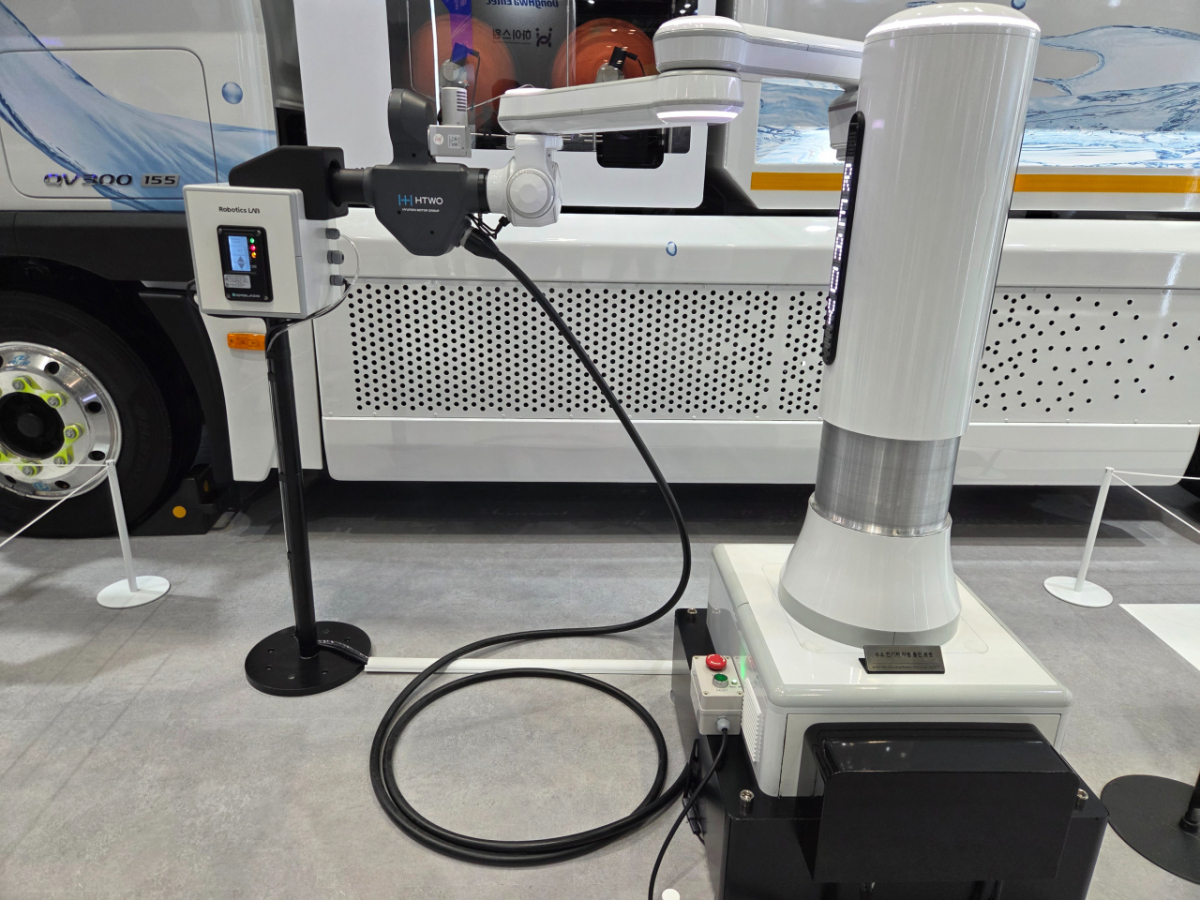
Furthermore, the group displayed a hydrogen electric cleaning truck and demonstrated the charging process using an automatic charging robot (ACR-H). Visitors observed how the automatic charging robot uses vision AI technology to independently recognize the vehicle's charging port, open the protective cap, and connect the connector.
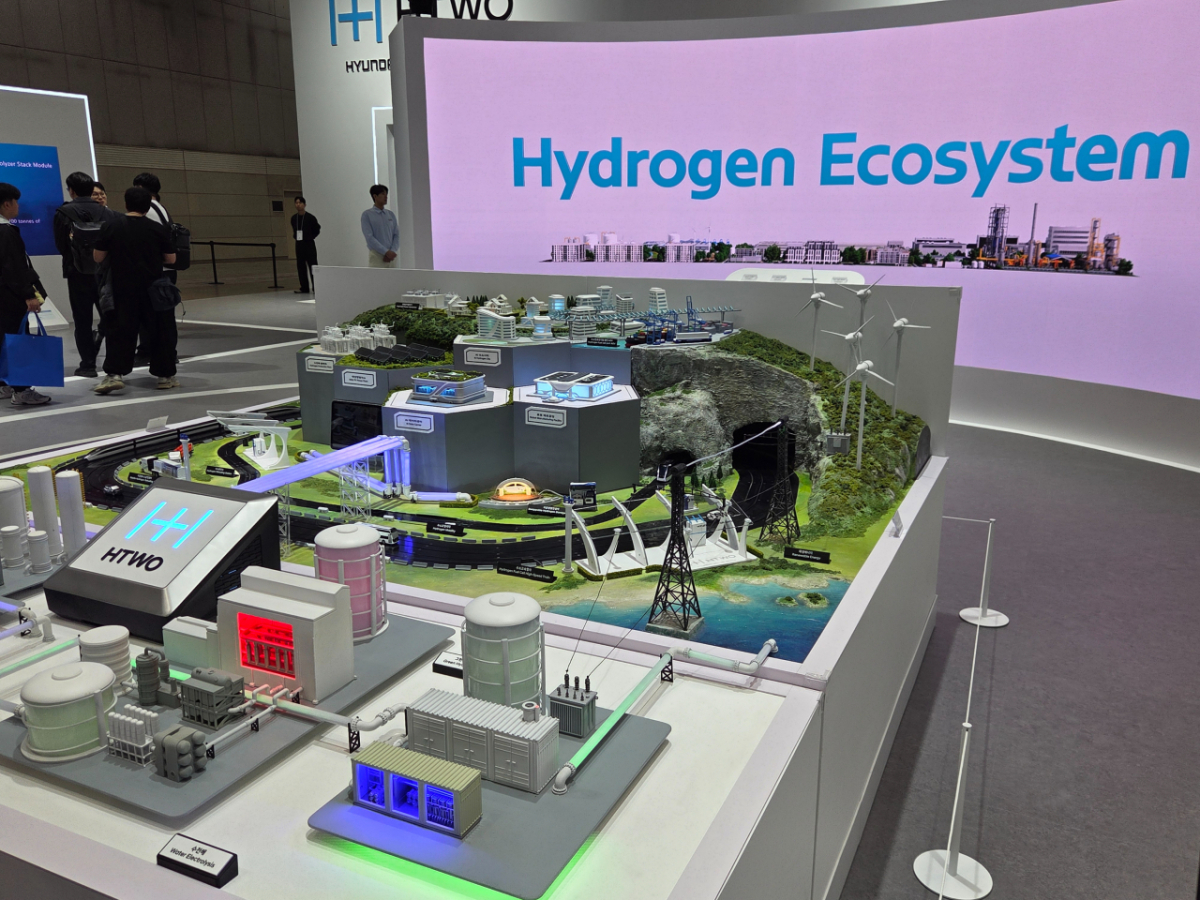
Hyundai Motor Group realized a future industrial city model reflecting its "Saemangeum AI Valley" project as a diorama. The Saemangeum AI Valley is a project that invests approximately 9 trillion won to build AI data centers, a robot manufacturing cluster, solar power generation, water electrolysis plants producing clean hydrogen, and an AI hydrogen city.
On the day, Jang Jae-hoon, Vice Chairman of Hyundai Motor Group, visited the venue and toured the group's exhibition hall. He also inspected the exhibition booths of major participating companies to review the status of hydrogen-related technologies and businesses.
A Hyundai Motor Group official said, "At this exhibition, we are introducing the group's integrated hydrogen solution, covering everything from hydrogen production to applications in mobility, urban, and industrial sectors, and will expand cooperation opportunities with customers and partners." The official added, "Based on our hydrogen production capabilities, we will discover various application areas and provide solutions optimized across the entire value chain to connect them into practical businesses."

 in INDUSTRY

