

![[Seoul=NEWSIS] Reporter Lee Young-hwan . 2025.08.12. 20hwan@newsis.com /Photo=Lee Young-hwan](https://thumb.mt.co.kr/cdn-cgi/image/f=avif/21/2026/07/2026073014271792889_1.jpg)
It has been revealed that nearly half of the imported beer entering Korea this year is Japanese-made. This is attributed to Korean consumers' high familiarity with Japanese beer, combined with aggressive market penetration through low prices and large-volume shipments.
According to export-import trade statistics from the Korea Customs Service released on the 30th, beer imports from January to June totaled 124,200 tons, an 8.1% increase compared to the same period last year (114,863 tons). The surge in Japanese beer shipments was particularly notable. Beer imports from Japan reached 58,305 tons in the first half of this year, accounting for 46.9% of the total—a 33.5% increase from the same period last year (43,676 tons).
Furthermore, the share of Japanese beer in total beer imports rose by 8.9 percentage points (P) within a year, climbing from 38.0% to 46.9%. While total beer imports increased by 9,337 tons compared to last year, the increase attributable solely to Japanese beer was 14,629 tons. In contrast, shipments from the remaining 41 countries excluding Japan fell from 71,187 tons to 65,894 tons, a decline of 7.4%. This indicates that the increase in Japanese beer not only filled the gap left by other countries but also exceeded it.
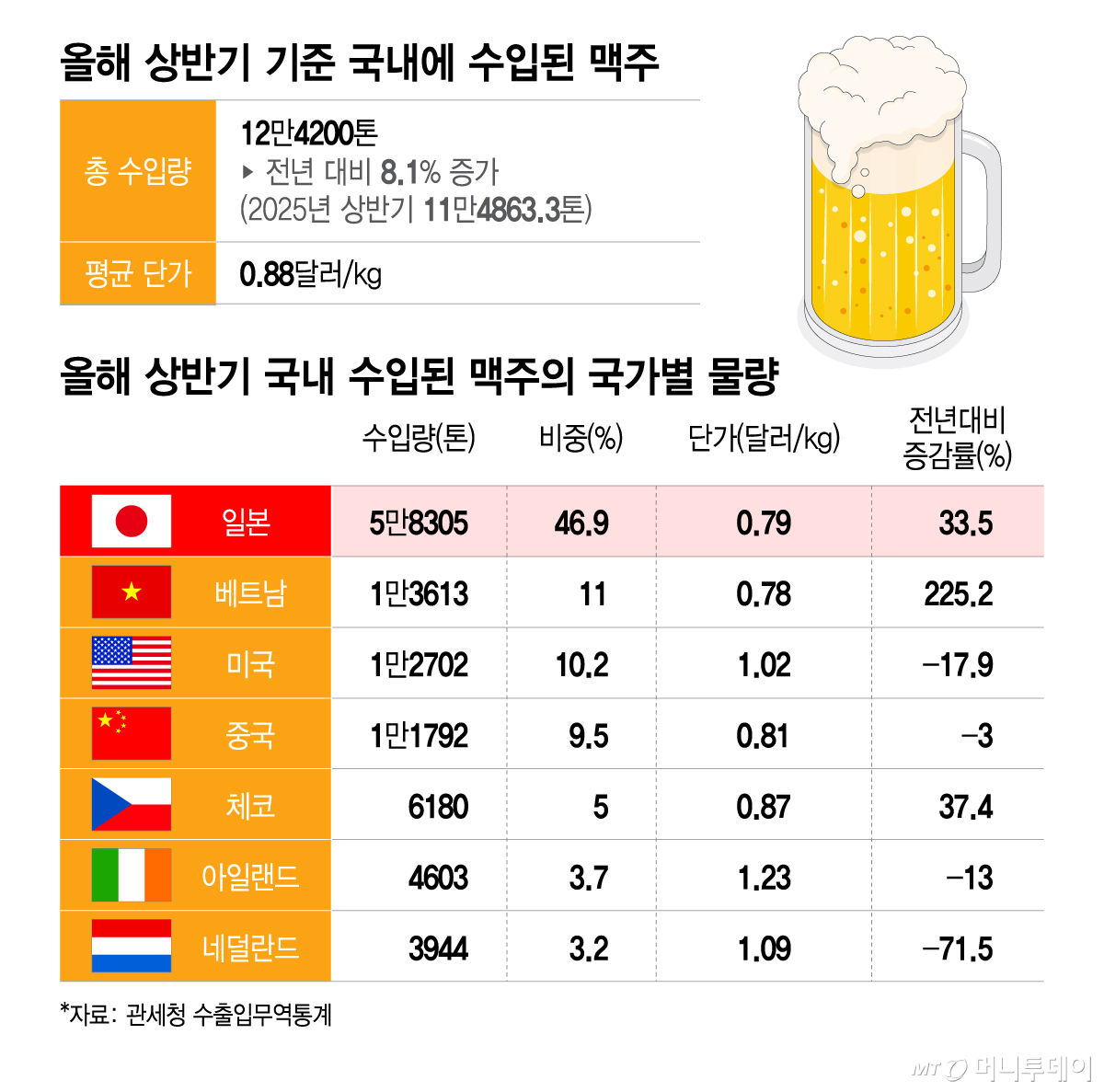
Japanese beer falls on the lower end of unit prices among importing countries. The import price for Japanese beer in the first half was $0.79 per kg, below the average of all 42 importing countries ($0.88). This represents a 2.6% decrease from one year ago ($0.81), placing it on par with other low-cost importing nations such as Vietnam ($0.78) and China ($0.81).
Conversely, imports from high-priced countries saw simultaneous declines in volume. Dutch beer, priced at $1.09 per kg, dropped to 3,944 tons—a 71.5% decrease year-on-year. U.S. beer (at $1.02) fell by 17.9%, and Irish beer (at $1.23) decreased by 13%.
Actual sales of Japanese beer are also on the rise. According to Sapporo, domestic sales in the first half of this year increased by 52% compared to the same period last year. Even when comparing against the previous year's first-half figures, the growth rate reached 59%.
An industry official stated, "The recent trend of a weak yen has led to an increase in Japanese tourists, and there are more cases where people who tasted Japanese beer while in Japan seek it out again upon returning to Korea." The official added, "It appears that factors such as relatively high familiarity with Japanese beer brands, premium image, and preference have collectively influenced this trend."
While domestic drinking rates continue to decline annually, Korea remains among the highest globally. According to the OECD's "Health at a Glance 2025," as of 2023, South Korea ranked fifth among 27 comparable OECD countries in terms of monthly binge-drinking rates. Additionally, an analysis by the KDCA based on last year's community health survey data revealed that 6 out of every 10 adults (57.1%) consumed alcohol at least once a month last year.
Meanwhile, whiskey imports totaled 8,860 tons in the first half of this year, down 30.0% from 12,663 tons in the same period of 2024, but the unit price jumped from $9.30 per kg to $11.34 per kg. Other fermented beverages including sake saw a volume decrease from 11,003 tons to 9,299 tons (a 15.5% drop), while the unit price rose from $2.34 to $3.07, an increase of 31.2%. This suggests that while beer remains a relatively affordable product, demand for whiskey and sake is concentrated on higher-priced items despite lower consumption volumes.

 in LIVING

